
I had been looking for an Enicar for a while. Several had appeared in my daily searches through online auctions, and several had slipped away. Then this Ocean Pearl surfaced: an unassuming silver dial, a warm gold-tone case, and a name whose history had already caught my attention long before I owned one.
The auction didn’t include a movement photograph. That always makes the decision a little less comfortable. But the price left room for uncertainty, and this time I came away with the watch.
What changed the story was not the dial. It was the back. Turn the watch over and the surface becomes a tiny piece of sculpture: a marine creature, the ringed planet Saturn and the Ocean Pearl name pressed into a circular field of metal. I had wanted an Enicar because of the Racine family. Once I saw the craftsmanship on the back, I understood why I wanted to write about this particular one.

The Hunt: Waiting for an Enicar
A good portion of the hunt happens nowhere near a workbench. It happens while scrolling through auction after auction, learning which names to recognize and deciding when a watch has enough promise to pursue.
Enicar was on that mental list. I had already discovered that its name was the surname Racine rearranged backward, and that small piece of history made the brand unusually memorable. I kept encountering examples without winning them. By the time this Ocean Pearl appeared as a single-watch lot, I was ready to take a closer look.
There was no elaborate bidding war to overcome this time. The price was low enough that buying without a movement photo felt like an acceptable chance to take, not an act of blind optimism. Vintage watches can go either way. This one turned out to be a win.
On arrival the silver dial looked as restrained as the auction photos suggested. The caseback, however, was something else entirely. I was struck by the time and design work invested in a part of the watch that spends almost its entire life facing the wrist.
At a Glance
| Maker | Enicar (Enicar S.A. historical Swiss brand) |
| Model family | Ocean Pearl; Star Jewels automatic dial signature |
| Case reference | 144-39-09, based on the owner’s reading of a faint exterior stamp; still subject to magnified verification |
| Case serial / inner stamp | 846940 on the exterior; separate interior marking 2319 |
| Approximate period | Mid-to-late 1960s to early 1970s, an estimate |
| Movement | Enicar-signed Swiss automatic; exact caliber and jewel count not yet identified |
| Functions | Hours, minutes, central seconds and date at 3 o’clock with burgundy numerals |
| Case | Gold-tone metal case with a separately marked stainless-steel back; solid-gold construction not established |
| Size | 33.8 mm diameter · 39 mm lug-to-lug · 11.3 mm thickness · 17.8 mm lug width |
| Crystal | Original crystal retained and hand-polished; exact material untested |
| Restoration | Original crystal polished and case polished; no documented internal overhaul or replacement components |
| Current operation | Running and setting per owner; date quickset, accuracy and power reserve not verified |
| Water resistance | Historic caseback says WATERPROOF; no current water-resistance guarantee |
Companion watch listing: Enicar Ocean Pearl Star Jewels Automatic, ref. 144-39-09 (currently prepared as a draft; available when the product is published).
Racine, Read Backward
Enicar begins with a family name. In 1913, Swiss watchmaker Ariste Racine and his wife Emma Blatt established their business in La Chaux-de-Fonds. The word Racine was already registered for watch-related use by another member of the extended family. Emma is credited with proposing the reversal of the letters: R-A-C-I-N-E became E-N-I-C-A-R. The name was registered in January 1914.
That origin story is memorable, but the business that followed is more interesting. The operation started small, then developed into an industrial watchmaker based in Lengnau, with movement production and finishing capabilities. By 1932 it was organized as Enicar S.A. Decades later, at the firm’s 1963 fiftieth-anniversary celebration, a contemporary Europa Star account described an enterprise employing hundreds of workers across its Lengnau and Oensingen facilities. Those period documents place the company well beyond the small workshop implied by the charming reversed name.
For much of its postwar history, Enicar was adept at presenting watchmaking as both industry and imagination. It made accessible mechanical watches and also pursued demanding sports models, developing recognizable visual identities for the Seapearl and Sherpa lines. The familiar Saturn symbol—the planet wrapped in a ring—became a recurring signature on dials, packaging and advertising.
On this Ocean Pearl, that history is visible in miniature. The raised Saturn emblem sits above the Enicar signature. On the reverse, the brand’s visual language has expanded into an entire scene.

The Other Side: An Ocean Pearl in Relief
Most watch backs exist to close a case. Some carry a serial number or a modest manufacturer mark. Enicar used the reverse as another canvas.
The Ocean Pearl back carries a high-relief aquatic animal—described variously in collector references as a dolphin, porpoise or jumping shark—together with the ringed Saturn emblem and a surrounding circle of inscriptions. We do not need to settle the animal’s biological identity to appreciate the effect: the engraving makes the brand unmistakable before the case is even opened.
Around the design are the Ocean Pearl name and period wording that includes AUTOMATIC, INCABLOC, WATERPROOF and STAINLESS STEEL BACK. The back also bears the number 846940 and a much fainter reference that has been read as 144-39-09. Those details are not ornamental; they connect the artistic object to the watch’s mechanical and commercial identity.
The WATERPROOF engraving reflects how Enicar presented the case when new. It does not make a vintage watch safe to submerge today. Its gold-tone body also should not be confused with an all-stainless-steel or solid-gold case: it is the separately marked back that is stainless steel.
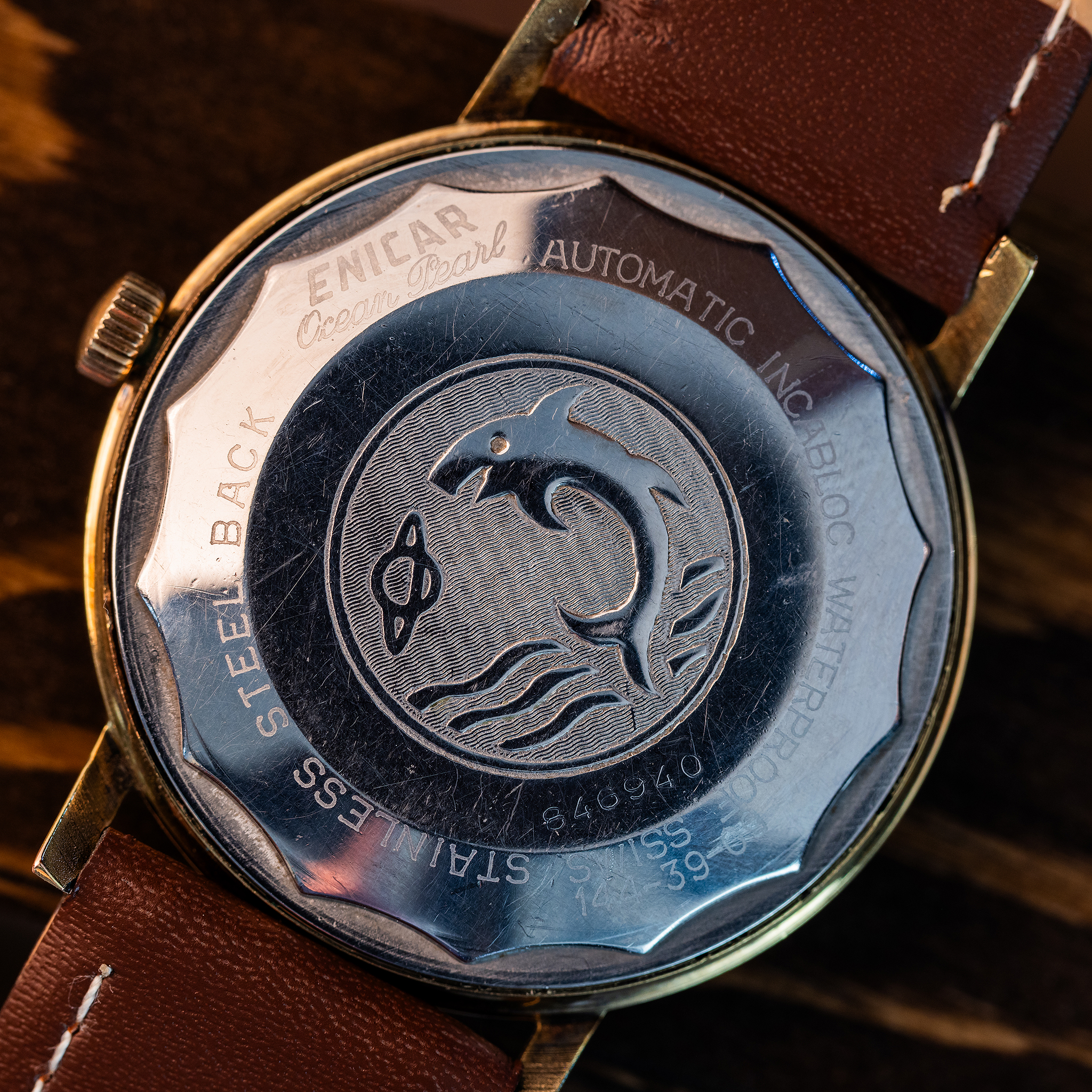
This relief is a particularly good example of a maker investing in an experience that the owner would seldom see on the wrist. It turns routine case-opening—something necessary for any mechanical watch over time—into an encounter with the brand.
A Small Number and a Larger Question
The inside of the back is signed ENICAR WATCH CO. / SWISS / 2319. The number 2319 is an interior case marking, not a movement serial number. Outside, 846940 is recorded as the caseback or case serial. Keeping the numbers distinct is important: none should be repurposed into a confidently dated production sequence without documentation.
The faint exterior reference is read as 144-39-09, and another independently documented Ocean Pearl has been advertised under that same reference. That is a useful supporting comparison, although the final digits on this watch are still worth confirming under magnification. The comparison also demonstrates the danger of importing specifications from a nearly identical watch: its seller identified an Enicar AR1145 automatic with 24 jewels, but that does not establish the caliber or jewel count of the example on this page.

A Quiet Face With a Flash of Red
The front is almost a deliberate counterpoint to the sculptural reverse. The silver-to-champagne surface has a fine radial sunburst texture that changes with the angle of the light. Black-inlaid gold-tone baton markers sharpen the hour positions. The hands echo their shape, and the small black outer minute track keeps the face orderly.
Then the date interrupts the restraint. At three o’clock a raised frame surrounds a burgundy-red numeral—a small detail that adds character without disturbing the composition. The dial reads ENICAR beneath the raised Saturn mark, with STAR JEWELS automatic below the hands and SWISS MADE along the lower edge.
There are minute signs of age in the dial and hands, but the surface is notably well preserved for a watch of this period. The crystal, reported as the original fitted piece, was polished rather than replaced. That decision matters because the goal was not to redesign an already appealing watch. It was to recover a clear view of the details that survived.

Inside: What Star Jewels Actually Meant
Opening the Enicar reveals a gold-tone central winding rotor signed with the Enicar name and the words STAR JEWELS. The movement is a Swiss automatic: motion of the rotor provides winding energy while the watch is worn.
Star Jewels is easy to misread. It sounds like a promise about the number or quality of the movement’s jewels. Enicar’s own period marketing used it differently. Collector research drawing on a 1966 Europa Star technical article and a 1968 Enicar catalog shows that the company applied the name to a process involving carefully controlled lubrication and chemical surface treatment, often called epilamisation. The idea was to discourage oil from creeping away from the precise contact points where it belonged.
That process grew out of Enicar’s earlier Ultrasonic promotion, associated with ultrasonic cleaning and preparation of movement components beginning in the 1950s. It was both a technical proposition and a clever public story: maintenance and precision made into a name a buyer might remember.
Crucially, neither the words Star Jewels on a dial nor the appearance of the rotor establishes an exact jewel count. On this watch, the underlying movement caliber and its number of jewels remain unconfirmed because the identifying marks have not been reliably read. The AR1145 is a plausible candidate from a related same-reference watch, not a verified identification. A clean-looking movement is not the same thing as a documented complete service.
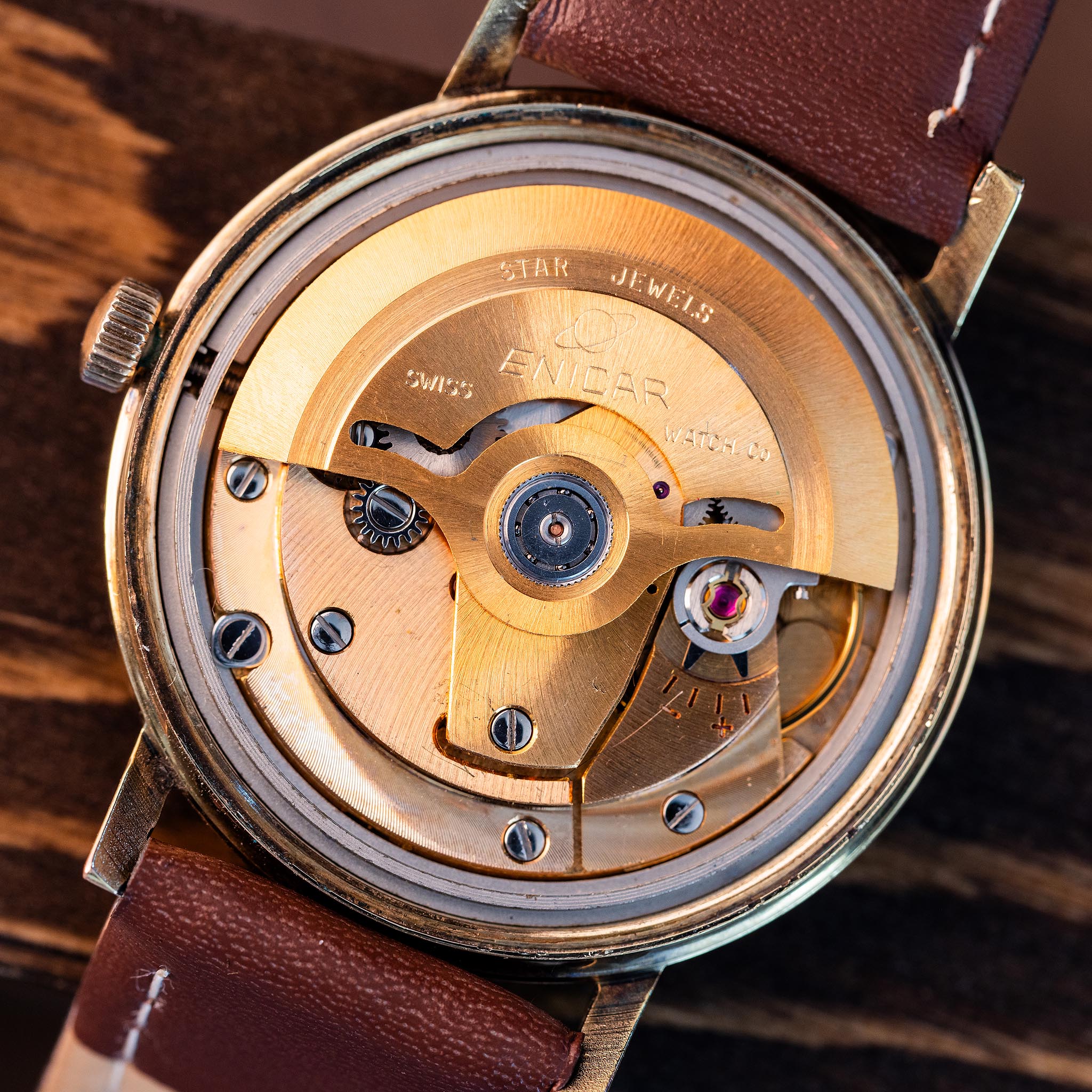
The watch is reported running and setting correctly. There is no measured daily rate, power reserve, automatic winding efficiency test or confirmed date quickset result available for this particular example. Those are real limits to what its present mechanical condition can tell us.
What the Period Material Can—and Cannot—Prove
There is no shortage of attractive old Enicar advertising. Surviving print examples range from straightforward product announcements to richly illustrated Seapearl campaigns, sports endorsements and bold Sherpa graphics. A particularly useful set of 1966 catalogs, preserved by an Enicar collector, shows how varied the company’s contemporary offerings and regional market presentation could be. A 1968 catalog excerpt explains the Star Jewels process. A 1963 anniversary booklet and contemporaneous report document the scale and confidence of the Racine company.
These are authentic period-era materials for understanding the maker and the Star Jewels branding. None of the period artwork located for this article has been verified to depict this precise silver-dial Ocean Pearl, reference 144-39-09. The reference itself is supported by other surviving watches and the observed marking, rather than a catalog page we can conclusively assign to this example.
The caseback design, raised Saturn emblem, silver sunburst dial and red date all fit comfortably in the design language Enicar was using in the mid-to-late 1960s and into the early 1970s. That is a reasoned historical placement, not a factory-dated certificate.
Restoration Without Rewriting the Watch
The watch arrived in good enough shape that the work could remain modest. The original crystal was polished to restore clarity. The case was polished as well. No dial repainting, hand refinishing, movement overhaul, regulation or replacement components have been documented. We have not established whether the polishing was done by hand or machine, and no claim is made that the case is untouched by earlier polish.
Under the newly clear view, the sunburst texture remains visible, and the original-looking dial presentation keeps the small marks of its age. The case retains ordinary surface wear, and the crown is unsigned in the available photographs; its factory originality cannot be guaranteed. The brown stitched strap suits the period visually but is not documented as factory supplied.
This was not a story of replacing broken pieces until a watch looked new. It was a story of finding one already worth preserving, removing the interference of surface scratches and allowing the design to speak for itself.

What to Look For When Buying an Enicar Ocean Pearl
Start with the caseback. Photograph its marine medallion, the surrounding inscriptions and every number, even the faint ones. Confirm whether the back reads Ocean Pearl, Seapearl or something else: those names cannot simply be substituted. Check that any claimed gold or steel composition agrees with the stamps rather than with its color. Remember that old WATERPROOF markings describe a promise made decades ago, not a current pressure-test result.
Then inspect the dial signature, Saturn emblem, lume-style dots, hands and date disc. Enicar made many legitimate variations, so a different index pattern is not automatically evidence of a problem; equally, familiar branding alone does not prove every component is factory-original. Requests for movement photographs are particularly important. A signed rotor is useful, but a clear photograph of the actual caliber marking—often visible near the balance—is more persuasive than a seller transferring a caliber number from another watch.
Ask how well it runs, whether the date advances correctly, whether the crown winds smoothly and what work was actually done. On an older automatic, a polished crystal, a good-looking rotor and a movement that starts ticking are all positive signs, but none substitutes for a proper mechanical condition assessment.
Why This One Stays With Me
I had wanted an Enicar because of a name: Racine, turned backward into something new. It is a curious little origin story, one that makes an otherwise unfamiliar dial suddenly recognizable.
What I found was a more complete story. A quiet silver face. One red date. An automatic movement carrying the trace of a real technical idea. And, on the reverse, an elaborate marine scene that seemed far too considered to be hidden against the wrist.
This Ocean Pearl does not need to be a rare Sherpa or a famous chronograph to deserve the effort. It represents the wider world of mechanical watches—the objects that working companies designed thoughtfully, sold in quantity, and expected people to wear.
A search that began with a surname ended with an appreciation of how much care Enicar could put into every side of a watch.
Less casting aside. More restoring.
Research Notes and Period Sources
- Signs of Saturn: the evolution of Enicar’s logo — later collector research into the 1913 Racine/Blatt founding, 1914 Enicar trademark and logo designs; contextual rather than this reference’s factory dossier.
- Enicar’s 1963 fiftieth-anniversary materials and Europa Star account — reproduces primary-period company history and factory information; maker-level evidence, not a model-specific advertisement.
- 1966 Europa Star technical description and 1968 Enicar catalog excerpt — period explanations of the Ultrasonic and Star Jewels movement-treatment language; family-level technical context.
- Surviving 1966 Enicar catalogs and 1957 Japanese advertisement — original-era print artwork showing the brand’s range and marketing approach; not a verified depiction of ref. 144-39-09.
- Collection of original Enicar advertising — period-era examples, including Seapearl and Sherpa materials, not exact Ocean Pearl watch evidence.
- Collector listing for Ocean Pearl 144-39-09 — secondary modern same-reference comparison; reported movement specifications apply to that watch, not automatically to ours.
- Practical originality checks for vintage Enicar — collector guidance on casebacks, reference codes, dial refinishing and movement identification.
Explore the companion Enicar Ocean Pearl product page for its complete photo gallery, known condition and availability when published. More historical features appear in The Found Dial Reference Room.



0 Comments