
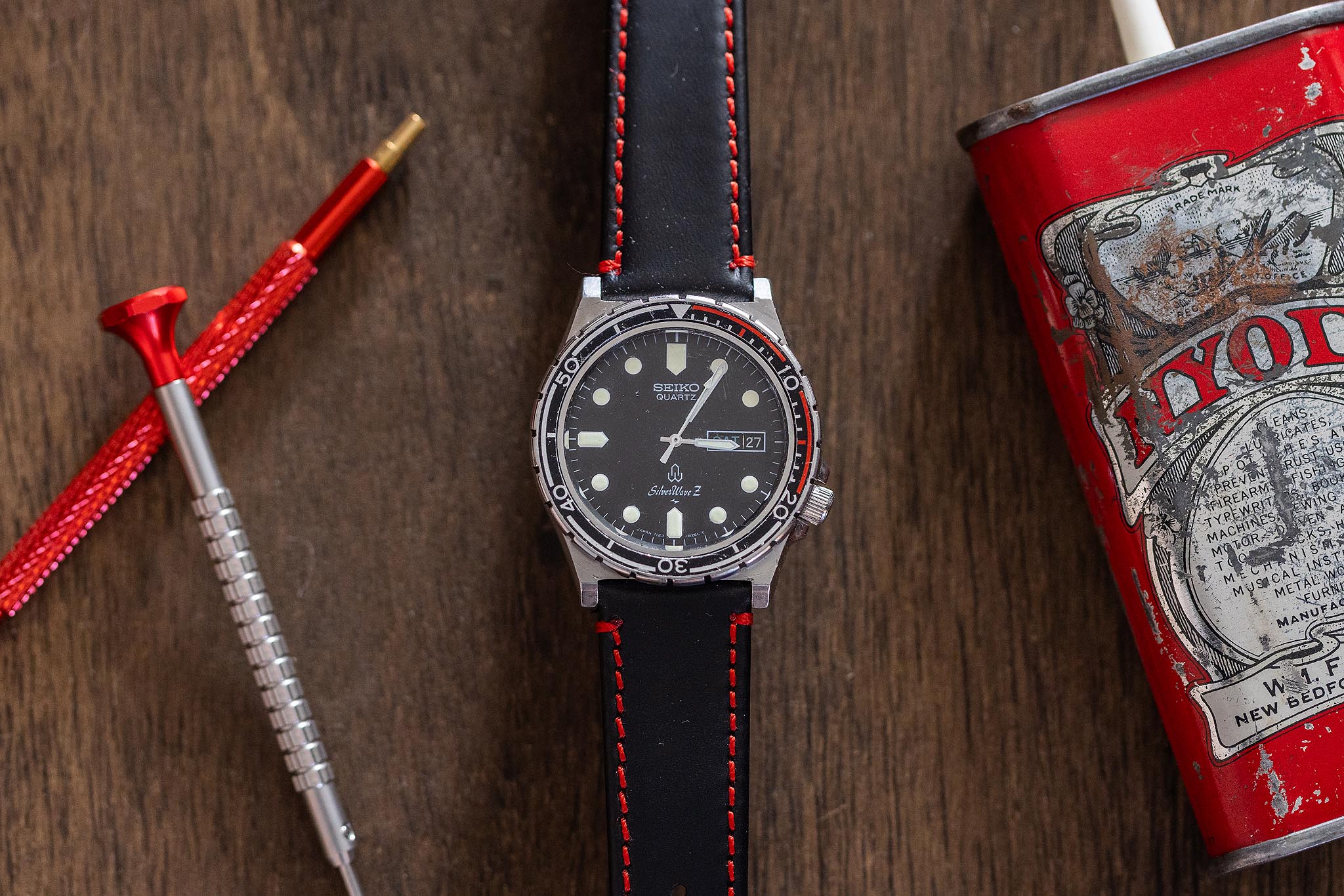
It was not the watch I was bidding on.
The auction photos were poor, the lot was a gamble, and my attention was fixed somewhere else entirely: a Universal Genève Polerouter. The Seiko was simply another watch sharing the same group, one more object to account for when deciding how far I was willing to bid.
Then the lot arrived.

The Seiko was not running. It had no battery. Its bezel was effectively seized. The case showed the kind of wear that does not need a story invented around it; somebody had simply worn this watch, and worn it often. But the first thing that changed the direction of the watch was smaller: the day wheel.
Kanji.
That detail sent me looking for the model number printed at the bottom of the dial. With a vintage Seiko, that is normally the beginning of an easy search. Seiko references tend to leave tracks: catalog scans, old sales listings, forum posts, parts pages, collector databases. Searching a Seiko number and finding almost nothing is the unusual outcome.
This one returned almost nothing.
That was the moment the secondary watch in the Polerouter lot became the one I needed to understand.
The Hunt
This SilverWave Z came from an online auction in a group of watches photographed badly enough to make the purchase uncomfortable. I had not been looking for a SilverWave. I did not know the reference. I did not know the movement. I did not even know the significance of the configuration when I placed the bid.
The Polerouter was the target. The Seiko was along for the ride.
Once it was in hand, the Japanese day display immediately separated it from the anonymous quartz watch I had expected. I searched the dial number—because with Seiko, that should usually open the door—and instead found a wall. Very few useful results appeared. That absence did not prove rarity, and it still does not. What it did prove was that this exact configuration was going to require more work than a normal reference search.
That is enough reason to keep digging.
At a Glance
| Watch | Seiko SilverWave Z |
|---|---|
| Case reference | 7123-8250 |
| Dial code | 7123-826T |
| Serial | 950025 |
| Production date | May 1979, based on the conventional Seiko serial-date system and period catalog evidence |
| Movement | Seiko caliber 7123 quartz |
| Jewels | 2 |
| Frequency | 32,768 Hz |
| Functions | Hours, minutes, seconds, bilingual day, date, stop-seconds |
| Case | Stainless steel |
| Case diameter | 38 mm |
| Lug-to-lug | 44 mm |
| Thickness | 9.2 mm |
| Lug width | 20 mm |
| Bezel | Black-and-red rotating timing bezel |
| Current strap | Aftermarket black leather with red stitching |
| Water resistance | Not pressure tested; no current water-resistance guarantee |
| Available from The Found Dial | Purchase this Seiko SilverWave Z in the store |
The World It Came From
By 1979, quartz was no longer an experimental sideshow for Seiko. A decade had passed since the company commercialized the Astron in 1969, and the 1970s became a period of rapid expansion in quartz production, miniaturization and functionality. Seiko’s own historical material describes the decade as one in which quartz watches moved quickly from breakthrough technology toward mainstream production.
The SilverWave name was older than this watch. Seiko had used it on water-oriented mechanical watches years earlier, then returned to the name during the quartz era for sporty models that sat outside the company’s professional dive-watch line. The result was a useful middle ground: watches designed with rotating bezels, luminous displays and stronger water-oriented cases, but without needing to be treated as professional divers.
The 1979 Japanese catalog places the 7123 <825-826> family directly inside the SilverWave Z lineup. That matters. It gives this obscure watch something online listings cannot: period documentation from Seiko itself.
In that catalog, 7123-powered SilverWave Z models were advertised with approximately ±15 seconds-per-month accuracy, a five-year battery-life specification, battery-life indication, luminous markings, bilingual Japanese/English day display, a screw-down crown and water resistance intended for sports and water-related use. The 7123 <825-826> variants were listed at ¥35,000.
That is a more useful historical description than calling this a “quartz diver.” It is a late-1970s Japanese sports watch from the moment when quartz had stopped being futuristic and started becoming normal.
How Seiko Sold the SilverWave Z
The surviving period advertising helps explain the watch in a way specifications alone cannot. Seiko was not presenting the SilverWave Z as a dressy quartz watch with a rotating bezel added for effect. The campaign language was explicitly sporty and seasonal: a new SilverWave Z group aimed at active summer use and waterside recreation.

The exact-reference evidence comes from Seiko’s own catalog material rather than this advertisement. A Japanese Seiko catalog lists PGP038 at ¥35,000 and associates it with the 7123 <825-826> family, Hardlex crystal, luminous markings, the bilingual day system and the SilverWave Z specification set. That catalog entry is the stronger source for identifying this particular configuration; the advertisement above is family-level context, not proof that the pictured watches are the same model. View the period Seiko catalog.
That distinction matters in the Reference Room. Period artwork is most useful when it is allowed to say exactly what it says: the advertisement tells us how Seiko sold the SilverWave Z idea, while the catalog tells us where PGP038 fits inside it.
The Numbers That Do Not Match — And Why That Matters
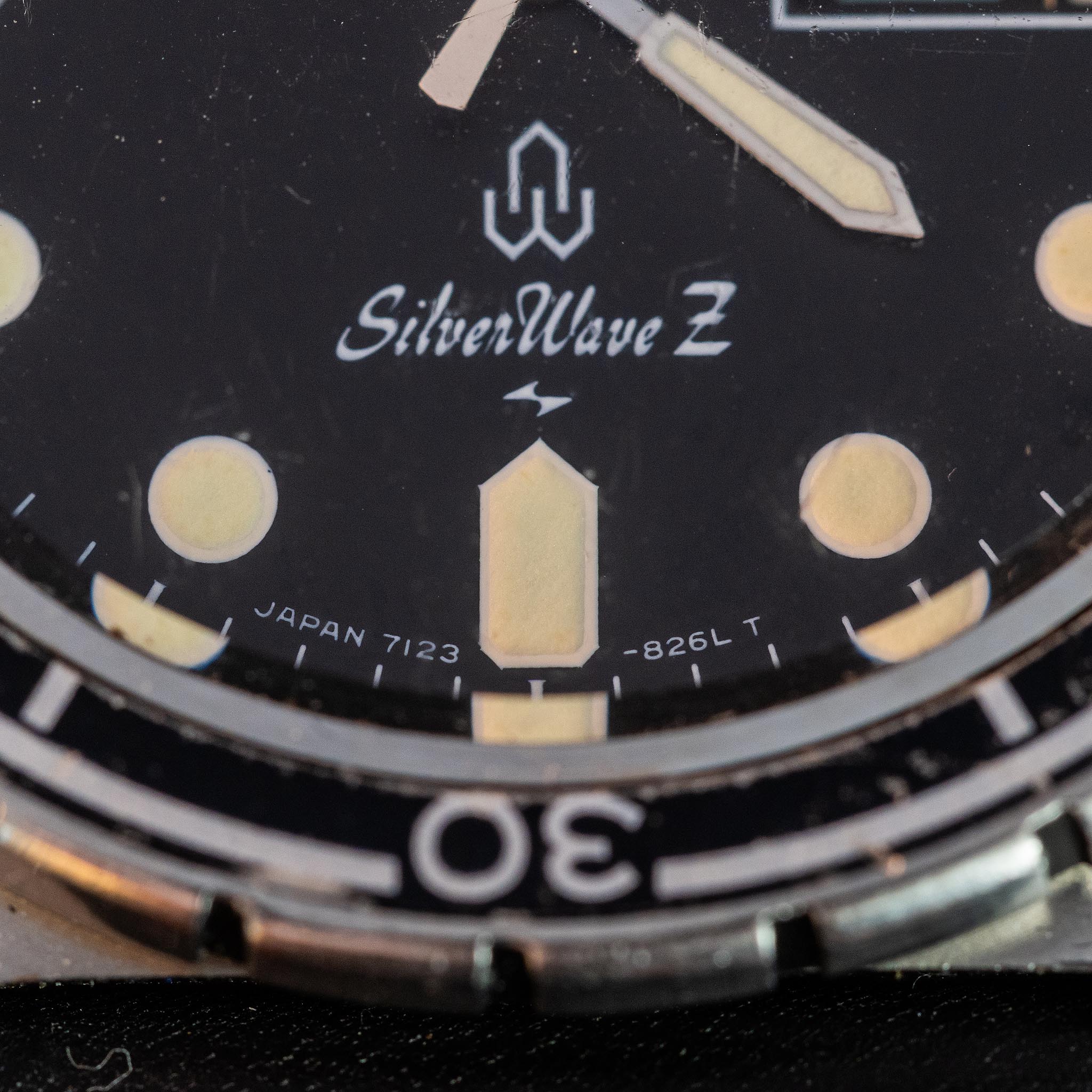
There are two numbers on this watch that deserve to be recorded exactly.
The caseback reads 7123-8250. The dial is marked 7123-826T.
Those numbers are not supposed to be forced into one identifier. Seiko commonly used a caliber-and-case reference on the caseback and a separate dial code on the dial. The suffixes can differ because they are identifying different components.
The 1979 catalog is especially useful here because it groups the family as 7123 <825-826>. That period evidence makes the relationship between the 825 case family and 826 dial designation much easier to understand. The difference is part of the watch’s identity, not something to edit away.
It is also probably one reason this exact watch is so awkward to research. Search only “7123-826T” and you are searching a dial code. Search only “7123-8250” and you miss examples cataloged by other markings. Search the SilverWave Z name alone and you enter a much broader family that used several quartz calibers and numerous cases.
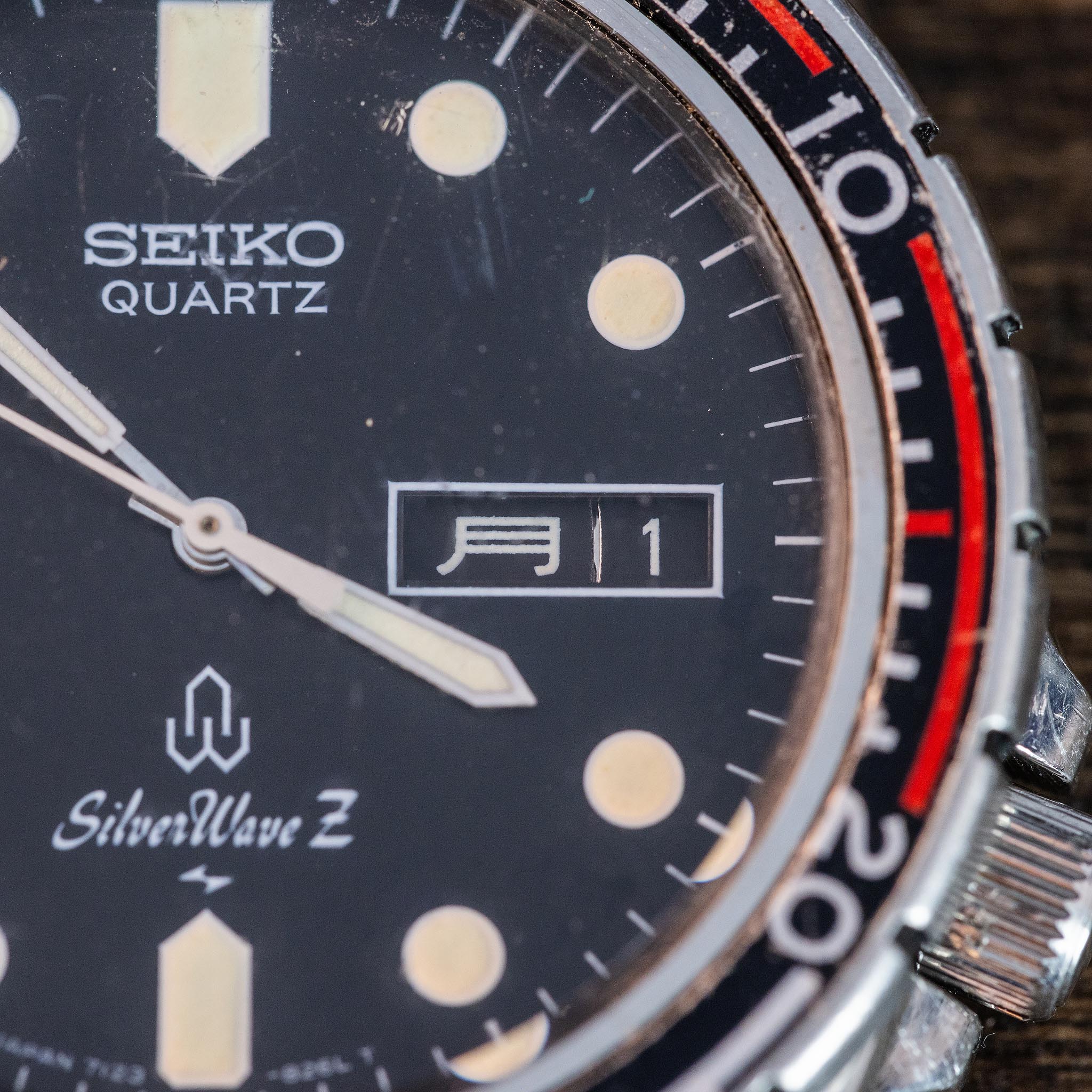
The Detail That Changed the Watch: Kanji
The bilingual day wheel is the detail I would show first if this watch were sitting on a table between two collectors.
There is nothing exotic about bilingual Seiko calendars in isolation. Seiko made many of them. What matters here is the context. This watch arrived as an unidentified extra in a mixed lot. The Japanese characters were the first visible clue that the watch deserved a closer look, and they connect directly to the Japanese-market catalog in which the SilverWave Z family appears.
The caliber 7123 was designed with a bilingual day-change system and quick calendar correction. On this example, both the English and Kanji display remain functional. The day/date is not merely a convenience feature; it is the detail that led to the watch being researched at all.

The Bezel Tells the Truth
The bezel barely moved when the watch arrived.
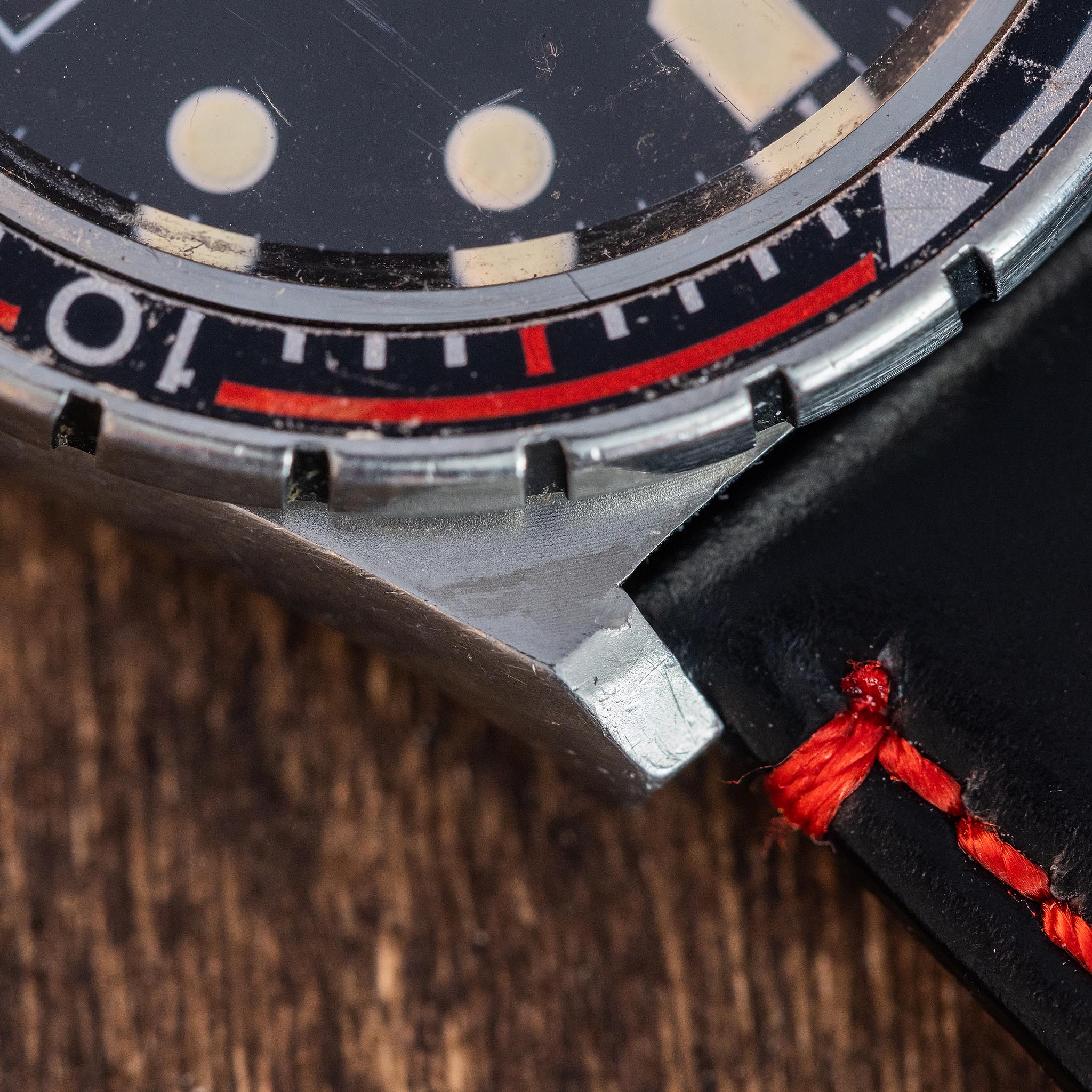
Eventually it came off. Underneath was no dramatic mechanical failure—just the less glamorous evidence of long-term wear: sweat, grime and dirt packed into a place that had probably not been cleaned in years.
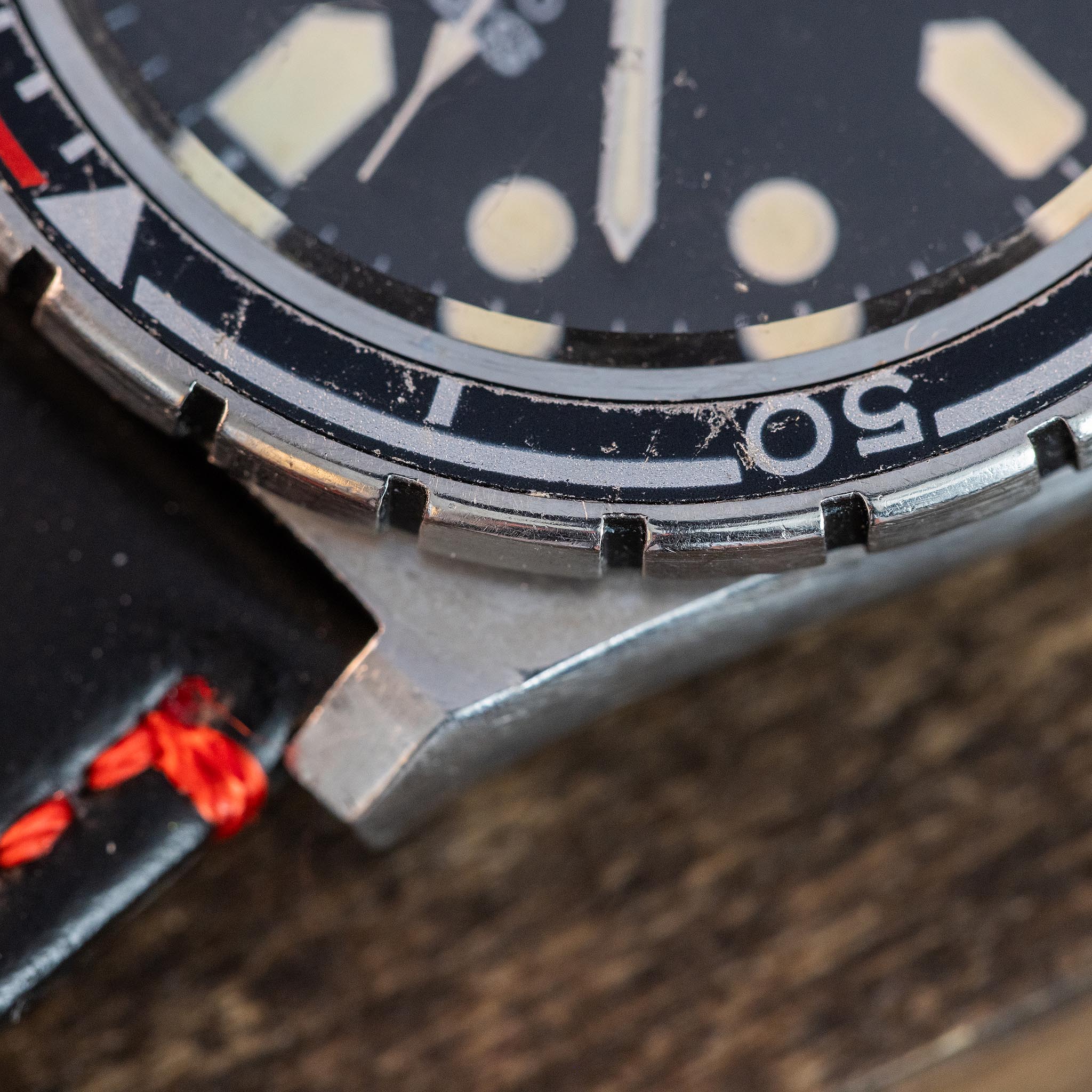
That is one of the most convincing things about this watch. The case and bezel are not pristine. The red section of the insert has aged. The surfaces carry scratches and marks. The watch looks like something that was used for the purpose Seiko marketed it for: daily, practical wear.
There is a temptation with vintage watches to remove that evidence. Here, the better decision was to remove the dirt without removing the history.
The case and accessible components were deep cleaned. The bezel was freed and cleaned. The watch was not machine polished. The crystal was not polished. Cosmetic wear remained where it was found.
Inside: Seiko Caliber 7123

Opening the case changed the character of the watch again.
The exterior had clearly lived a life. Inside, the movement looked remarkably undisturbed. I found no obvious corrosion, water damage, service markings or replacement work. I cannot prove that nobody had opened it before, but visually it looked as though I may have been the first person back inside since it left regular use.
The 7123 is a two-jewel analog quartz caliber operating at 32,768 Hz. Seiko’s technical guide documents hours, minutes and central seconds, day and date, bilingual day switching, instant calendar correction, stop-seconds behavior and a battery-life indicator. Contemporary movement references place its introduction around 1978.
That specification list can sound ordinary from a modern perspective. In context, it represents the point at which quartz engineering had become compact, practical and mature enough to disappear into an everyday sports watch.
The movement did not need to be rebuilt. A fresh silver-oxide battery brought it back to life, and the time-setting and calendar functions operate correctly.
What Original Looks Like — And One Question We Cannot Close
The dial, hands, case components and movement present as period-correct to this watch, and there is no visible evidence in the current inspection that suggests a heavily assembled or cosmetically reconstructed example. The prior service history remains unknown, so that conclusion should stay appropriately limited.
The crystal deserves a separate note.
The current watch was documented during intake as having an acrylic crystal, and it was not replaced or polished during this restoration. However, Seiko’s 1979 catalog lists Hardlex for the 7123 <825-826> SilverWave Z family.
Those two facts do not agree cleanly. The most likely explanations are straightforward: the crystal may have been replaced sometime before this watch was acquired, or the current crystal material may have been misidentified during intake. Without stronger physical or parts-reference evidence, there is no reason to pretend the question is settled.
That uncertainty belongs in the record.
The Watch We Found

The caseback gives us the best dating evidence: serial 950025.
Vintage Seiko serials are conventionally read with the first digit representing the final digit of the production year and the second representing the month. On that basis, “95” indicates May of a year ending in nine. The movement era and the appearance of this exact case family in Seiko’s 1979 catalog make May 1979 the coherent interpretation.
That places this watch squarely in Seiko’s rapid quartz expansion at the end of the decade.
It also helps explain the watch visually. The case is angular without becoming oversized. The bezel is functional but graphic. The dial is almost tool-like in its contrast. It feels like a design standing with one foot in 1970s dive-watch language and the other already stepping into the sharper sports watches of the 1980s.
Restoration Without Erasing the Past
This was not a restoration built around making the watch look new.
The work was simple and deliberate: install the correct battery, remove the seized bezel, clean away accumulated sweat and debris, remove the movement so the case and accessible components could be cleaned properly, verify operation, and put the watch back together without refinishing what decades of use had left behind.
The crystal stayed as found. The case stayed unpolished. The worn bezel stayed worn.
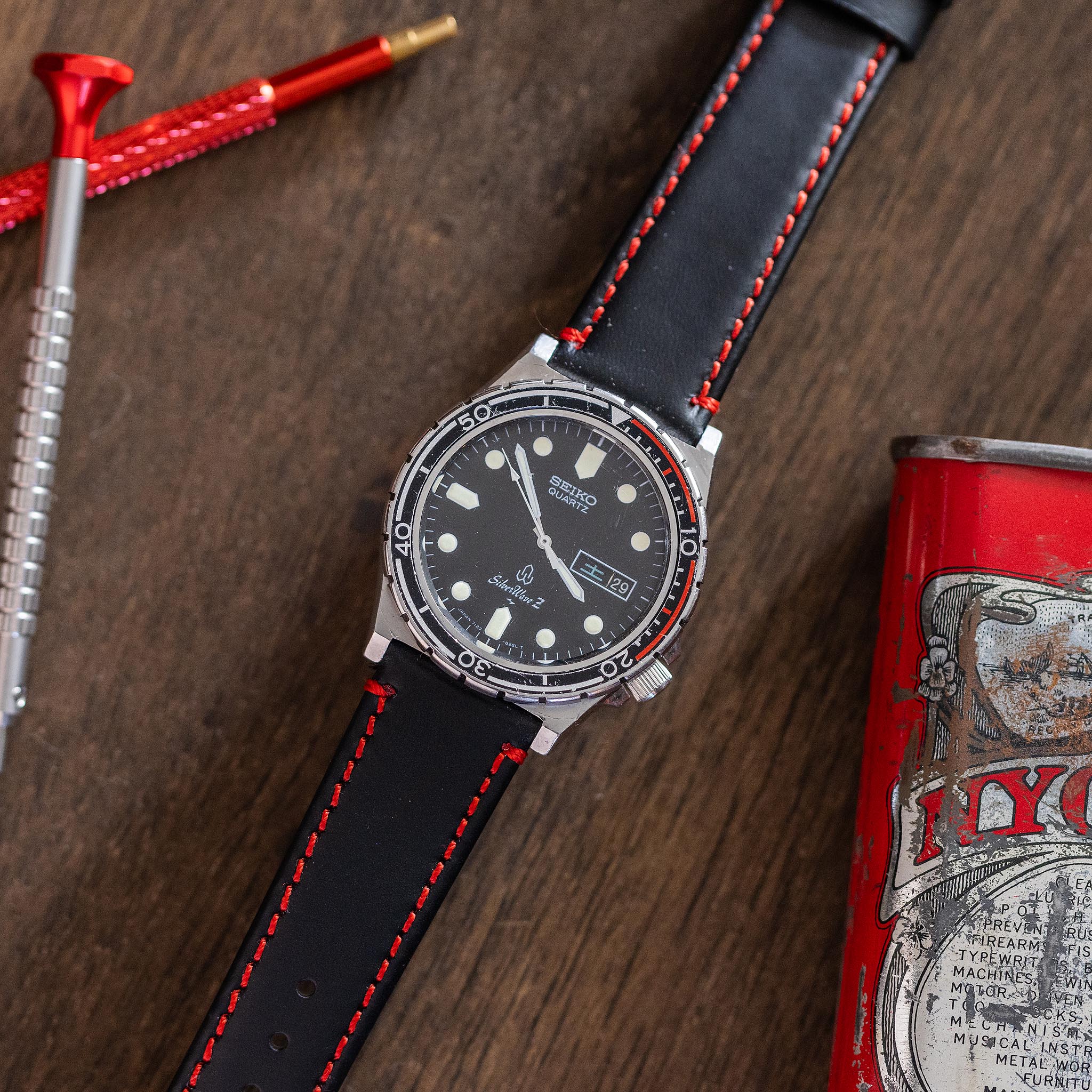
The one obvious modern addition is the strap. The original bracelet was not present, so I chose black leather with red stitching specifically to echo the deep red remaining in the bezel. It is not meant to pass as original. It is meant to make the surviving watch feel visually complete without pretending 1979 followed it home untouched.
Why It Still Matters
This is not a watch that needs an unsupported production number or an “ultra rare” label to be interesting.
Its importance is smaller and more specific.
It is a well-documented piece of Seiko’s late-1970s quartz transition. It belongs to a historically older SilverWave name adapted for a new technology. It carries a Japanese/English calendar, a sporty rotating bezel and a purpose-built quartz movement from an era when Seiko was actively redefining what an everyday wristwatch could be.
And this particular configuration is genuinely difficult to trace. That statement should not be confused with proof of formal rarity. It simply means that direct examples, documentation and indexed references are sparse enough that the 1979 catalog becomes unusually valuable.
More than anything, it is a reminder that the watch worth understanding is not always the one that brought you to the auction.
What to Look for When Buying One
- Record both identifiers. A 7123-8250 caseback and 7123-826T dial are not automatically contradictory. Photograph and search both.
- Check the serial in context. The first two characters can indicate year and month, but the decade has to make sense for the movement and model.
- Inspect the calendar. Confirm both day languages, date correction and day/date changeover work correctly.
- Check the bezel before assuming it is damaged. Dirt and dried contamination can make an old friction bezel nearly immovable.
- Open the watch when appropriate. Battery leakage and corrosion matter far more to a vintage quartz movement than whether the exterior looks freshly polished.
- Do not assume every crystal is original. Period catalog documentation for this family specifies Hardlex; surviving watches should be checked against that rather than judged from appearance alone.
- Be cautious with water. Historical water-resistance specifications are not current guarantees. This example has not been pressure tested.
The New Life
The Polerouter was still the reason I entered the auction.
But the Seiko became the reason I kept researching after the box arrived.
It came with no battery, a seized bezel, accumulated grime and almost no obvious online footprint under the number printed on its dial. Underneath all of that was a working 1979 SilverWave Z with a Japanese calendar, an intact early quartz movement and enough honest wear to show that somebody once depended on it as a watch rather than preserved it as an object.
It did not need to be made new. It needed to be understood, cleaned, put back into service and documented well enough that the next person who searches 7123-8250 or 7123-826T does not find quite as little as I did.
Less casting aside. More restoring.
Reference notes: Period model information was checked against a 1979 Japanese Seiko catalog and Seiko’s technical guide for caliber 7123A. Seiko’s own historical material was used for the broader quartz-era context. Identification and originality claims above are intentionally limited to what the watch, the Product Sheet, period documentation and available photographs support.
Explore: View this Seiko SilverWave Z · The Reference Room



0 Comments