
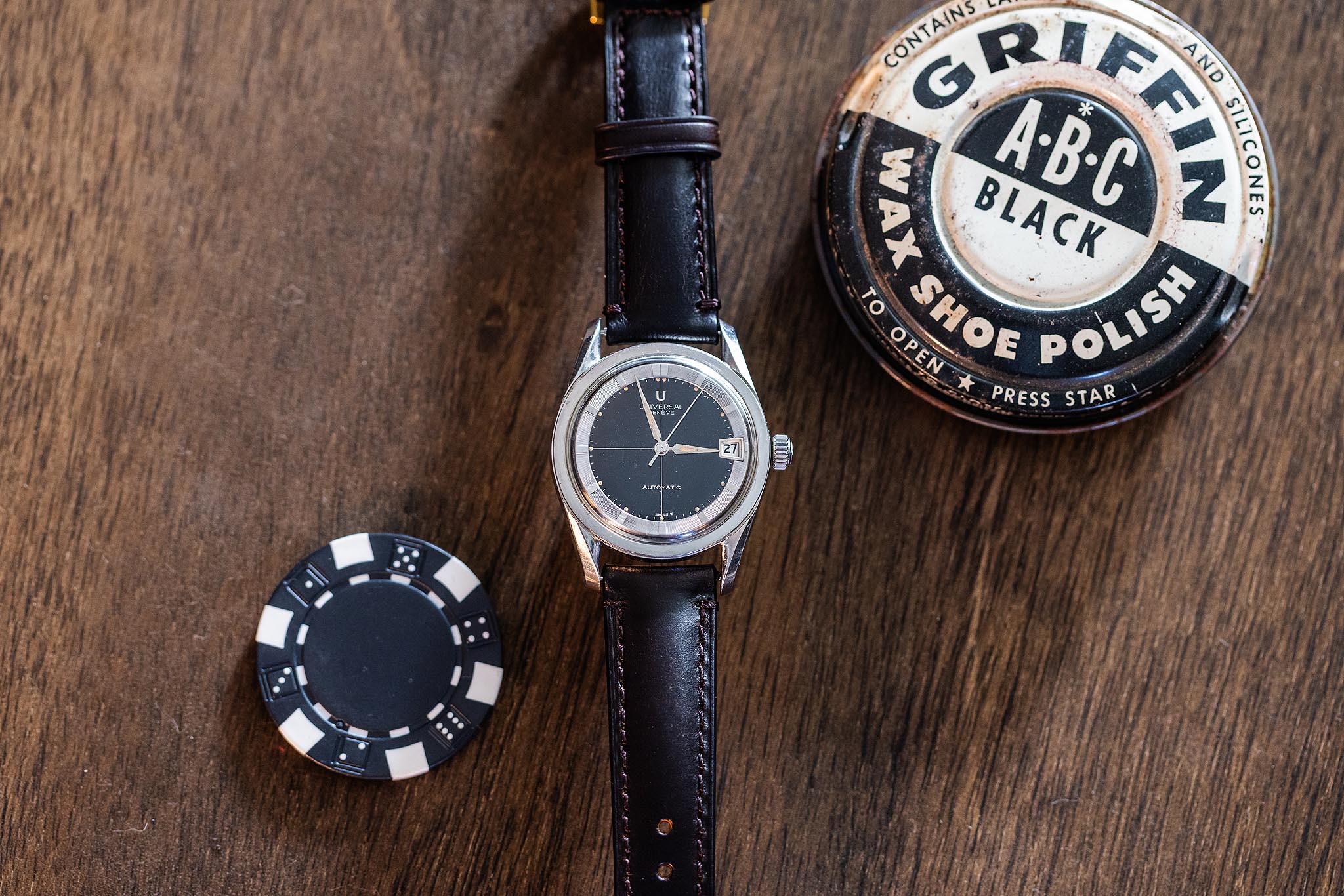
I did not know what a Polerouter was when I bid on this watch.
I had found a new auction site after watching a YouTube video about places to hunt for watches online. One of the first lots I stopped on had photographs poor enough to make the entire purchase uncomfortable. The watch I eventually learned was a Universal Genève Polerouter Date looked as though it had either a badly damaged dial or a crystal so scarred that there was no way to tell what was underneath.
Three weeks later, the box finally arrived.
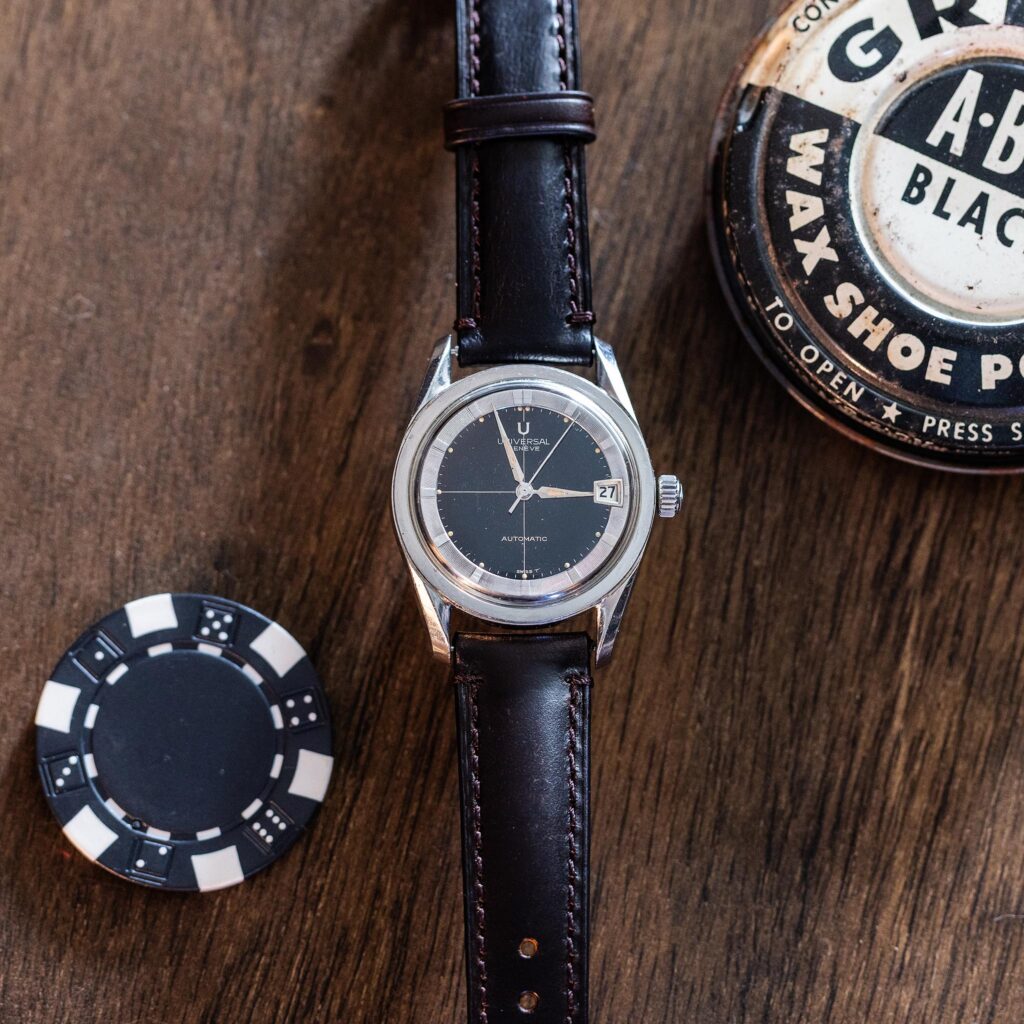
The relief was immediate. The dial was not destroyed. The crystal was simply bad enough to make it look that way.
That discovery opened the door to everything else: a 23-year-old Gérald Genta, Scandinavian Airlines System, commercial flights over the magnetic North Pole, Universal Genève’s Microtor engineering, and a watch that suddenly felt much larger than the object sitting in my hand.
This was the first watch I owned that felt like more than a nice vintage watch. It felt like a timepiece with a story substantial enough that the watch itself became a doorway into the history behind it.
The Hunt
The Polerouter was not the result of a long collector search. It was almost the opposite.
I was experimenting with a new auction platform and came across a group of watches with photographs that gave me more questions than answers. The Universal Genève became the focus, but I was bidding without the comfort of knowing whether the dark, cloudy face in the listing was a ruined dial, a damaged crystal, or both.
I also knew almost nothing about the model. I had never heard the Polerouter story. I did not yet know that Universal Genève had developed the watch for the SAS polar route, that its design was tied to the beginning of Gérald Genta’s career, or that the movement inside represented one of the most important chapters in thin automatic watchmaking.
That knowledge came after the bid.
By the time the watch arrived three weeks later, the suspense had become part of the experience. Seeing the black dial survive underneath the damaged acrylic was the moment the gamble changed into a project.
At a Glance
| Watch | Universal Genève Polerouter Date |
|---|---|
| Case reference | 204612/2 |
| Production era | Early 1960s |
| Movement | Universal Genève caliber 218-27 Microtor automatic |
| Jewels | 17 |
| Frequency | 18,000 vph |
| Functions | Hours, minutes, central seconds, date |
| Case | Stainless steel |
| Case diameter | 35.3 mm measured |
| Lug-to-lug | 45 mm measured |
| Thickness | 10.6 mm measured |
| Lug width | 19 mm measured |
| Crystal | Original acrylic retained and repolished |
| Dial | Black crosshair dial with silver radial chapter ring |
| Current rate | Approximately -6 sec/day at latest check |
| Water resistance | Not pressure tested; no current water-resistance guarantee |
| Available from The Found Dial | View this Polerouter Date in the store |
The World It Came From
The Polerouter begins with aviation rather than jewelry.
In 1954, Scandinavian Airlines System opened a commercial route between Copenhagen and Los Angeles that crossed the magnetic North Pole. Universal Genève’s own history describes the Polerouter as a watch developed for that environment: resistant to shock, water, dust and, critically, magnetic interference. The original watch was called the Polarouter; Universal later adopted the Polerouter spelling.
The designer was Gérald Genta, only 23 years old at the time. Universal Genève now describes the Polerouter as his first major creation—the beginning of a career that would eventually include some of the most recognizable watches of the twentieth century.

The aviation story is not marketing added decades later. Contemporary advertisements repeatedly connected the Polerouter to SAS, polar navigation and the demands of long-distance flight. The watch’s clean appearance hid a genuinely functional brief.
A Design That Works in Layers
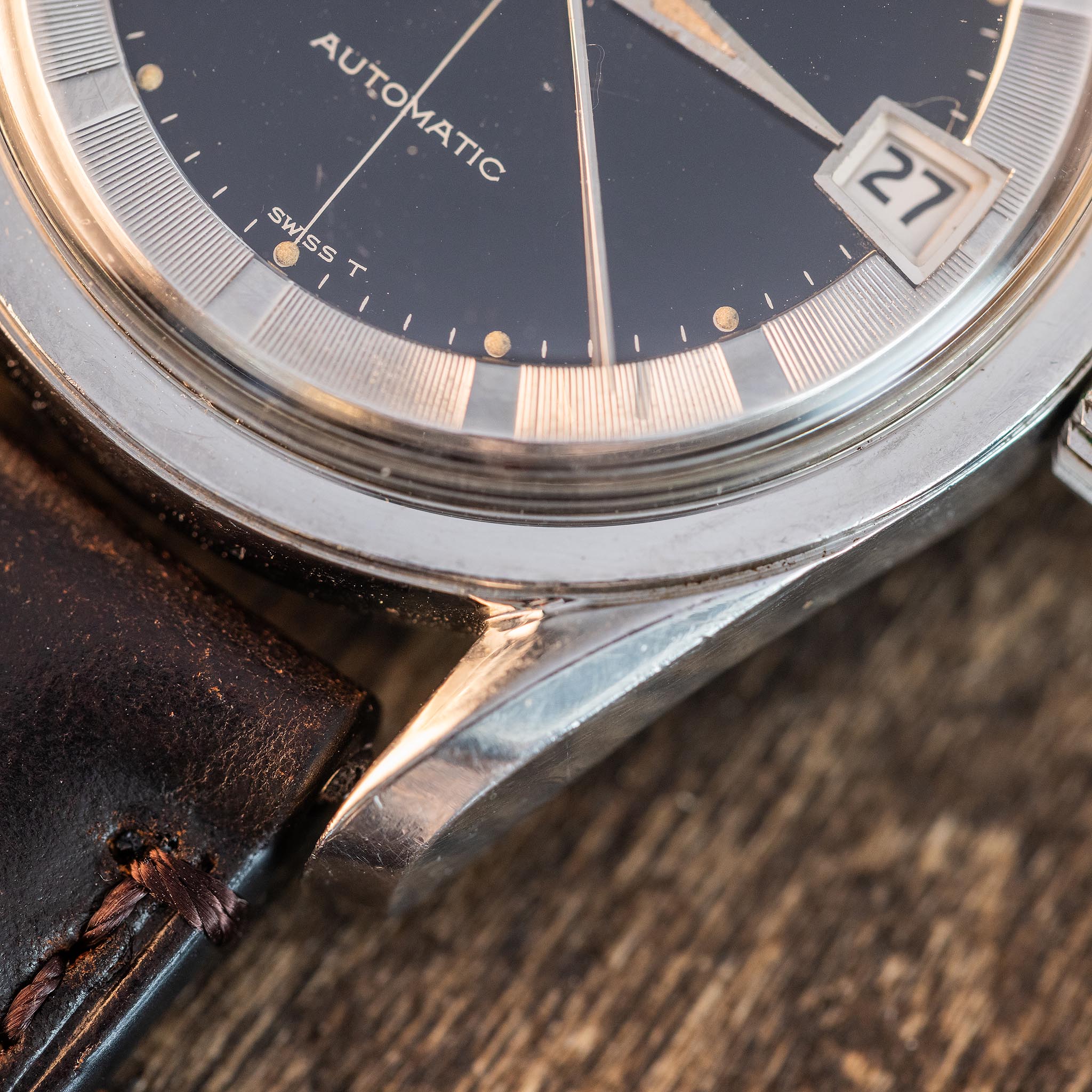
The feature I point out first is not the Microtor. It is the applied Universal Genève “U” at twelve.
From straight on, it is a small piece of polished metal. Move the watch through the light and the angled surfaces suddenly flash. The detail is simple, but it explains much of what makes the Polerouter work: the watch rewards movement. The chapter ring, dauphine hands, crosshair and faceted lugs all change as the angle changes.
Universal’s early Polerouters often used a two-level dial structure, and the company itself notes that Genta’s original design used a complex layered dial. On this example the black center and bright radial perimeter create much of that effect. It is restrained in a photograph and far more dimensional in person.
The Crystal Was Worth Saving
The auction photographs made the crystal look bad enough that the dial itself became a question mark. Once the watch arrived, that uncertainty disappeared: the damage was largely in the acrylic above the dial.
Instead of replacing the crystal, I repolished and retained it.
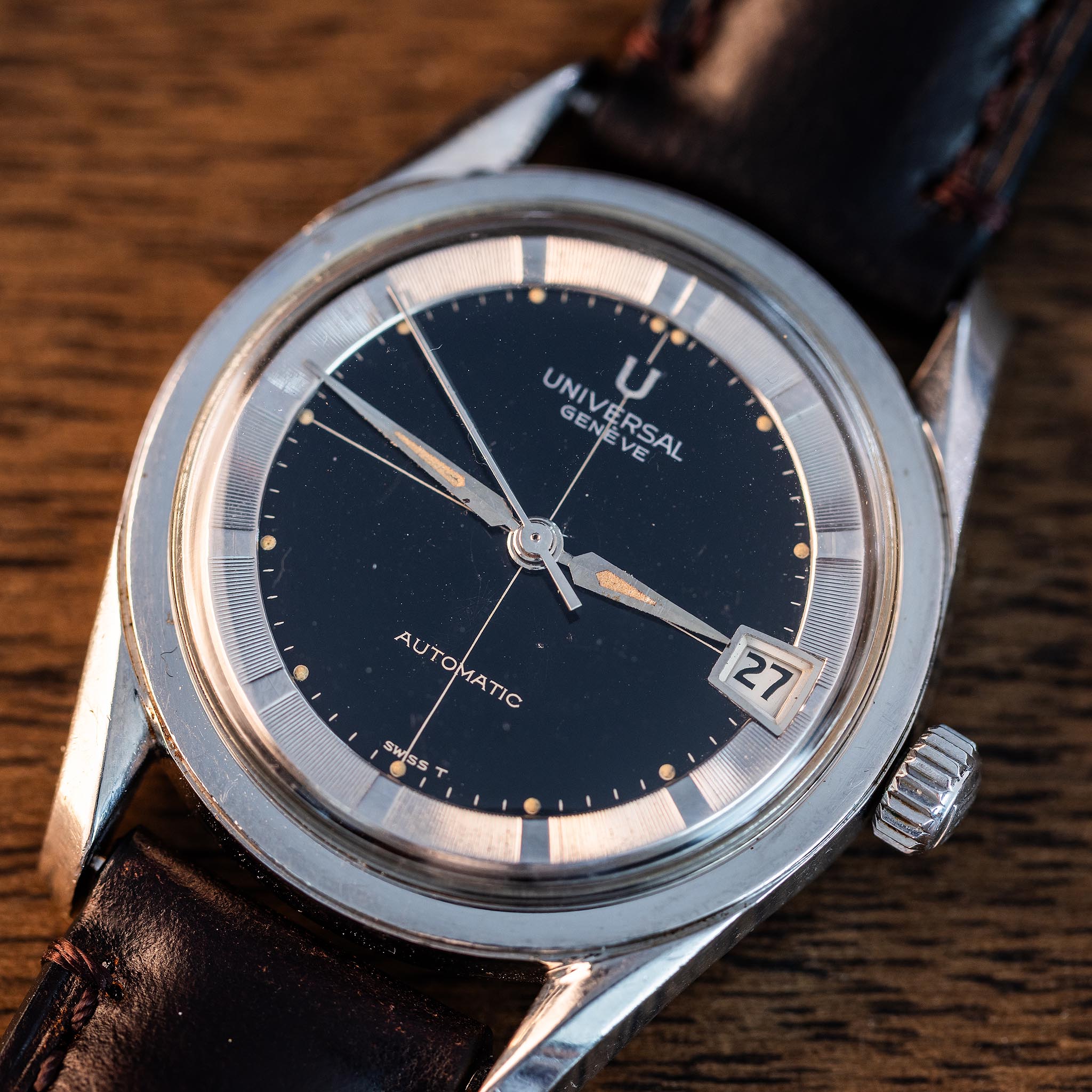
That decision became one of the most satisfying parts of the watch. The goal was never to make a sixty-year-old Polerouter look new. It was to remove the damage that prevented the watch from being read while leaving the surviving watch intact wherever possible.
Inside: The Microtor Idea
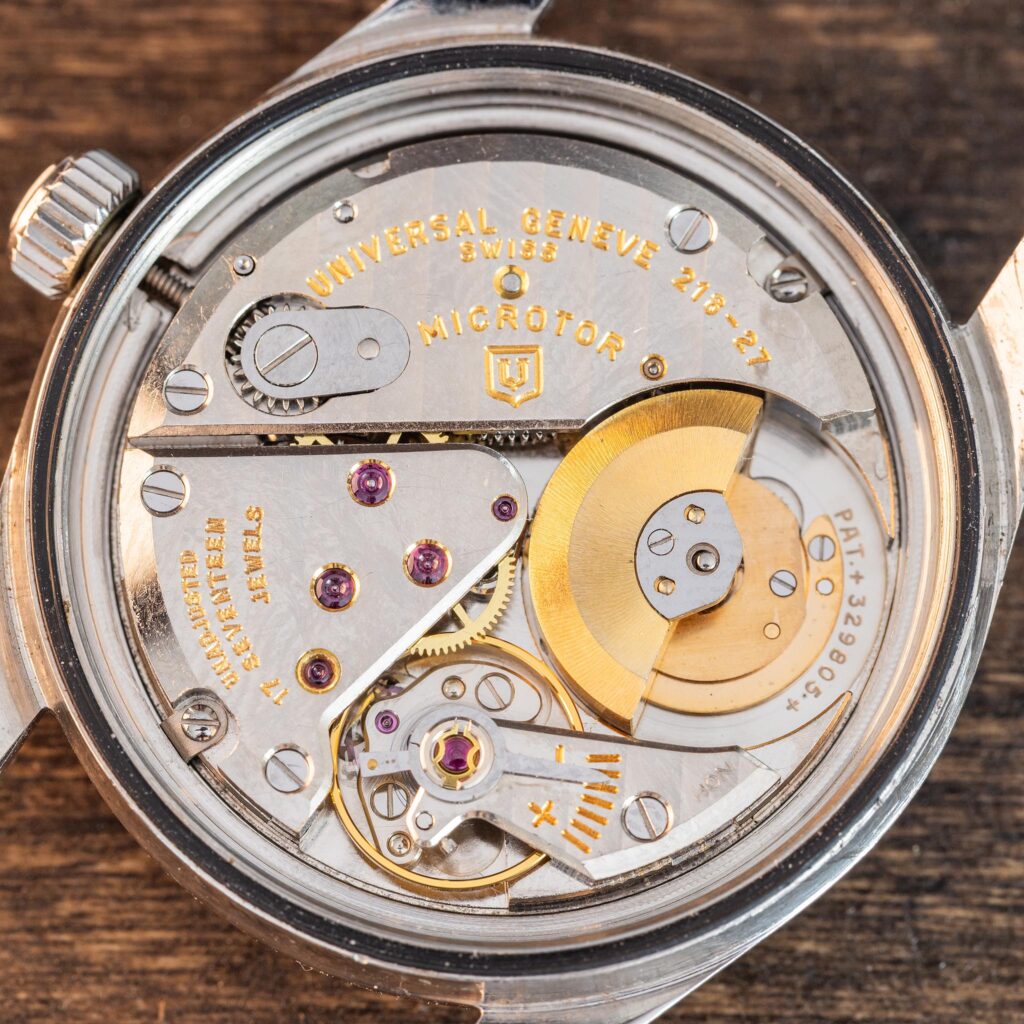
The Microtor is where the Polerouter’s history becomes mechanical.
Universal Genève introduced caliber 215 in the mid-1950s, placing a small automatic winding rotor within the movement rather than over the top of it. That architecture allowed the movement—and therefore the watch—to remain relatively thin while retaining automatic winding. By around 1960, the 218 family represented the next development of that architecture.
This watch carries caliber 218-27, the 17-jewel date version. Collector research on U.S.-market Polerouters identifies 17-jewel variants such as the 218-27 together with the HON import code as characteristic of watches imported for the American market.
At 18,000 vibrations per hour, the movement is not remarkable because of speed. It is remarkable because of packaging. The small rotor sits down inside the caliber, surrounded by the rest of the train rather than obscuring it. More than sixty years later, it is still one of those mechanisms that makes sense the moment the caseback comes off.

The Crown That Would Not Stay Put
The watch arrived running, but one mechanical problem was impossible to ignore: the crown was extremely loose and could pull all the way out.

The cause was inside the setting mechanism. The yoke had worked its way off its pivot point. I disassembled the affected setting works, reset the yoke onto its pivot, lubricated the mechanism and reassembled it. Normal crown engagement returned without replacing the underlying parts.
There was something different about doing that work on this watch. By then I understood what the Polerouter was, what it represented, and what comparable examples could mean to collectors. Correcting a real mechanical fault on a watch of this significance—and watching the mechanism return to normal—was one of the moments when the watch stopped feeling like an auction gamble and started feeling like something I had genuinely brought back.
A Seconds Hand That Did Not Need Saving
Preservation does not mean keeping every component simply because it was there when the watch arrived.
The central seconds hand on this example was already aftermarket and bent enough that continuing to manipulate and reuse it carried more risk than benefit. I replaced it with another silver seconds hand rather than treating an already non-original, damaged component as sacred.
The hour and minute hands, dial and other visible period details were left alone. No dial repainting was performed. The case was not machine polished.
The Reference: 204612/2

The factory case reference is 204612/2, confirmed directly from the caseback. That reference fits the physical watch in hand: a larger steel Polerouter Date case measuring 35.3 mm across, 45 mm lug-to-lug and 19 mm between the lugs.
Reference 204612/2 belongs to the early-1960s steel Polerouter Date family and is documented in the larger case format seen here, with roughly 35.5 mm diameter, 19 mm lugs and an approximately 45 mm lug-to-lug span. The black dial, applied Universal Genève emblem, luminous details and date at three all align with the documented /2 configuration.
In this case, the reference number, the dimensions and the visible configuration all point in the same direction. That makes 204612/2 the correct reference for the watch rather than an unresolved identification.
What the Caseback Remembers
The inside caseback is covered with hand-scratched service marks.
They are not decorative and they do not tell us enough to reconstruct a service history, but they matter because they show that this watch was maintained before it was discarded into the auction system that eventually brought it here.
That is a more believable kind of provenance than an invented ownership story. We know someone wore it. We know watchmakers opened it. We know the acrylic became heavily damaged. We know the crown mechanism eventually slipped out of position. And we know the watch was still running when it arrived.
The Watch We Found
What arrived was not an untouched survivor.
The case and lugs show scratches and edge wear. The dial carries light speckling and age. The luminous material has aged. The hour and minute hands show patina. The caseback records prior intervention. The seconds hand was already a non-original replacement and had become bent enough to warrant replacement again.
But the important architecture survived.
The black crosshair dial remained. The radial chapter ring remained. The applied “U” still caught the light. The Microtor movement was alive. The original acrylic could be saved. The crown fault could be corrected without replacing the setting components.

Restoration Without Erasing the Past
The work on this watch stayed narrow by design.
The original acrylic was repolished rather than discarded. The slipped yoke was reset and lubricated rather than replaced. The already aftermarket, bent seconds hand was replaced because preserving it would have preserved neither originality nor function. The dial and hour/minute hands were left cosmetically untouched. The case was not machine polished.
The result is not a Polerouter pretending to have avoided six decades of use. It is a Polerouter that can be seen, set, wound, worn and understood again.
At the latest check, the watch is running at approximately -6 seconds per day. That figure is a snapshot, not a promise of chronometer performance from a vintage movement, but it is a useful indication of how well the watch is operating today.
Why It Still Matters
The Polerouter sits at an unusual intersection of design, engineering and aviation history.
Its origin is tied to a real technological problem encountered on polar commercial flights. Its design is tied to the beginning of Gérald Genta’s career. Its Microtor movement represents a serious effort to make automatic winding thinner and more integrated. And the Date versions show how Universal turned that original aviation watch into something practical enough for daily civilian life.
That combination is why this watch changed the way I looked at collecting.
Before this one, a vintage watch could be interesting because it looked good, because it was old, or because it represented a good find. The Polerouter was the first one that made the history inseparable from the object. The more I learned, the more the watch itself changed.
What to Look for When Buying a Polerouter Date
- Do not rely on the dial alone. Record the caseback reference, movement caliber, jewel count and import markings.
- Measure the case. Polerouter references can look extremely similar while using meaningfully different case dimensions. Measurements can expose a reference question that photographs miss.
- Inspect the micro-rotor system. Wear in the rotor bearing system is a known service concern on these movements, and parts are not something to treat casually.
- Look closely at the dial. Crosshair printing, chapter rings, lume, applied emblems and text vary across legitimate references, but refinished Polerouter dials also exist.
- Check the crown and setting mechanism. Make sure the stem remains retained and that winding, time setting and date operation engage normally.
- Document service evidence without inventing a story. Watchmaker marks establish prior work, not who owned the watch or exactly what was done.
- Do not assume water resistance. Historical construction and period advertising are not a current pressure-test result.
The New Life

Someone cast this watch aside.
Eventually it ended up in a poorly photographed group lot on an auction site I had only just discovered. I bought it without knowing its history, waited three weeks to find out whether the dial had survived, and opened the box to a watch that became more important the farther I went into it.
That is the part of the Polerouter story I keep coming back to.
A watch designed to cross the North Pole, built around one of the most inventive automatic movements of its era and connected to the beginning of one of watch design’s most influential careers did not arrive in a museum tray. It arrived almost hidden.
Less casting aside. More restoring.
Research notes: Historical context was cross-checked against Universal Genève’s history of Gérald Genta and the Polerouter, Phillips’ Polerouter reference guide, and the collector-built Polerouter Reference Website, including its movement, U.S.-market and case-reference tables. Period advertisements are used as historical family context unless specifically stated otherwise.
Explore: View this Universal Genève Polerouter Date · The Reference Room



0 Comments