
I could see the old Rockford Watch Company building from my photography studio.
That fact had nothing to do with watches when I lived in Rockford, Illinois. It was simply part of the city around me—one of those surviving industrial buildings that becomes familiar enough to stop demanding attention.
Years later, after moving away and falling much farther down the vintage-watch rabbit hole, a Rockford pocket watch appeared in an online auction. I was not looking for a pocket watch. I was not hunting a particular Rockford grade. But the watch came with a period Rockford Watch Co. presentation box, the case looked unexpectedly clean in the photographs, and suddenly the name on the movement was not just another defunct American manufacturer.
It was home.

The bidding turned competitive. Part of that was the watch. Part of it, I suspect, was the box. For me, though, the decision had already been made. A watch from my hometown, made in a factory whose building I had looked at from my own studio, had found its way into the same kind of auction hunt that now defines The Found Dial.
The Hunt
I rarely go looking specifically for pocket watches. They live adjacent to the watches I usually chase rather than at the center of the hunt. But this one had two things working against my better judgment: Rockford on the movement and Rockford on the box.
The auction photographs suggested a watch in surprisingly clean condition, especially the gold-filled hunting case. I knew very little about the exact movement when I started bidding. I did not know the Grade 350 production numbers. I did not know where serial 822099 sat in Rockford’s final years. I had not yet dug into the Iroquois name.
I only knew that I wanted the chance to find out.
When the watch arrived, it was better than expected. More character, more detail, more presence. The case engraving was sharper than the auction photographs suggested, the dial had the kind of typography that makes an American pocket watch feel unmistakably of its era, and the movement itself was much more visually interesting than I had anticipated.
At a Glance
| Watch | Rockford Watch Co. Iroquois |
|---|---|
| Grade | 350 |
| Model | 1 |
| Movement serial | 822099 |
| Production | Circa 1909 |
| Movement size | 12 size |
| Jewels | 17 |
| Configuration | Hunting, pendant set |
| Case | Gold-filled hunting case, marked Warranted 25 Years |
| Case serial | 1750348 |
| Case diameter | 48.2 mm measured |
| Overall length | Approximately 65 mm from top of bow to bottom of case |
| Thickness | 10.6 mm measured |
| Dial | White dial with bold black Arabic numerals, red five-minute numerals, blued hands and subsidiary seconds |
| Current rate | Approximately +30 sec/day at latest check |
| Amplitude | 254° observed |
| Included | Period Rockford Watch Co. presentation box; not represented as proven original to this exact watch |
| Available from The Found Dial | View this Rockford Iroquois in the store |
The World It Came From
Rockford Watch Company grew out of the nineteenth-century American watch industry at a time when domestic factories were trying to turn precision watchmaking into repeatable industrial production. The company was organized in Rockford, Illinois in the 1870s using equipment purchased from the failed Cornell Watch Company, and its factory was completed in 1876.
Rockford’s location made sense. Railroads converged on the city, and the company developed a particularly strong connection with railroad workers. Across roughly four decades of production, Rockford made watches in multiple sizes and grades before closing in 1915 after producing approximately one million movements.
The factory building survived.
That survival is part of why this watch feels unusually tangible to me. The company did not exist only in a catalog or a collector database. The place where Rockford watches were made was part of the landscape I lived in.
A Grade Near the End
The Grade 350 belongs to the later Rockford period. Surviving production records document it as a 12-size, Model 1, 17-jewel hunting movement with a nickel finish and pendant setting.
Estimated production is only about 1,800 movements across three runs during 1909–1910. Movement serial 822099 falls inside the 822001–823000 run, which current production research places in 1909.
That number deserves context rather than hype. Low production does not automatically make every Grade 350 enormously valuable, and survival rates are unknown. What it does tell us is that this was never a mass-production Rockford grade on the scale of the company’s broader output.
The Iroquois Name Is Actually There
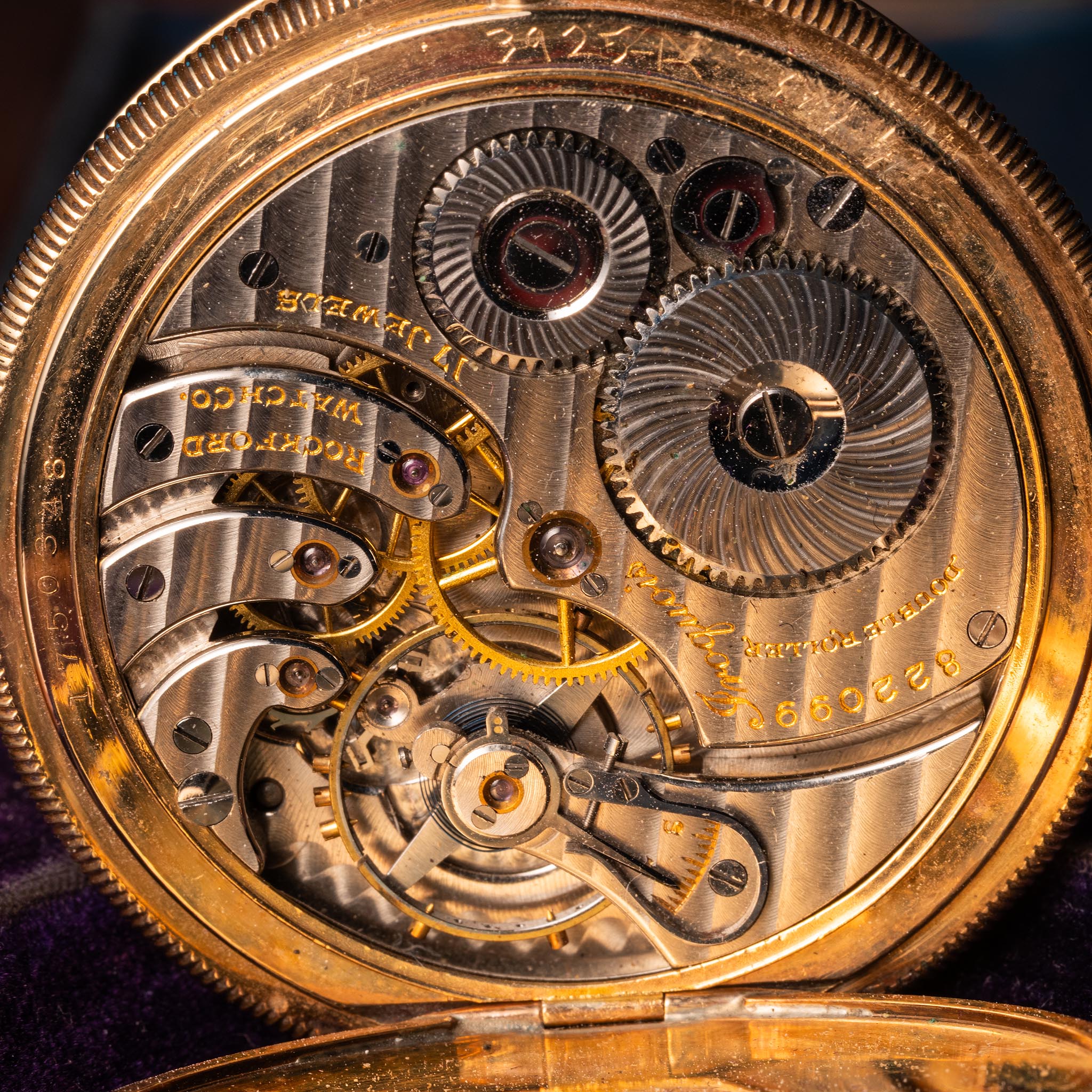
On this watch, Iroquois is not a name added later from a database entry. It is written directly on the movement in cursive.
That matters because American pocket-watch research can easily become a stack of secondary identifiers: serial charts, grade tables, model numbers, case information and collector shorthand. The strongest evidence is still the evidence on the watch itself.
Here, the movement gives us the name, the maker, the serial and the architecture in one place. The lettering also gives the movement personality. Industrial production did not mean visual anonymity; makers still understood that the inside of a watch could carry identity.
A Case Built to Be Seen
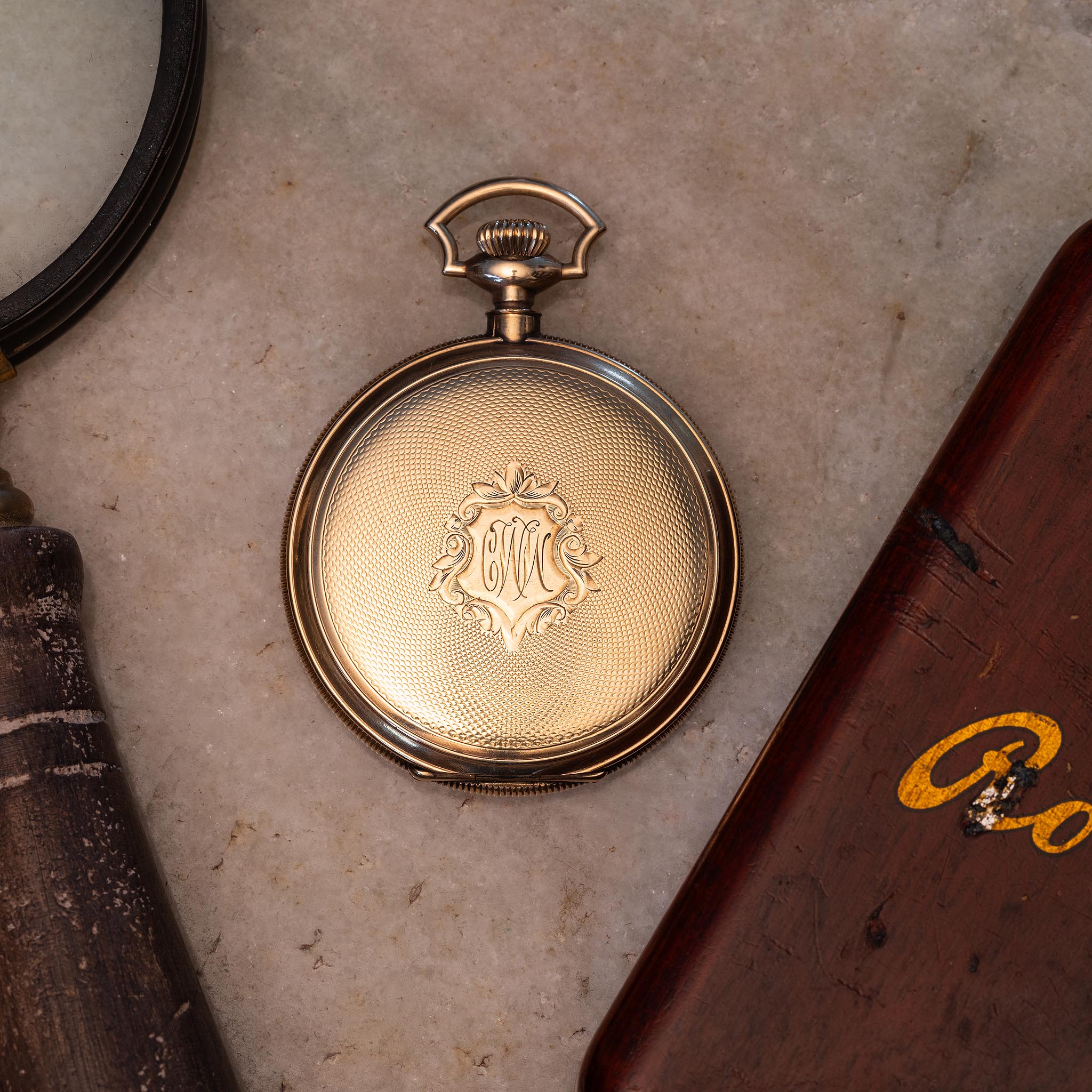
The exterior is the detail I would point out first after the Rockford lettering around the dial and movement. The gold-filled hunting case carries dense engine-turned decoration and an intertwined monogram at the center.

Inside, the case is marked Warranted 25 Years and carries case serial 1750348. That wording identifies a gold-filled case with a period wear guarantee, not a solid-gold case. It is exactly the kind of distinction that matters when evaluating old American pocket watches, because the movement maker and case maker were often separate parts of the final watch.


The Dial Still Carries the Era

The dial is quieter than the case, which is part of why the watch works so well visually. The white surface uses bold black Arabic numerals for the hours, smaller red five-minute numerals around the perimeter, blued hands and a subsidiary-seconds register at six. The cursive Rockford signature sits almost delicately in the center, giving the face plenty of identity without competing with the case.
It is one of those combinations that makes more sense in hand than in an auction thumbnail. The outside of the case is ornamental. The dial is functional. The movement becomes ornamental again when the rear cover is opened.
The Box Is Part of the Story—But Not Proof of Provenance

The wooden presentation box was one of the reasons I kept bidding.
It is a period Rockford Watch Co. box, complete with the company name on the lid and its surviving interior fabrics. What I cannot prove is that this exact watch left a dealer inside this exact box. Without paperwork or traceable provenance, that pairing should remain an open question.
That does not make the box less interesting. It makes the description more accurate.
I have left it completely untouched. No refinishing. No polishing. No attempt to make the fabric look younger. The watch could tolerate some careful cosmetic work; the box was better left alone.
Inside the Watch

The Grade 350 is a 17-jewel movement, a meaningful specification for a small American watch of this era. The layout uses a three-finger bridge arrangement that leaves the train visibly articulated instead of hiding most of the mechanism beneath one large plate.
That architecture is part of why the watch had more character in person than I expected. The movement feels deliberate. There is enough visible mechanical structure to reward opening the case, and the Iroquois script gives the otherwise industrial nickel finish a human signature.
At the latest check, this example was running very well with approximately 254° amplitude and a rate around +30 seconds per day. Those readings are a snapshot of current behavior rather than a promise of future accuracy from a watch made more than a century ago.
What the Service Marks Tell Us
There are old watchmaker marks inside the case near the movement.
They prove prior service attention, but not much more. They do not tell us who owned the watch, exactly what work was performed, or when each intervention happened. That is the boundary between evidence and storytelling, and it is worth keeping intact.
What we can say is simpler: this watch was maintained before it reached me. Someone cared enough to keep opening it, servicing it and putting it back into use.
Restoration Without Erasing the Past
This was one of the easy ones.
There was no broken setting system to chase, no cracked crystal demanding replacement, no donor movement, no parts search. The movement was already running very well. The work was almost entirely careful hand polishing.
Sometimes you get lucky.
The goal was simply to let the case detail read again without trying to erase its age. The watch did not need to become something different. It needed decades of accumulated surface dullness taken out of the way so the engraving, monogram and form could show themselves again.
The box received the opposite treatment: nothing at all.
Rockford in 1909
The year associated with serial 822099 also lands directly in one of Rockford’s more interesting advertising periods.
In 1909 the company commissioned illustrator Richard F. Outcault—creator of characters including the Yellow Kid and Buster Brown—to produce a thirteen-month dealer postcard campaign. Beginning in November 1909 and continuing through November 1910, the cards promoted Rockford watches under the idea of “True Time for a Lifetime,” using monthly illustrations, humor and dealer-focused sales copy.
That campaign does not document this exact Grade 350. It does something different and equally useful: it shows how Rockford was presenting itself to customers and dealers at almost exactly the time this movement was being produced.
It is the kind of period material that puts a watch back into its world rather than treating it as an isolated object.
Why It Still Matters
There are Rockford watches that are more complicated, more valuable, more railroad-focused and more technically ambitious than this one.
This is the one I wanted.
Part of that comes from the Grade 350 and its small production run. Part comes from the movement layout, the Iroquois signature, the gold-filled hunting case and the period box. But the real reason is geographic.
Rockford has had a difficult modern history. Industries changed, factories closed, neighborhoods changed with them, and the city’s identity became more complicated than the version represented by an ornate watch made in 1909.
This pocket watch is a throwback to the other Rockford—the city confident enough to put its own name on a precision product and ship it out into the world.
I used to look at the building where it happened.
What to Look for When Buying a Rockford Grade 350
- Use the movement serial, not the case serial. American pocket-watch production dating is based on the movement number.
- Confirm the grade and model. Grade 350 is documented as a 12-size, Model 1, 17-jewel hunting movement.
- Look for the Iroquois signature. On examples marked this way, it is visible directly on the movement and should be photographed clearly.
- Separate movement value from case value. Gold-filled, coin-silver and solid-gold cases can produce dramatically different prices even when the movement is similar.
- Inspect the dial carefully. Hairlines, edge chips, surface marks and repairs can be difficult to see in poor auction photographs.
- Check the hunting-case hinges and covers. Both lids should open and close cleanly without excessive play or distortion.
- Treat boxes as separate evidence. A genuine period Rockford box adds presentation and collector interest, but it does not prove original pairing without documentation.
- Do not confuse low production with guaranteed rarity value. Survival, condition, case material and collector demand all matter.
The New Life

When I bought this watch, I expected the connection to Rockford to be the reason it mattered.
I did not expect the object itself to be as good as it was.
The case had more character. The movement was more attractive. The Iroquois script was there in plain sight. The period box felt less like an accessory and more like another surviving piece of the same manufacturing culture.
That is what I like most about the hunt. Sometimes the research rescues a watch from anonymity. Sometimes the restoration rescues it physically.
And sometimes you get lucky enough that the watch arrives already telling most of its own story.
Less casting aside. More restoring.
Research notes: Production and movement specifications were cross-checked against the Pocket Watch Database Grade 350 record and its production charts. Company history was cross-checked against the Rockford Watch Co. history archive. Period advertising context comes from documented Rockford catalogs and the company’s 1909–1910 R. F. Outcault postcard campaign; this period advertising is used as company-era context and is not represented as an advertisement for this exact watch.
Explore: View this Rockford Iroquois · The Reference Room



0 Comments