
The first thing I noticed was the dial. Under the right light, its fine crosshatched texture turns an otherwise restrained Longines into something remarkable. Tiny ridges cross the silver-white surface like threads in a piece of woven linen. Gold hour markers seem to float above it. You can look at dozens of old watches without encountering one that has kept this much quiet character.
But the second thing I noticed made the watch harder to forget. Turn it over and the gold case reads like a small engraved trophy: LONE STAR CO / TOP SALES / MANAGERS CLUB / FRANK E. / JONES / 1962. Whoever presented it wanted that accomplishment remembered.
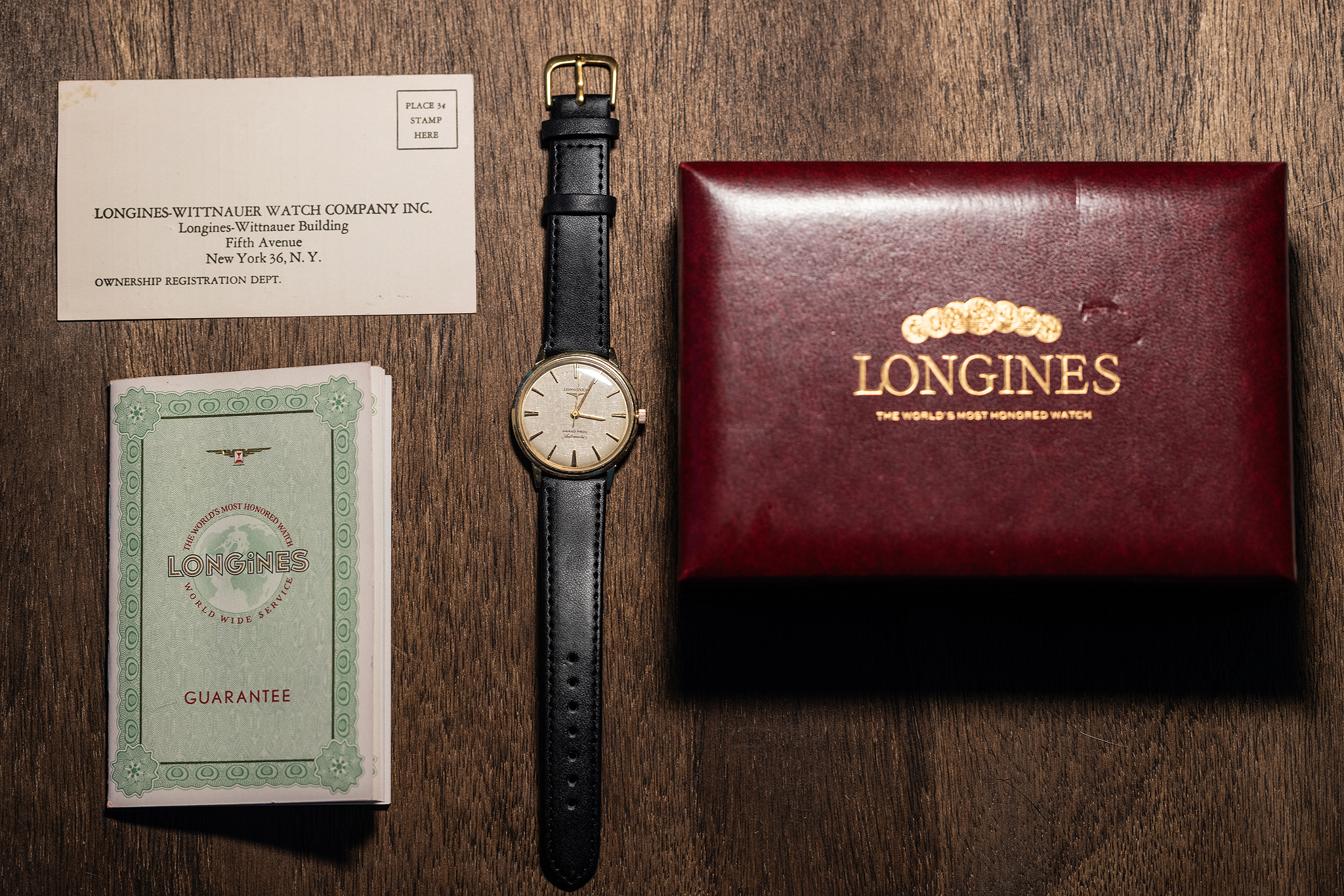
Then there were the things that had somehow remained with it: a Longines presentation box, warranty booklet, and card. For a watch of this age, those small survivors felt almost as telling as the engraving. It was never just metal and gears. In 1962, it had been an occasion.
Decades later, it appeared at an online auction, where the gold alone could have decided its fate. This is the story of the prize that very nearly lost everything except its weight.

The Hunt: When the Gold Buyers Walked Away
Longines was one of the first names that drew me deeper into mechanical watches. It was not a brand I had known well before I started collecting and restoring; the more I learned, the more intriguing it became. The watches had genuine mechanical ambition, but often expressed it in a way that seemed effortless.
This Grand Prize appeared on its own in an online auction. Its solid 14K case caught attention, and it was obvious that people interested in the gold had noticed it. I could see why. There was real precious metal here. But the watch also had an exceptional textured dial, a complete-looking vintage presentation, and a personalized award on the back. The watch itself was far more interesting than the material it was made from.
As bidding moved past the gold’s scrap value, that competition disappeared quickly. I was happy to keep going. I could picture how easily a watch like this might be stripped and melted almost immediately after arriving at the wrong buyer’s door. Instead, I was bidding for the thing that someone had once been proud to receive.
When it arrived, the dial was even more impressive in person. The texture had survived. The engraving had survived. So had the box and papers. The most surprising part was not a hidden technical discovery. It was how complete the experience of the watch still felt.
At a Glance
| Watch | Longines Grand Prize Automatic |
| Historical date | 1962, engraved presentation date; movement likely from circa 1961 |
| Movement | Longines caliber 340, automatic, 17 jewels |
| Movement serial | 11,709,496 |
| Case markings | Longines-Wittnauer / D&A / 14K GOLD; case number 5005; additional caseback number 2,738,540 |
| Case | Solid 14K yellow gold; case and back weighed together at 14.32 g |
| Measurements | 34.8 mm across; 39.6 mm lug-to-lug; 9 mm thick; 17.7 mm lug spacing |
| Dial | Fine silver-white linen crosshatch, applied gold-tone baton markers |
| Functions | Hours, minutes, sweep seconds; no date |
| Condition | Running and setting per owner; crystal replaced, movement lubricated and gold case polished by hand |
| Provenance detail | Frank E. Jones, Lone Star Co. Top Sales Managers Club, 1962 (caseback inscription) |
| Surviving accessories | Original Longines box, warranty booklet and warranty/registration card |
See the watch: 1962 Longines Grand Prize Automatic — solid 14K gold, original box and papers.
Longines, Awards, and the Meaning of Grand Prize
The watch’s name makes the engraving unusually fitting. For decades, Longines had built its identity around precision, industrial skill and awards won at international exhibitions. The company established itself at Saint-Imier, Switzerland, where the winged hourglass became one of the watch industry’s most enduring signatures. The nineteenth-century quest to build watches accurately and consistently matured into twentieth-century production that balanced precision and elegant design.
By the early 1960s, Longines proudly advertised its collection of international honors. The words Grand Prize on the dial deliberately echoed that heritage: awards earned by a company now carried into a watch meant to reward someone’s own achievement. In this case, the connection is unusually direct. Grand Prize Automatic is printed on the front; Top Sales Managers Club is engraved on the back.
One of the best historical discoveries is a December 1962 Longines magazine advertisement. The advertisement presents the Grand Prize Automatic by showing the movement itself and explaining Longines’ approach to automatic winding, shock protection and precise assembly. Its featured gold model is identified in the advertising as the Summit, a related Grand Prize configuration, not a confirmed advertisement for this exact case reference or linen dial.
What makes the advertisement valuable is its date. While this very watch was being presented for someone’s success, Longines was explaining to prospective buyers why the movement inside mattered. The historic sales message, the preserved packaging and the personal award inscription all belong to the same moment in consumer history.
The Dial: An Unexpected Piece of Textile
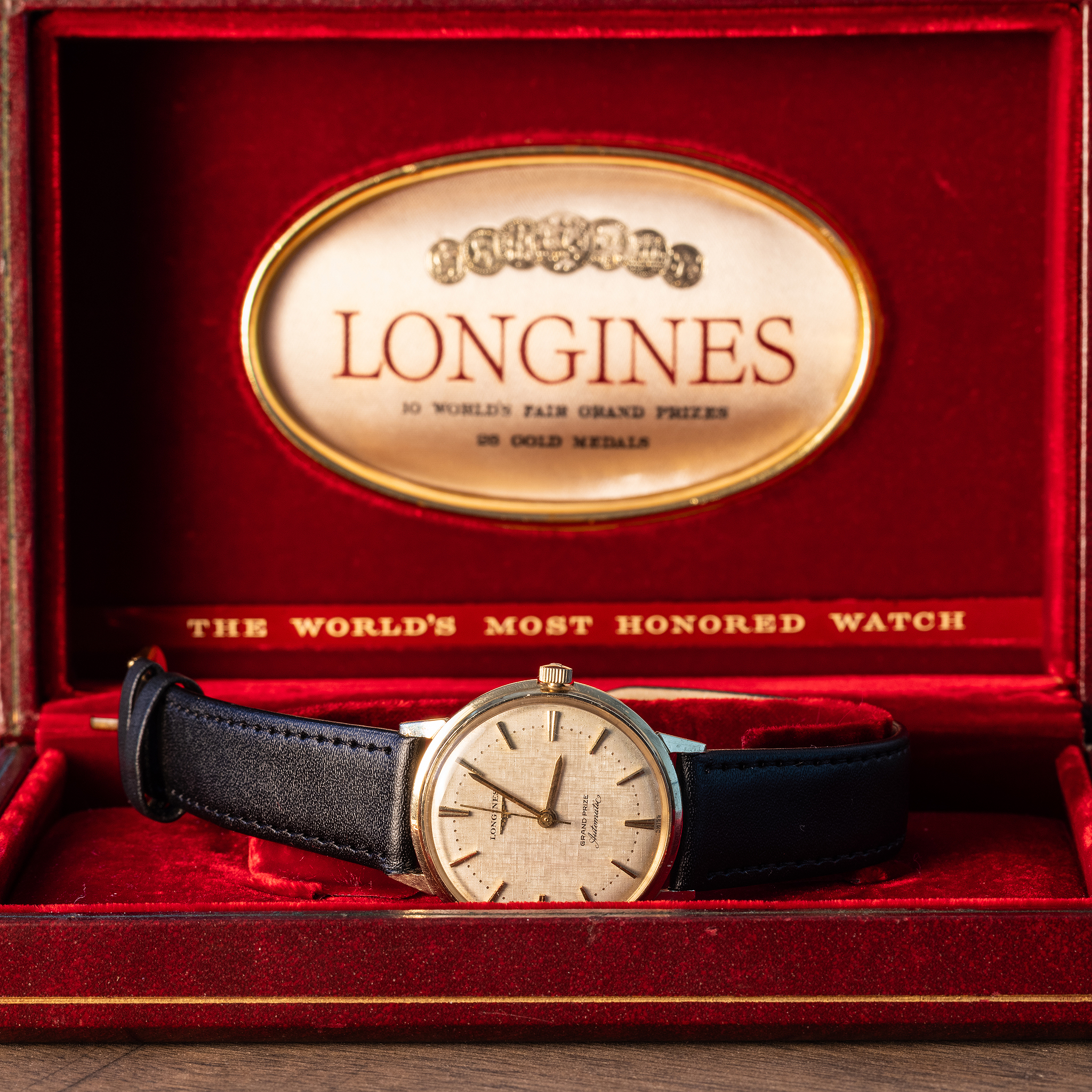
The first close-up almost makes the dial look woven rather than manufactured. Fine intersecting lines run across its pale face. The texture breaks up reflection, then lets individual bright threads of light reappear as the angle changes. It is a different visual language from a typical silver sunburst dial: subtle, orderly and wonderfully tactile, even through the crystal.
The applied gold-toned markers are narrow and faceted, with a tiny dotted minute track just beyond them. A winged-hourglass emblem sits beneath the Longines name at twelve. Below the hands, GRAND PRIZE and the slanted Automatic signature complete the layout without overcrowding it. Dauphine-shaped hands, a fine central seconds hand and a plain gold bezel leave the texture to carry the personality.
The photographs show small marks of age, including tiny dial flecks and wear or oxidation near the hand stack. They are part of what survived with the watch. A dial like this is worth protecting precisely because replacing or refinishing it would destroy the surface that makes it compelling.

The Name in the Gold: Frank E. Jones, 1962
A watch can outlive a company and still keep the moment that connected them. Here, that moment is preserved in the back of a solid-gold case. The engraving tells us that Frank E. Jones was named in a Lone Star Co. Top Sales Managers Club presentation in 1962. It tells us he was recognized. It does not tell us how long he worked there, what he sold, or where his career took him afterward.
I spent time following the Lone Star name into Texas history. One compelling lead is Lone Star Gas Company, whose historic Art Deco buildings in downtown Dallas still preserve the company’s name and whose operations later became part of Enserch and other corporate successors. Fort Worth has its own landmark Lone Star Gas building, too. These surviving buildings give a very tangible sense of the Texas corporate world in which a recognition watch could have been awarded. The engraving says Lone Star Co., however, rather than spelling out Lone Star Gas Company. Until a company record connects Frank E. Jones to that specific firm, the building is a fascinating research lead, not a proven employer identification.
There is something wonderful about the parallel. The building may keep a company’s name in stone; the watch keeps an individual’s name in gold. Corporate names change, offices become something else, and people move on. A small inscription can survive all of it.

Inside: The Unusual Longines Caliber 340
Turn to the movement and the visual logic changes completely. Longines caliber 340 arrived around 1960, when manufacturers were competing to improve automatic winding without creating watches that felt unnecessarily thick. Many automatic movements use a weight pivoting at the center. The 340 uses a large off-center oscillating rotor with a toothed perimeter, mounted on a ball-bearing system, leaving an immediately recognizable shape when the back is removed.
The large rotor is not only visually interesting. It is part of Longines’ attempt to make a reliable, efficient self-winding watch through a different piece of engineering. A wearer moving throughout the day supplies energy through the rotor’s movement, and the watch stores it in the mainspring. Longines’ 1962 advertising described the care taken with its winding design and the associated mechanical details.
The photographed movement is signed Longines caliber 340 and 17 jewels. Published movement specifications give a rate of 19,800 vibrations per hour and a nominal reserve of about 43 hours. Those describe the caliber as designed; they are not performance measurements for this particular sixty-plus-year-old watch. The owner’s inspection found it running and setting correctly, but a current measured rate and power reserve are not recorded.
The related caliber 341 added a date, while later variants altered the architecture. The Grand Prize name appeared across different dial styles and cases, including gold-filled and solid-gold examples. A collector should pay attention to the movement, case stamps and specific configuration rather than assuming every Grand Prize Automatic was built exactly alike.

Two Sets of Numbers, Two Different Histories
The owner-confirmed Longines movement serial is 11,709,496. Approximate Longines serial chronologies place it around 1961, consistent with the watch’s engraved presentation date of 1962. On the inside of the gold back are a case marking 5005 and a separate stamped number 2,738,540, alongside Longines-Wittnauer, D&A and 14K GOLD marks. The case number and the movement serial should never be treated as interchangeable.
Longines-Wittnauer distributed and cased Swiss movements for the North American market, an important detail when studying watches of this era. The case and movement bring together different makers and parts of the trade, just as collectors would expect to find in an American-market Swiss watch.
Longines maintains historical archives associated with watch serials. Its official archive-extract service offers a route to research the factory record for this movement. Until an extract is obtained, the 1962 engraving remains the firm’s presentation date, not a factory-certified date of manufacture or delivery.

Restoration: Keeping the History in Place
This was not a watch that needed its past erased. The crystal was replaced, the movement received lubrication, and I polished the gold case by hand. The point was to improve the experience of wearing and seeing it while respecting what had been there for decades.
The linen dial was left to speak for itself. The small age marks and hand patina remain. And the engraved back was deliberately preserved, because removing it would also remove the strongest human part of the watch’s history. A spotless blank caseback would tell us far less.
Hand-polishing is different from machine refinishing, but it still matters to document the work performed. This watch was not given a full movement overhaul, and the replacement crystal is not presented as original. The case retains its everyday scratches and its very specific 1962 identity.
The Original Box, and What the Paperwork Cannot Tell Us
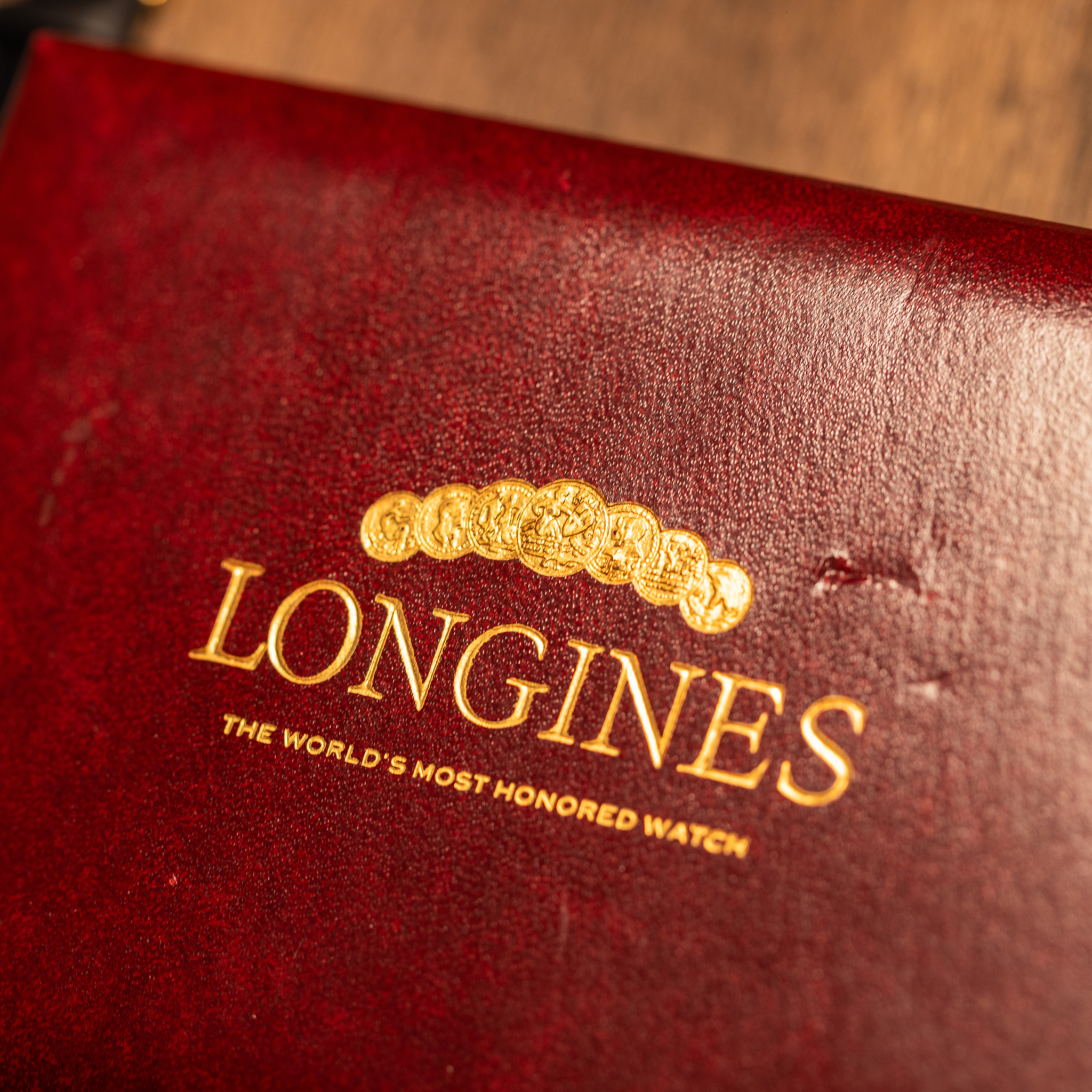
For me, the original box and warranty materials are among the most satisfying parts of this find. The maroon presentation box carries Longines branding and its award-winning identity, while the booklet and warranty/registration card show the world of paperwork that surrounded an important watch purchase.
I checked the cards for the kind of small handwritten clue that could link the set back to Frank E. Jones: a dealer, date, name or serial number. None was filled in or identifiable. There is no need to manufacture a paper trail where the documents don’t provide one. Their significance is that the original materials have remained with this watch through the years.
It is easy to imagine a box placed in a drawer after a ceremony, perhaps brought out on special occasions. The actual family or ownership journey is unknown. But the box, the paper and the engraving make the 1962 presentation unusually present, even today.
What Original Looks Like — and What to Check When Buying
Originality in a Grand Prize is best approached as a collection of small details rather than one dramatic test. Study the dial printing, applied hour markers and the relationship between the dial, hands and case. Linen finishes, sunburst finishes, date and no-date configurations all appear in the wider family. A redone dial can look tidy while losing the subtle surface that makes a survivor interesting.
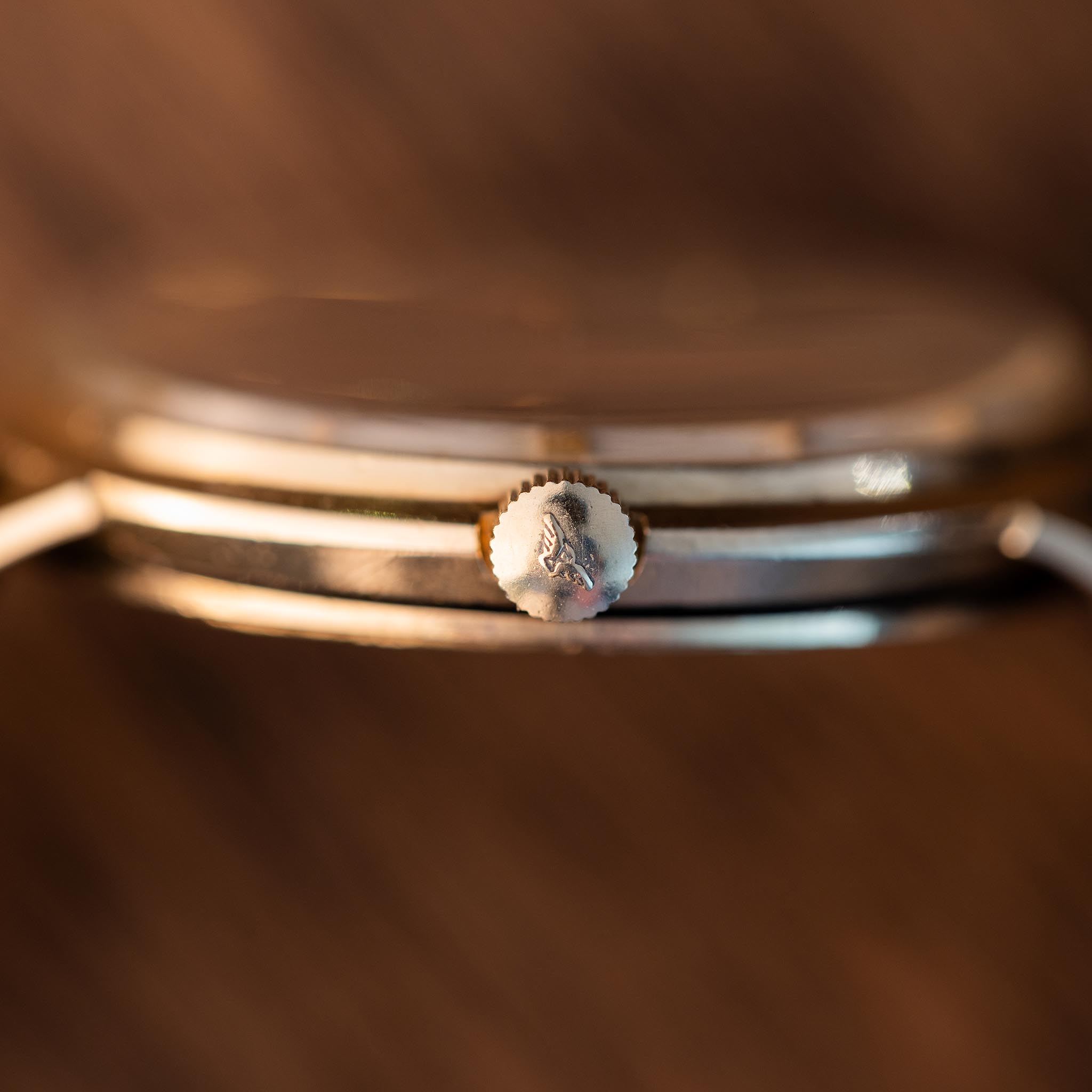
Inside, verify the caliber stamp and inspect the winding rotor, its gearing and the condition of the movement. These early automatic systems deserve a watchmaker familiar with their construction, especially where bearing wear or unwanted rotor contact is a possibility. Watch for damaged or replaced crowns, evidence of earlier repairs, and caseback opening marks. The Longines-Wittnauer case signatures help tell you how a Swiss movement was sold into the American market.
Case composition is another essential distinction. Longines Grand Prize examples were sold in several materials; gold filled is not solid 14K gold. Read the inner and outer case marks rather than relying on the appearance of yellow metal. This example’s solid-gold marks are photographed, and the owner weighed the empty case and back together at 14.32 grams.
Finally, separate the meaning of an inscription from its evidentiary limits. A presentation date gives a strong piece of human context. Matching documents and a manufacturer archive entry can add more. Both can be worth pursuing, especially when a watch preserves a story as particular as this one.
A Prize, Still a Prize
The auction could have ended with a small pile of gold. That would have been the simplest way to value this Longines, and the fastest way to lose everything else.
Instead, the dial still catches the light. The name Frank E. Jones is still engraved on the back. The old box still holds its watch. The caliber 340 still has the shape of an engineer’s solution to a difficult problem. Some pieces of the story are known, and others remain waiting in old company records, family albums or Longines’ archives.
That is what I want a rescued watch to do. Not pretend to be new, but give the past another chance to be noticed.
Less casting aside. More Restoring.
EXPLORE THIS LONGINES AT THE FOUND DIAL →
Further Research and Period Material
- HiFi/Stereo Review, December 1962 — period Longines Grand Prize Automatic advertisement, featuring a related Summit model and movement illustration, not a confirmed depiction of case 5005.
- Longines corporate historical timeline — watchmaking history and international exhibitions.
- Ranfft: Longines caliber 340 — movement architecture, technical data and related variants.
- History of Lone Star Gas Lofts, Dallas and Handbook of Texas: Enserch — research leads on the Texas Lone Star company name, not verified proof of the recipient’s employer.
- Longines: History of my watch — official archival research options.
Continue exploring The Reference Room, including the story of a Rockford Grade 918 that returned to life.



0 Comments