
You can hear this one before you begin studying it. The tick is deliberate, almost physical—a measured sound produced by pieces that feel substantial in the hand. When my Rockford Grade 918 arrived, it was heavier than any other pocket watch I had held. I wound it. It was running.
That first sound mattered because the auction listing had never said whether the watch worked. But the reason I went looking for it in the first place was older than the auction: Rockford, Illinois was my hometown, and I had been trying to find one of the company’s higher-grade watches built for railroad time service.
Under its white enamel dial is a movement from a period when being off by a little could have consequences far beyond missing an appointment. Inside the case are small scratches from people who may have tended the watch across generations. In the city where it was made, the factory itself still stands, awaiting another chapter.
The sound, the weight, the workmanship, the hometown connection: together, they made this more than a pocket watch to add to a shelf.

The Hunt: Looking for the Right Rockford
I had learned enough about the Rockford Watch Company to know I didn’t want to buy just any watch bearing the name. I was specifically looking for a better railroad-grade example—something that could show what the factory was capable of when accuracy, durability and craftsmanship mattered most.
The Grade 918 appeared as a single lot at an online auction that wasn’t particularly watch-heavy. Bidding stayed quiet. There was no assurance that it ran, and without that detail, buying an antique mechanical watch always involves some risk. The history and specification made the gamble worthwhile.
When it arrived, the size and heft were the first surprises. And then came the running movement, already alive. That was the beginning of a closer inspection, not the end of it. Only by opening the case did the extraordinary amount of work put into the movement become clear.
At a Glance
| Maker | Rockford Watch Co., Rockford, Illinois |
| Grade / Model | Grade 918 / Model 9 |
| Estimated movement production | Circa 1907–1908, based on reconstructed serial chronology |
| Movement serial | 707537, on the movement |
| Size / configuration | 18-size, open-face, stem wound, historically lever-set |
| Jewels | 21 |
| Factory adjustment | Marked adjusted to temperature and five positions; original catalog additionally specifies isochronism |
| Escapement | Double roller, marked on movement |
| Dial | White double-sunk-style enamel, black Arabic numerals, red five-minute marginal figures, small seconds at six |
| Case | Fahys, 14K gold filled—not solid gold |
| Case serial | 7116640, on the case interior (separate from movement serial) |
| Owner’s measurements | 54.7 mm case width; 17.2 mm thickness; additional 72.3 mm measurement with endpoints unconfirmed |
| Mechanical condition | Runs and sets according to owner’s inspection; no current measured rate or certificate |
| Restoration | Exterior case polishing and general cleaning |
| Crystal | Original according to the owner’s inspection |
| Railroad provenance | Railroad-grade design, built for the demanding timekeeping standards of the era |
Companion product: Rockford Grade 918, 21-Jewel Railroad-Grade Pocket Watch (product page currently saved as a draft).
Why the Railroads Demanded More
A century and a half ago, a watch could be an operational instrument. Trains were moving along shared stretches of track according to carefully coordinated schedules. A crew member who misread the time—or depended on a watch running well outside regulation—could upset that system. Accuracy was not merely an expression of a manufacturer’s pride; it was part of managing risk.
By the late nineteenth century, North American railroads increasingly formalized watch inspections and technical requirements. The famous 1891 collision at Kipton, Ohio became part of the history surrounding Webb C. Ball’s work in railroad time service, but the larger change extended over many years and varied among railroad companies. The commonly cited 1893 standards called for open-faced watches of substantial size, legible Arabic dials, at least seventeen jewels, lever setting, adjustments in multiple positions and stringent rate performance.
Lever setting was important because it helped prevent accidental changes of the hands when handling the winding crown. The bold black numerals and uncluttered white dial mattered for equally practical reasons: a watch that was hard to read could be almost as dangerous as one that kept poor time. The higher jewel count and careful adjustments addressed the wear and accuracy of the movement itself.
A watch qualified by its grade was not automatically approved for every railroad. Each line could impose its own inspection rules, and individual timepieces had to remain within tolerance in service. Today, describing a Grade 918 as railroad-grade means that it was designed and sold to meet the exacting standards of its era. It was the kind of precision instrument a railroad employee could have trusted on the job. Whether this particular watch ever rode the rails is one more part of its history still waiting to be discovered.
From Rockford, Illinois
Rockford Watch Company began in 1873, drawing on equipment from the earlier Cornell watch enterprise. The city was part of an expanding American industrial world, and precision watchmaking demanded the same combination of mechanical skill, repeatable production and skilled hands that defined the region’s broader manufacturing identity.
The company’s first completed watches emerged in the 1870s. It developed a reputation for substantial pocket-watch movements and promoted railroad-grade timekeepers during the years when railway operation helped shape the country’s daily understanding of standardized time. Despite skilled manufacturing and a catalog filled with increasingly sophisticated movements, financial pressures and reorganizations eventually overtook the business. The factory closed in 1915.
For me, Rockford isn’t just a name stamped onto a plate. It is a hometown. That makes the surviving factory building at 325 South Madison Street part of this story, too. The historic structure is still standing, though its future has required years of preservation and redevelopment work. In January 2026, Rockford City Council approved an amended agreement intended to support adaptive reuse of the former factory. The work of bringing that historic building into a new era is still unfolding. I like the parallel: people are trying to give the old factory a future, much as I hope to do for the watches that came out of it.
A factory can close. The work of its watchmakers can remain, turning quietly inside a case more than a century later.
The Page That Survived: Grade 918 in 1907
Among the most useful discoveries for this watch is not a modern sales listing, but Rockford’s own circa-1907 catalog. A period catalog page identifies the No. 918 by name, not merely a related model. It describes an 18-size, open-face-only grade with twenty-one ruby jewels, a double-roller escapement, sapphire pallets and jewel pin, a micrometric regulator, compensating balance, Breguet hairspring and carefully finished steel work. The movement was to be adjusted for temperature, five positions and isochronism.
The factory also specified a double-sunk glass-enamel dial with red marginal figures and nickel-damaskeened movement plates with gold lettering. All three characteristics are recognizable in the surviving watch. The 1907 catalog listed the No. 918 at $40—roughly $1,600 in 2026 purchasing power. That gives a sense of the serious investment Rockford was asking someone to make in a watch built for precision.
Rockford even offered a certificate of rating upon application, a fascinating piece of paperwork that would have accompanied the watch’s story. This one arrived without its certificate. Have you ever come across an original Rockford rating certificate? I’d love to see one—and perhaps add another piece to the story. The movement itself still carries its markings for temperature and five-position adjustment.
The Grade 918 was not Rockford’s only railroad-oriented product, nor its most expensive. Its significance is that it was an intentionally high-grade working instrument rather than a purely decorative object. Reconstructed production records compiled by Pocket Watch Database suggest roughly 2,900 Grade 918 movements in six runs, produced between about 1900 and 1908. Only a few thousand were made, and more than a century later, one is here in my hands. How many others survived, and where did they end up? That’s part of the hunt.
The digitized Grade 918 catalog entry preserves the exact factory illustration and specification in context. It is a better starting point for understanding this grade than assigning it attributes drawn from unrelated Rockford models.
Inside the Grade 918: More Than Decoration
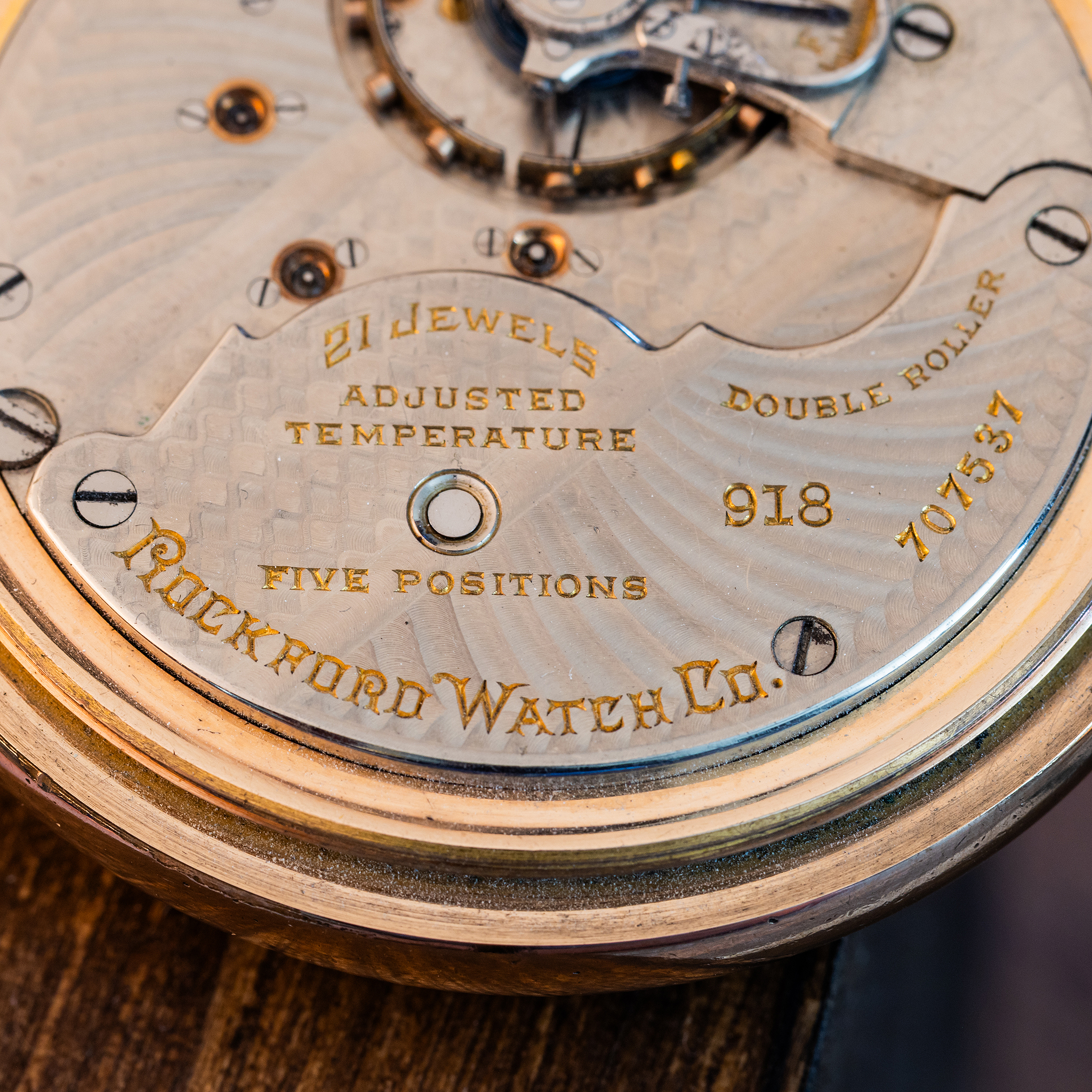
Opening the back is where this watch makes its strongest impression. The nickel-finished plates are dressed in dense, patterned damaskeening—curving rays and geometric detail that change as the light moves. Gold-toned engraved lettering crosses the surface. Under the visual flourish are the inscriptions that carry real mechanical meaning: 21 JEWELS, DOUBLE ROLLER and ADJUSTED TEMPERATURE / FIVE POSITIONS. The grade itself is marked 918, and the movement serial is 707537.
Jewels in a movement are not gemstones added for display. They provide durable, low-friction bearing points where precise moving parts meet. A double-roller escapement is a refined safety and impulse arrangement in the regulating mechanism. Position adjustment addresses how gravity influences rate when a watch is held differently; temperature compensation aimed to reduce another substantial source of variation. The micrometric regulator gave the watchmaker fine control over timing.
What fascinates me is the contrast: all that careful engraving and patterned metalwork inside a watch designed to do a job. Rockford gave real attention to the parts most owners would rarely see. More than a century later, the balance is still moving and the tick is still there. That alone makes opening the case a rewarding experience.
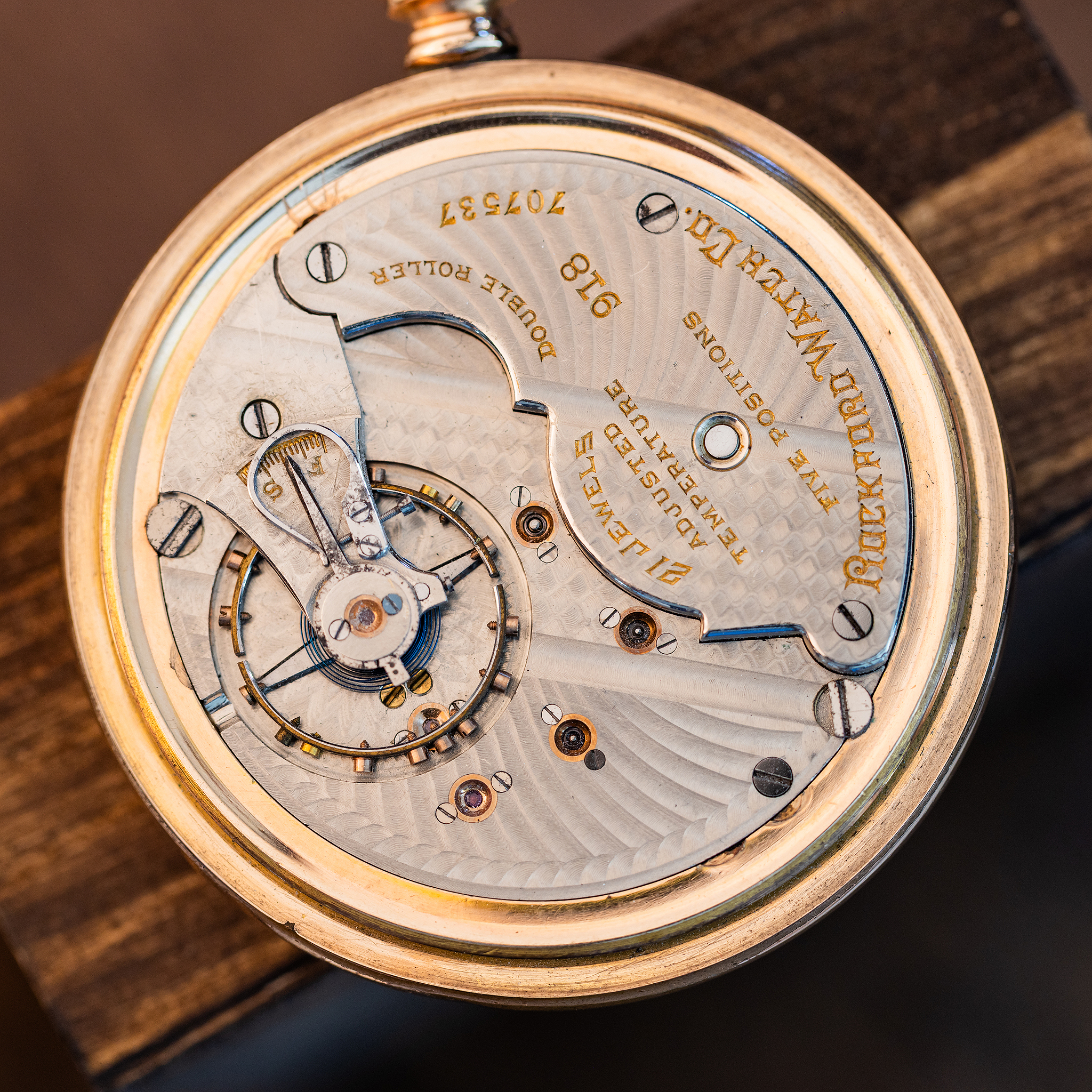
Movement serial 707537 places this remarkable piece of Rockford craftsmanship around 1907–1908. At the time, a movement and its case could begin life in different workshops before becoming one finished watch—a very different approach from the tightly integrated watch manufacturing we tend to picture today.
A Dial Made to Be Read, Not Admired
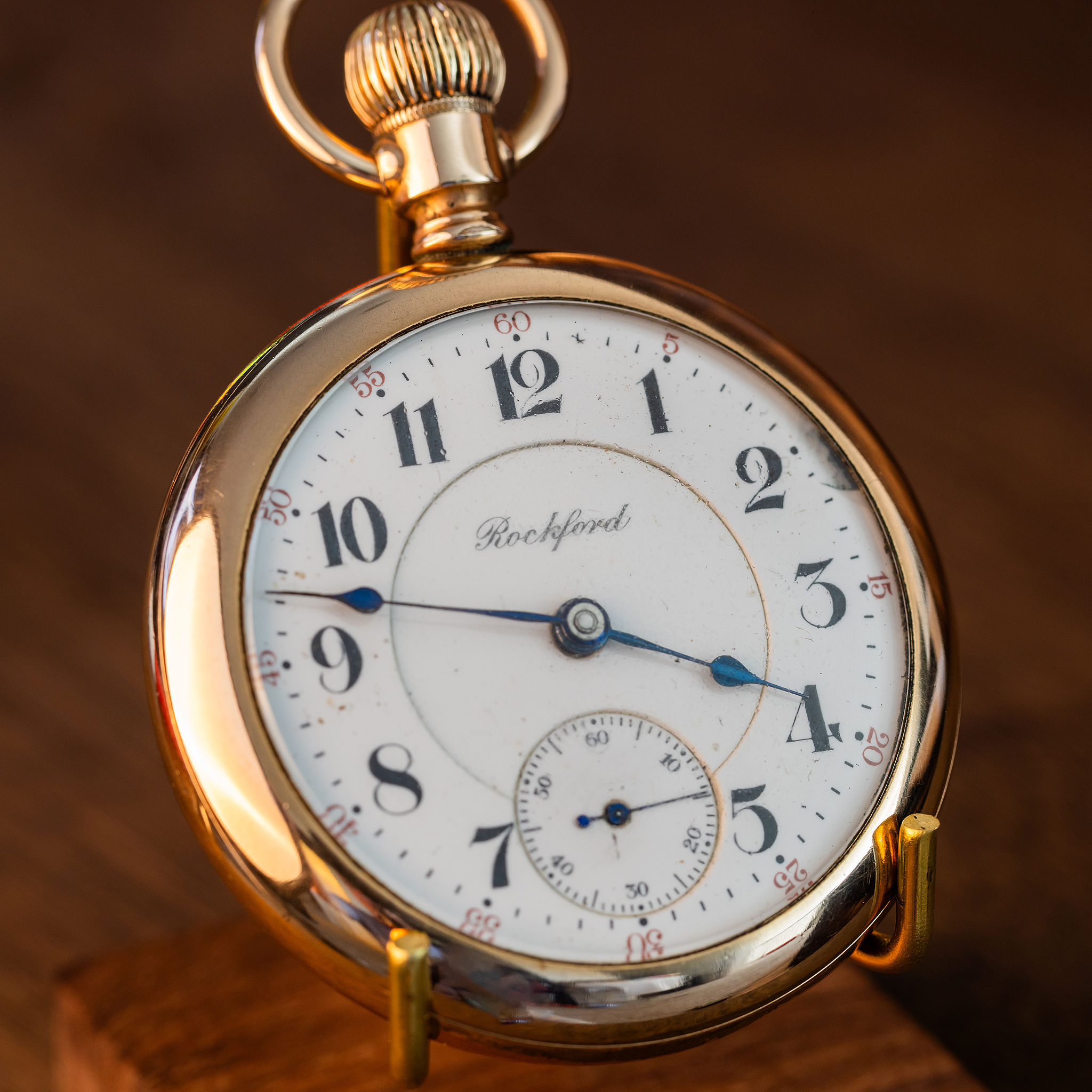
The white enamel dial is striking because it gives nothing away to flourish that could interfere with function. Large black Arabic numbers define the hours. A separate outer track carries bright red figures in five-minute steps. The hands retain their deep blue finish, with distinctive pear- or spade-like shapes; a small seconds hand moves in a recessed register at six.
The graceful Rockford signature is the one moment of decorative restraint. Everything around it is organized for quick reading, just as the period catalog describes. A century ago, legibility wasn’t a design trend; for someone working from a timetable, it was part of the watch’s purpose.
Close photography also shows the less flattering parts of age: scattered tiny specks, mild perimeter discoloration and a possible fine hairline around two to three o’clock, a small detail to explore under the loupe. The crystal has been described by the owner as original, and remains part of the watch’s surviving character.

Fahys: A Case With Its Own History
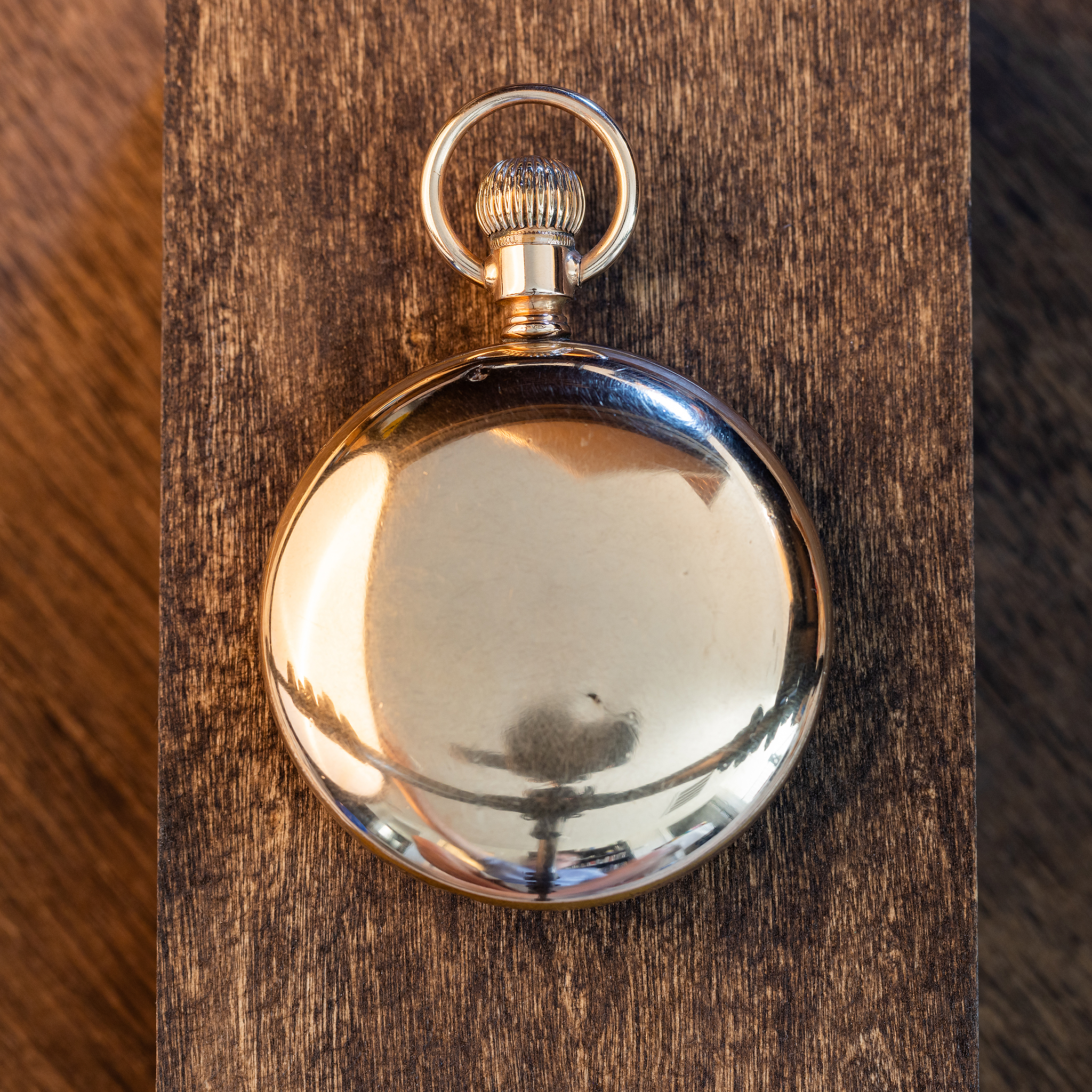
The back is golden, smooth and substantial. Inside, however, the stamp matters more than its warm color: WARRANTED 14K 25 YEARS Fahys. This is a 14K gold-filled case, constructed with a bonded layer of gold over a base-metal core. The twenty-five-year wording reflects how Fahys promoted the durability of its gold-filled cases more than a century ago.
The Fahys case carries serial 7116640, while the Rockford movement bears 707537. Two manufacturers, two specialties, one watch. This was a familiar part of American watchmaking: a movement maker concentrated on the intricate machinery of keeping time, while a case maker supplied the protective housing. Jewelers and retailers could bring the pieces together for their customers. Here, the plain, sturdy Fahys case seems well suited to the Grade 918’s working character. There is little interest in elaborate presentation; the appeal is in having a dependable instrument close at hand.
The outside retains fine scratches and small age marks. Case polishing was the primary cosmetic work performed here, bringing some of the life back to its appearance without trying to make the case look newly manufactured. The gold-filled construction is part of the object’s truth, and the surfaces still reveal it has been used.
The Marks No One Can Fully Translate
Inside the lid, near the case maker’s factory stamp, are the small hand-scratched marks that first invited a more personal question: how many hands did this watch pass through before it reached mine?
I initially wondered whether the inscriptions could help reconstruct its repairs. The research led to a more interesting—and less convenient—answer. Watchmakers often maintained their own ledgers and scratched corresponding job numbers, shorthand or symbols inside watch cases. Some marks denoted dates or particular work; others were references intelligible only to the person who made them. There was no universal system.
Those scratched marks leave us with more questions than answers—which, to me, is part of their charm. We cannot determine how many times this watch was fully serviced, what was repaired, or which craftsman worked on it solely from these engravings. Their number and variety are consistent with a watch that received attention during its life, but the inscriptions do not prove a documented schedule of regular care.
For me they are more interesting left unresolved. They are little private signatures from people whose names—and sometimes whose working codes—have disappeared. The inside back was never intended as a public display, yet it has kept those traces for generations.

Restoration Without Erasing the Work
This Rockford did not arrive asking for an entirely new identity. It was already running, the high-grade movement appeared substantially complete in the photographs, and the important character of the dial and case remained. The work I focused on was mainly polishing the case—a simple, tactile process that felt like breathing a little life back into a watch that had been overlooked.
The original intake also described a good general cleaning. My attention went to cleaning and refreshing the exterior rather than a complete mechanical overhaul. The movement was already running when the watch arrived, and I wanted to preserve the character that made it appealing in the first place.
I left the watch’s age where it belongs: on the dial, in the slight wear of the gold-filled surfaces, in the decorated movement that still shows its years, and in the coded marks inside the lid. Preservation does not mean doing nothing; it means knowing which signs of life to restore and which parts of the story not to erase.
What to Look For in Another Grade 918
Start by confirming what you are buying. Grade 918 is a movement designation. Look for the engraved grade, twenty-one-jewel inscription, factory adjustment wording and movement serial on the plates. Cross-check those against Rockford grade research and original catalogs, not merely the wording of an auction title.
Inspect the movement photographs carefully for missing screws, corrosion, damaged jewels, disturbed regulator parts and signs that a later repair has altered the original configuration. Confirm how it winds and sets; the model is historically lever-set, but the correct mechanism should be observed and checked on the individual watch. If timekeeping matters to you, ask for a meaningful measured rate and information about recent mechanical service.
Study the enamel dial under varied light. Fine hairlines and repaired chips can hide beneath reflections. Check whether the bold numerals, red five-minute figures and blue hands are consistent with the movement era, while allowing for legitimate period service variations. Then read the case stamps carefully. 14K gold filled is not the same material or value as solid 14K gold. Case numbers, movement serials and old repair marks each tell different stories.
Every surviving Grade 918 carries a little of this shared history, and sometimes a few clues to a more personal one. A name, an inscription or a service record could connect another example to the railroad worker—or everyday owner—who relied on it.
What Endures
I went looking for a better Rockford because I wanted to own a piece of the watchmaking history of my hometown. The Grade 918 gave me more than a maker’s name. It gave me the scale of an old working instrument, a movement whose specifications can still be traced to a factory catalog, and a tick that is impossible to ignore once it is in your hand.
Its makers are gone. The reasons for the small scratched marks in its case may never be known. The building where Rockford made watches has outlived the company and is itself being considered for another chapter. Yet this movement still runs.
There is something fitting about that. For a watch designed around the importance of keeping time, the passing of time has become the most interesting part of its story.
Photographed purely and sold honestly.
Less casting aside. More restoring.
Sources and Period Research
- Rockford Watch Co. factory catalog, c. 1907 — exact No. 918 illustration and specification — primary-period material; exact grade and factory specifications.
- Pocket Watch Database — Grade 918 historical profile — 18-size Model 9, 21-jewel, lever-set identification; reconstructed production figures.
- Rockford Watch Company history and serial chronology — company background and approximate movement dating.
- Historical summary of railroad timepiece standards — context for railroad-grade design and inspections, with differences between railroad operators.
- What the inscriptions inside pocket-watch cases mean — how watchmakers used personal ledger codes rather than one standardized scheme.
- Fahys 14K/25-year case marking reference — explanation of gold-filled case designations; background on period Fahys case markings.
- City of Rockford — former Watch Factory redevelopment opportunity and January 2026 approved redevelopment agreement — contemporary documentation of the surviving factory and proposed adaptive reuse.
Explore the companion Rockford Grade 918 product listing for all ten available photographs and the current condition summary when the product is published. A second Rockford example appears in The Found Dial’s Rockford Iroquois Grade 350 listing; it is a different movement and should not be confused with this Grade 918.



0 Comments