
The auction listing gave almost nothing away. Five watches, two brands mentioned, and one thin gold-colored dress watch with a dial I could not read.
There was no Breitling name on the front. No familiar model title. Just an unfamiliar insignia and a line of lettering beneath twelve o’clock. I initially wondered whether it was Russian. A blurred photograph of the back suggested something else entirely: could that really say Breitling?
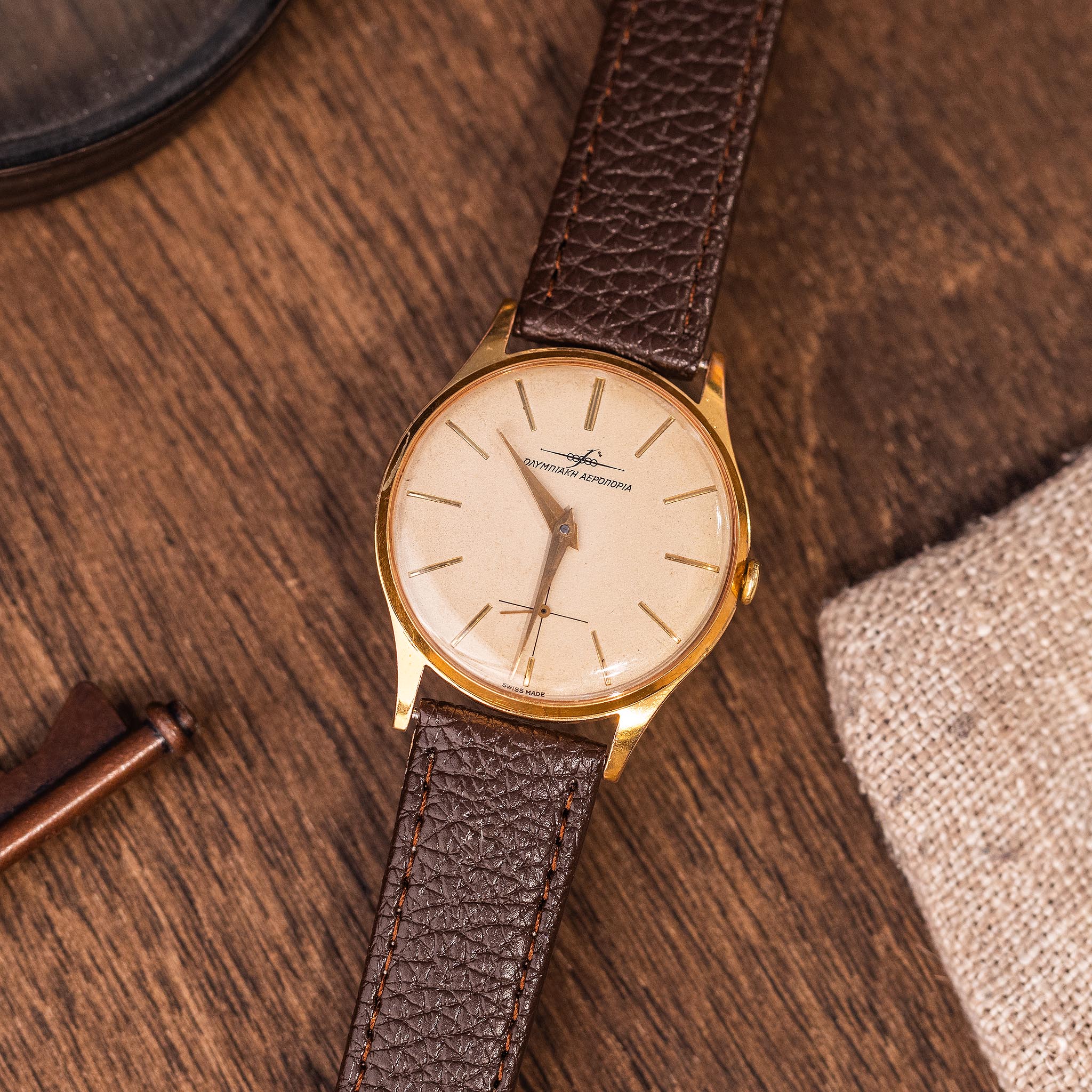
It did. And the words on the dial turned out to be Greek: ΟΛΥΜΠΙΑΚΗ ΑΕΡΟΠΟΡΙΑ. Olympic Airways.
That was the moment the auction stopped being a conventional watch hunt. It became a question about what happens when one of Switzerland’s recognizable watchmakers makes a watch whose face belongs entirely to an airline.
The Hunt: Five Watches, One Unfamiliar Dial
I found the Breitling in an online auction grouped with four other watches. The description did not mention Breitling, Greek aviation, or Olympic Airways. Two other brands were named, but this one was left to be interpreted from imperfect photographs.
A nearly anonymous dial is usually a warning or an invitation. Sometimes it is a redial, a lesser-known maker, or simply a photograph too poor to read. This time I kept returning to the letters and the blurry reverse image. The language was the first mystery. The identity of the case was the second.
Once I worked out that the inscription was Greek, the research began moving quickly. Olympic Airways led to Aristotle Onassis. An old Breitling collectors’ discussion turned up a remarkably similar watch with the same reference. It was the sort of detail a broad auction title was never going to reveal.
The bidding itself was surprisingly quiet. In a collecting world built around quickly recognized brands and reference numbers, an unnamed dial in a mixed lot can sit in plain sight. I took the chance. When the watch arrived, the dial was even better in person and the case noticeably thinner than I expected.
At a Glance
| Brand | Breitling — signed on movement and outside caseback |
| Dial | Olympic Airways / ΟΛΥΜΠΙΑΚΗ ΑΕΡΟΠΟΡΙΑ |
| Reference | 1351 (stamped outside caseback) |
| Case serial | 863119 |
| Estimated date | Circa 1957 (third-party case serial range; approximate) |
| Movement | 17-jewel Swiss hand-wound mechanical; exact caliber unconfirmed |
| Functions | Hours, minutes, subsidiary seconds |
| Case | 20-micron gold-plated with stainless-steel back |
| Measurements | 35.8 mm diameter · 42.7 mm lug-to-lug · 8.6 mm thick · 18 mm lugs |
| Work performed | Cleaning and replacement crystal |
| Current operation | Running and time setting work; measured daily rate not documented |
VIEW THE WATCH IN THE FOUND DIAL STORE →
The store listing will become accessible when the product is published.
The World It Came From: Onassis, Olympic Airways, and 1957
In 1957, Aristotle Onassis took a struggling Greek airline into a new chapter under the Olympic Airways name. An April service from Athens to Thessaloniki opened the era, and the network soon expanded toward major European cities. It was an airline built around Greek identity and international ambition.
The company paid attention to how that identity looked. Even its uniforms were part of the story: the Greek-born Paris couturier Jean Dessès designed the airline’s early crew clothing. Advertising presented a new era of Greek air travel, made tangible in print, in aircraft, and in the smallest details of presentation.
A 1957 Olympic Airways print advertisement preserved by the Imagining Greece archive provides a useful window into that launch. It is contemporary airline material—not an advertisement for this Breitling, and not evidence that a particular watch was commissioned that year.
Breitling occupied its own place in that expanding aviation world. The Navitimer had introduced complex flight calculations to the wrist in the early 1950s, while the company was building a reputation around aviation instruments and precise timing. The intriguing part of this particular watch is that it is nothing like a cockpit chronograph. No slide rule. No timing bezel. Just three hands, one small-seconds display, and the name of an airline.
Breitling’s own history of the era and an original 1957 Breitling advertisement for other watches show how aggressively the brand spoke to the flying world. The advert depicts different models; it should not be mistaken for a reference 1351 advertisement.
A Dial That Gives the Entire Stage to an Airline

The dial is disarmingly spare: warm champagne, long applied gold-tone batons, tapered hands and a recessed small-seconds register at six. Just below twelve, the Olympic Airways emblem and name take the place where a manufacturer’s signature might normally sit.
This is not evidence on its own that an executive instructed Breitling to omit its name. Nor would an unsigned dial have been wholly unknown to Breitling: some early aviation-association Navitimers carried an AOPA emblem rather than the Breitling wordmark. But on this restrained ref. 1351, the choice gives the watch a very different identity.
Look closer and the years appear. There are fine spots in the dial finish and subtle shifts in its surface. Those details have not been airbrushed from the photographs or the story. They are part of the watch we found.
The Name the Dial Withheld

The most decisive photograph is not of the dial. It is the outside of the caseback, where the Breitling name and emblem appear with 1351. This is the watch’s case reference, not its serial number. Inside, the back instead bears the FOND ACIER INOXYDABLE stainless-steel marking and the separate serial.
That distinction matters because the 2015 collectors’ discussion about another Olympic Airways Breitling contained exactly the same confusion. An experienced participant explained that reference 1351 should be separated from the six-digit production-era case number and that a marking reading plaqué G 20 denotes gold plating rather than solid 20-karat gold.

This example carries 863119 beneath the French-language stainless-back marking FOND ACIER INOXYDABLE. The figure falls in a third-party non-chronograph Breitling serial table associated with 1957. It is a useful dating clue, but not a Breitling factory extract, and it cannot independently tell us when the Olympic Airways dial was prepared or fitted.
Twenty Microns, Not Twenty Karats
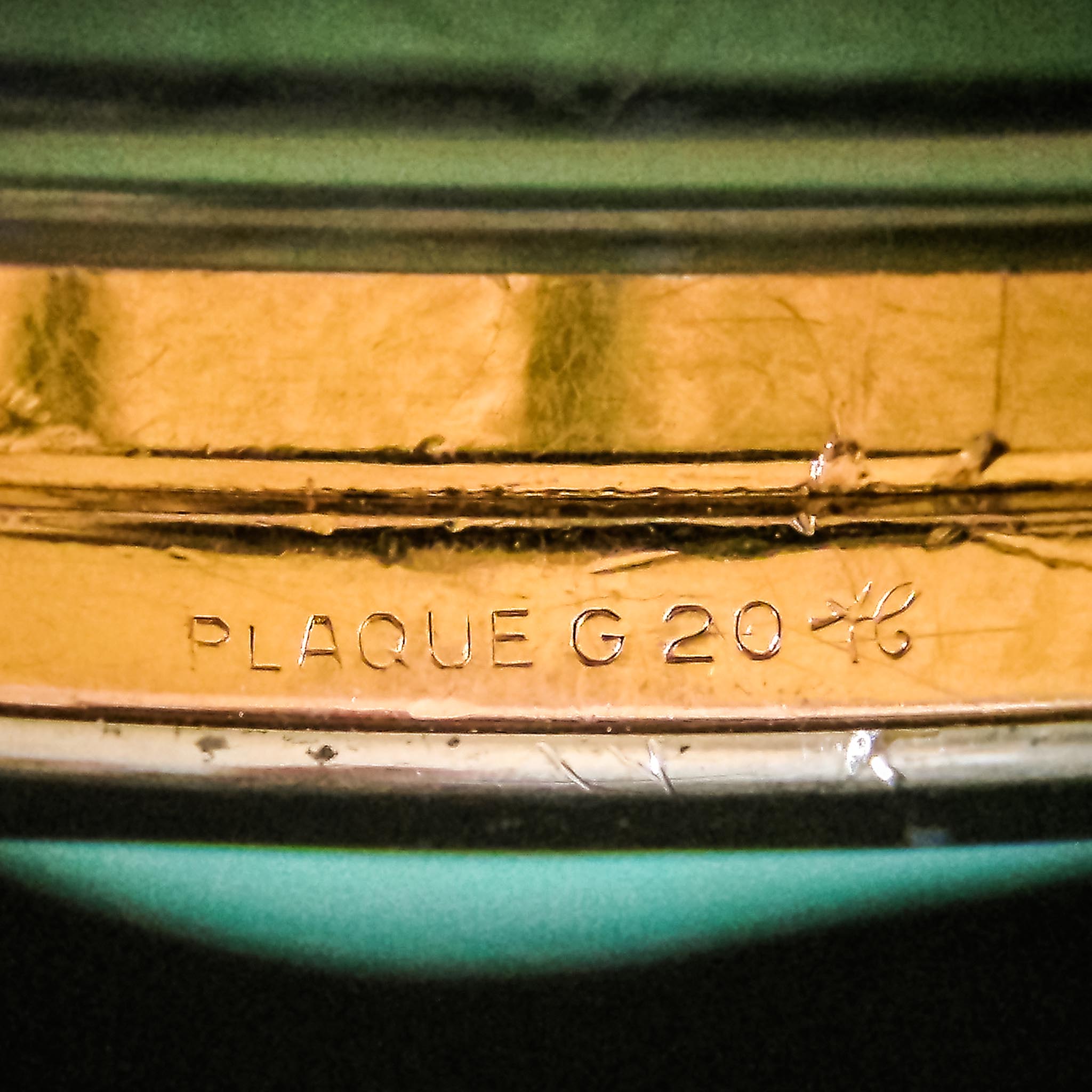
There is another marking worth spending time on: PLAQUÉ G 20, followed by a small, intertwined symbol. The lettering describes approximately 20 microns of gold plating rather than a solid-gold case. But that second stamp may be the more intriguing detail. Is it the mark of the case maker, a plating firm, or another business in the supply chain? I have not yet found a reliable identification. Its identity is now part of the hunt.
If you recognize the symbol beside the plating stamp, please get in touch. A name behind that mark might be one more way to trace this Breitling’s beginnings.
The plating has lived a life. Scratches and localized wear appear around the case, especially at edges and lugs. It would be easy to describe those details away under the word ‘patina,’ but the distinction between surface age and worn plating is part of an accurate condition report.
Paired with a brown textured leather strap, the watch remains understated. Its thinness is one of its pleasures: just 8.6 mm in the owner’s measurements, with a 35.8 mm diameter and 42.7 mm lug-to-lug span.
Inside: A Signed Seventeen-Jewel Movement

Removing the back reveals a traditional Swiss manual-wind movement with a visible balance assembly, gear train and mainspring barrel. Its bridge is signed Breitling, and another marking indicates 17 jewels. Those are observations supported by the photographs.

The exact movement caliber is still under investigation. A collectors’ forum once linked to a similarly described Olympic Airways watch advertised with a Landeron 523 movement, but a listing for another watch does not establish the caliber of this one. Assigning it without a readable movement code or further comparative technical evidence would turn an interesting possibility into an invented specification.
This watch currently runs, and time setting works. That is the extent of the confirmed functional record. We do not have a documented rate, amplitude, power reserve or complete overhaul. Running well after a gentle restoration is encouraging; it is not a replacement for a future full service assessment.
The Onassis Thread—and the Story Still Waiting to Be Told
The more I looked into the words on this dial, the more often one name appeared: Aristotle Onassis. His Olympic Airways began in 1957, remarkably close to the period suggested by this Breitling’s case serial. And here was a watch with the airline’s name on its face and Breitling’s name relegated to the back. Who would have arranged something like that? And for whom?
Then I found a 2015 conversation among Breitling collectors. Someone had posted an Olympic Airways-dialed Breitling that he said belonged to his grandfather. According to the family’s story, his grandfather received it from Onassis after being asked to help establish the airline in Greece in the late 1950s.
I didn’t arrive at the auction knowing that story. I found it afterward, in a conversation that had been waiting online for years. The watch in that discussion was another example, not mine—but the Greek lettering, the Breitling reference and the case details were unmistakably worth following. Suddenly, this little watch had a much bigger world around it.
In May 2026, another Olympic Airways-dialed Breitling reference 1351 was offered at auction by Loudos Auctions in Athens. The catalog documents the watch, but does not disclose its final hammer price. It is another rare public appearance rather than a usable confirmed sale-price comparison. The publicly documented examples are scattered, and the records behind them are thin. How many were commissioned? Were they given to executives, staff or people connected to the airline’s early years? Were they intended as gifts at all? Those are still open questions.
And there is one more clue, barely larger than a scratch. Beside PLAQUÉ G 20 on this case is a delicate, intertwined mark I have yet to identify. It may point to a case maker or a business responsible for the plating. If someone recognizes that symbol, perhaps we can trace the people who supplied the cases—and, just possibly, another piece of the Olympic Airways story.
I don’t know who first owned this particular watch. Between its early years and the anonymous online auction lot where I found it, there is a long blank space. Perhaps there is an extraordinary story there. Perhaps it is a quieter one. Either way, I would rather keep looking than pretend the questions have been answered.
So the hunt is still open. If you worked for Olympic Airways, know its early history, recognize the small case mark, have photographs or documents from the period, or have encountered another watch like this, please send me a message. Even a small clue could help us understand a watch that has already spent decades keeping its story to itself.
Restoration Without Erasing the Past

This was not a rescue from a seized movement or a deeply damaged dial. It was running when it arrived, and the biggest practical need was a better crystal. Cleaning and fitting the replacement brought a clear view of the lettering, the fine markers and that warm dial surface.
I did not repaint the dial or restore the hands into some imagined factory-fresh finish. The gold plating, including its scratches and wear, was left to tell the truth of the watch. No complete movement overhaul has been represented, and the present crystal and strap are both disclosed as replacements.
The surprise was how modest the restoration needed to be. The history was already there; the work simply made it easier to see.
What Originality Can—and Cannot—Tell Us
Caseback, movement and dial together present a coherent picture of a Breitling-built watch with an Olympic Airways face. The signed back gives a documented reference. The serial gives a production-era clue. The movement is signed, while the case side’s plating designation corresponds to a mid-century gold-plated dress watch.
What the metal cannot yet tell us is how this particular watch made its way from an Olympic Airways dial to an anonymous auction lot. The original recipient, the company’s order records and the reason for the unusual dial are still out there somewhere—if they have survived at all. And while the components look consistent with the period, their full history remains a question worth pursuing.
For collectors, that distinction should make the watch more fascinating, not less. The questions are part of what makes this small object worth documenting carefully.
Why It Still Matters
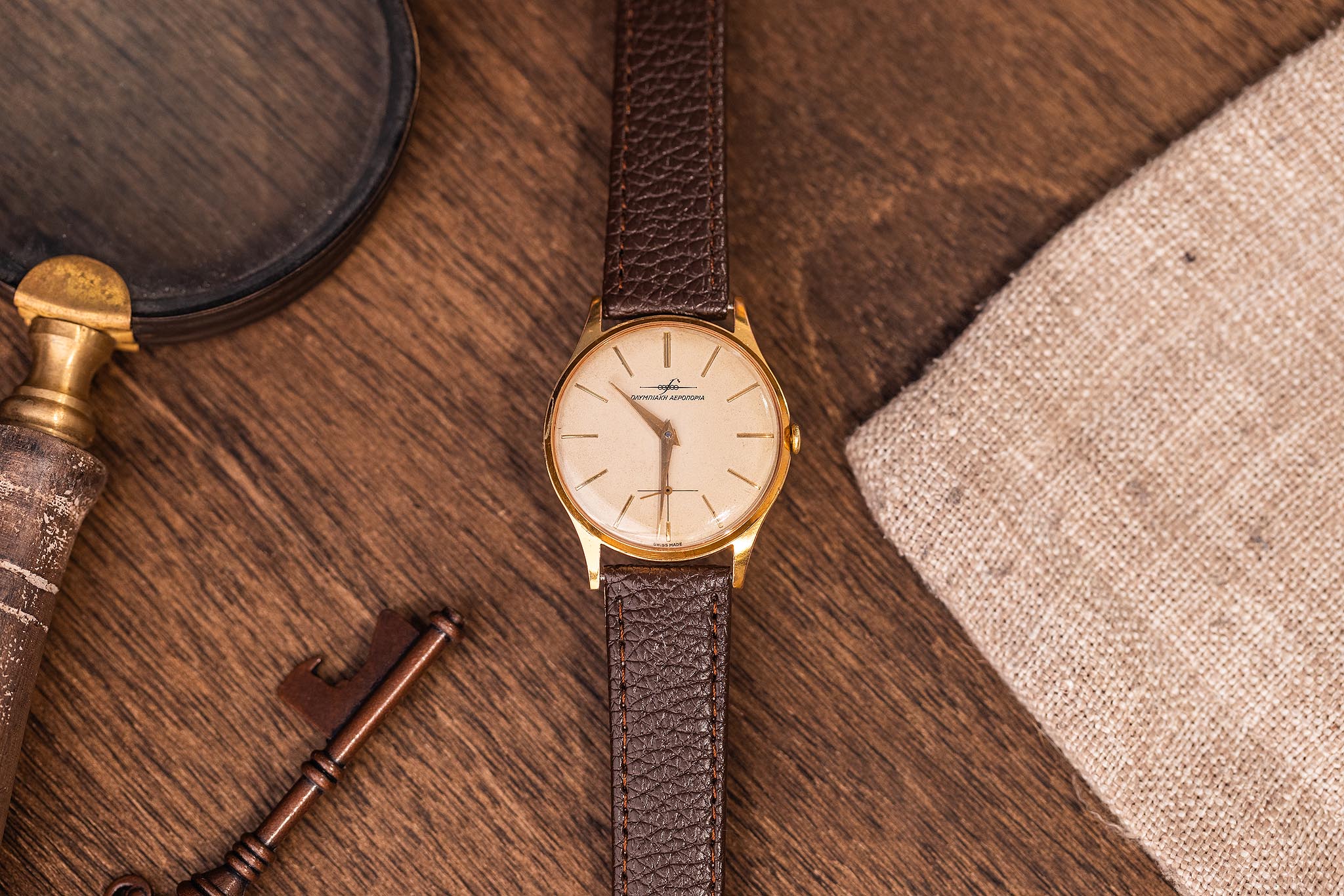
The part I keep coming back to is the auction photograph: a watch almost invisible to search because nobody thought to identify the language or look closely at the back. The case told us Breitling. The dial told us Olympic Airways. Research revealed a connection to a moment when Greece was presenting itself to a newly mobile world.
Was it ordered for an airline executive, presented to someone who helped build Olympic Airways, or made for a purpose no one has remembered to write down? Could the small mark beside the plating inscription lead us to the firm that made the case? I don’t know yet. But the idea that one photograph, an old letter or a reader’s memory might move the story forward is exactly why I wanted to share this watch.
From a mixed lot that barely mentioned it to a watch whose details are now carefully photographed and recorded, its second life has begun. And the hunt isn’t finished. If you know anything about these Olympic Airways Breitlings—or that mysterious mark on the case—please write to me. I would love for the next chapter to come from someone reading this.
Primary research and period material
- BreitlingSource, 2015 Olympic Airways collectors’ discussion — records a collector’s family account involving Onassis and another Olympic Airways Breitling.
- Loudos Auctions, 2026 Olympic Airways ref. 1351 listing — another example offered at public auction; the listing does not reveal a final hammer price.
- Imagining Greece, 1957 Olympic Airways print advertisement — original airline-era material, not a watch advertisement. Artwork remains with its rights holders and is linked rather than reproduced.
- DC Vintage Watches, original 1957 Breitling advertisement — period Breitling advertising for different watch models, not ref. 1351.
- Breitling historical archive — general 1950s aviation-watch context.
- Third-party Breitling serial reference — indicative case dating, not an official extract.
Explore this watch in The Found Dial store · More stories in the Reference Room · Browse the collection



0 Comments