
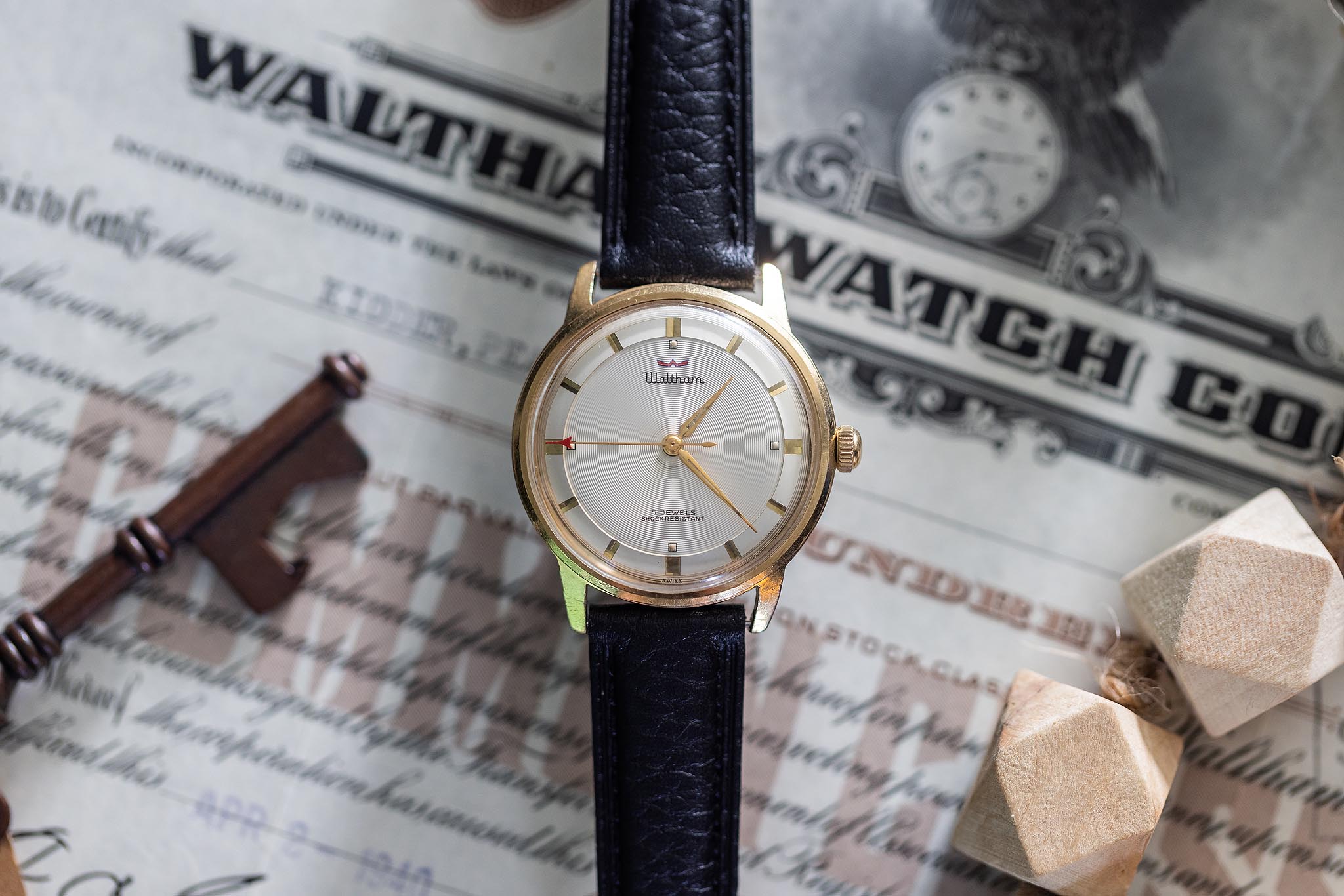
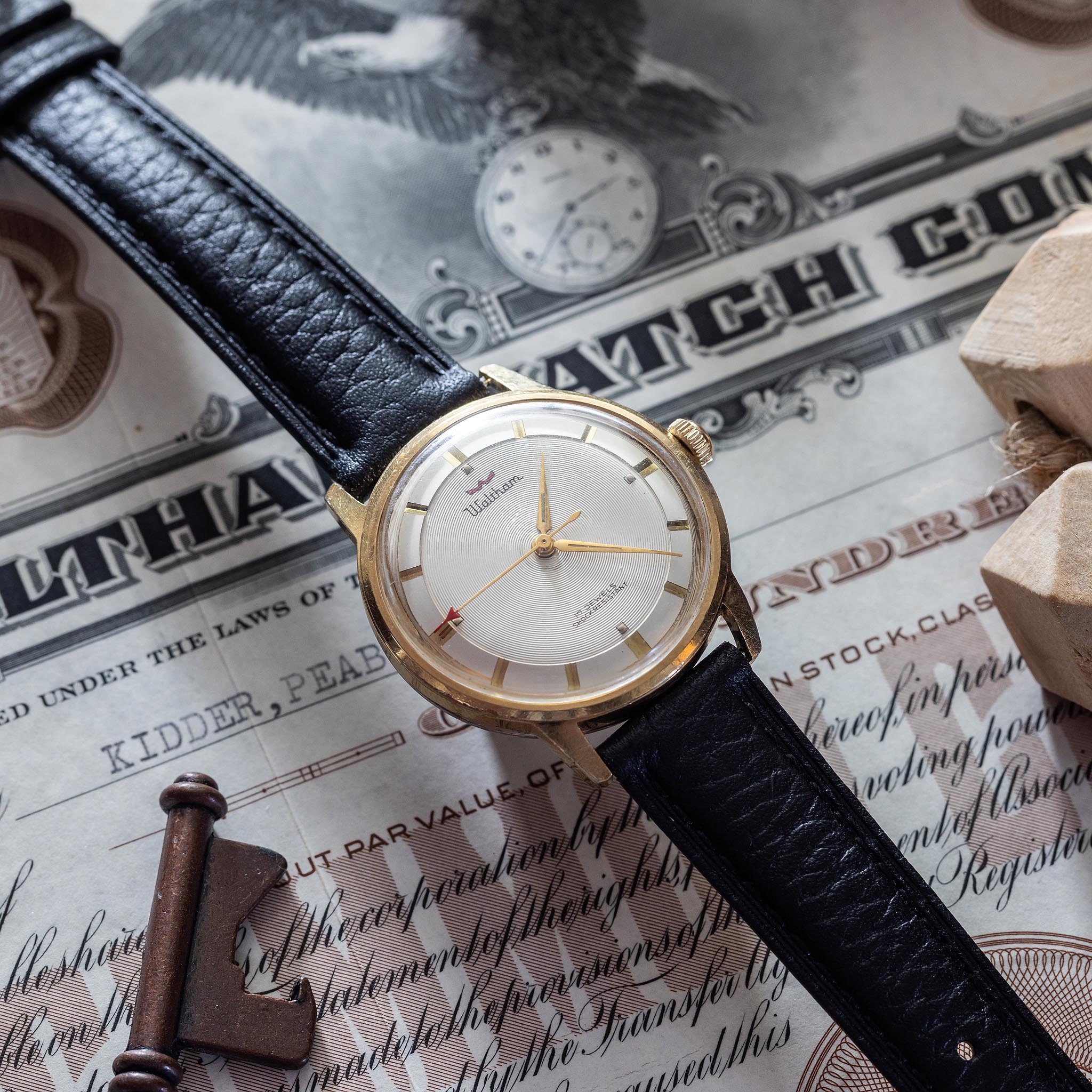
The watch and the stock certificate never belonged together.
That is what makes the photograph work.
I found the watch at the Franklin, Tennessee flea market, sitting in a glass case at a booth filled with the kind of vintage objects that make you slow down even when you are not looking for anything specific. There were very few watches. This one was tucked in among smaller pieces, its crystal badly scratched and carrying a strange tint that made it difficult to tell what was underneath.
At a completely different flea market, on a completely different day, I found an old Waltham stock certificate.
Neither object has any known provenance to the other. The certificate did not come with the watch. The watch did not come from a Waltham employee or shareholder. They simply found their way to me separately.
Put together, though, they tell a much larger story than either object can tell alone.
The Hunt
The booth had a little of everything: larger antiques, small objects, odds and ends that had survived long enough to become interesting simply because they were still there. I also bought the old silver lighter from the same seller—the one that later began appearing in some of The Found Dial flat lays.
The Waltham was sitting in a case with other small items.
What caught me immediately was not the Waltham name.
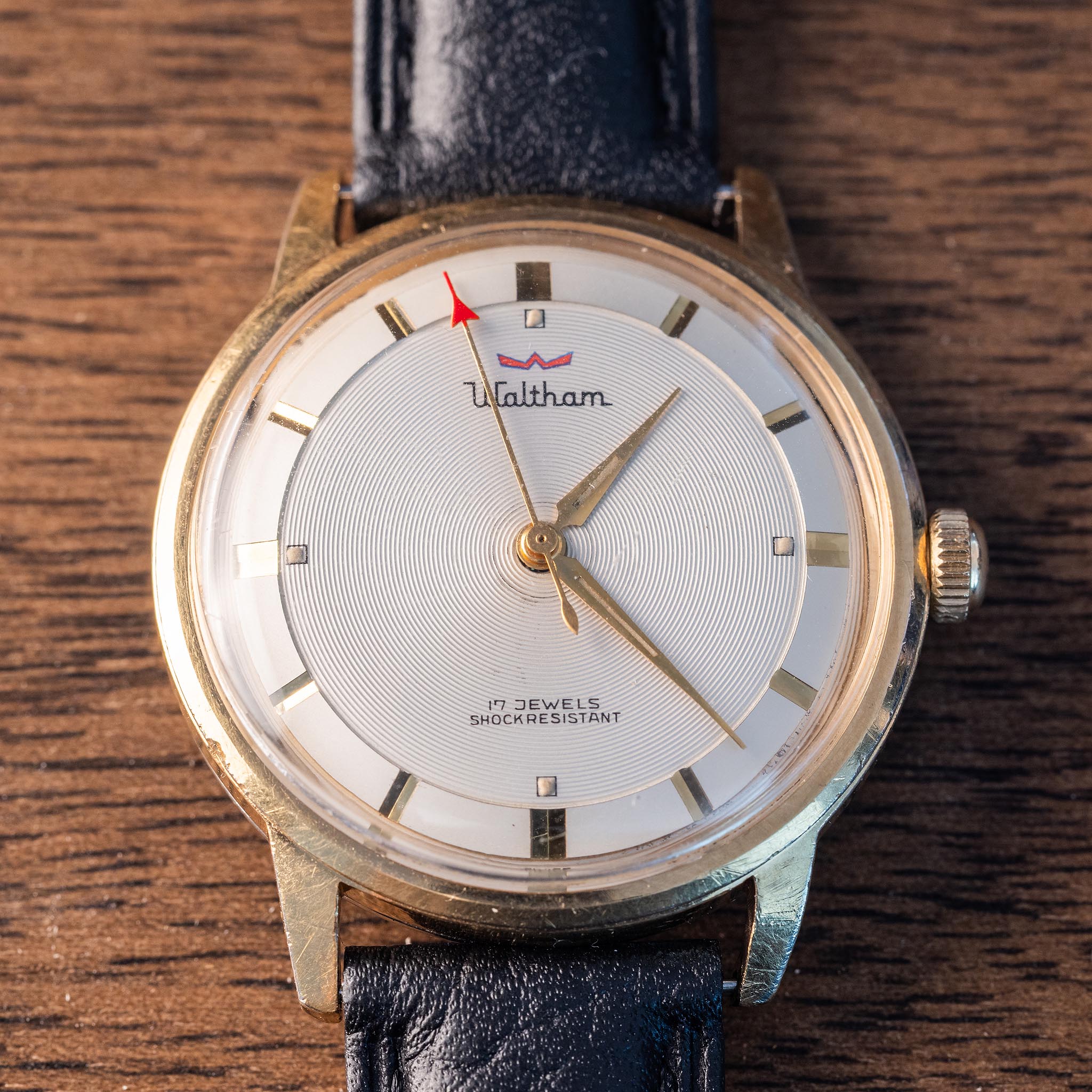
It was the seconds hand.
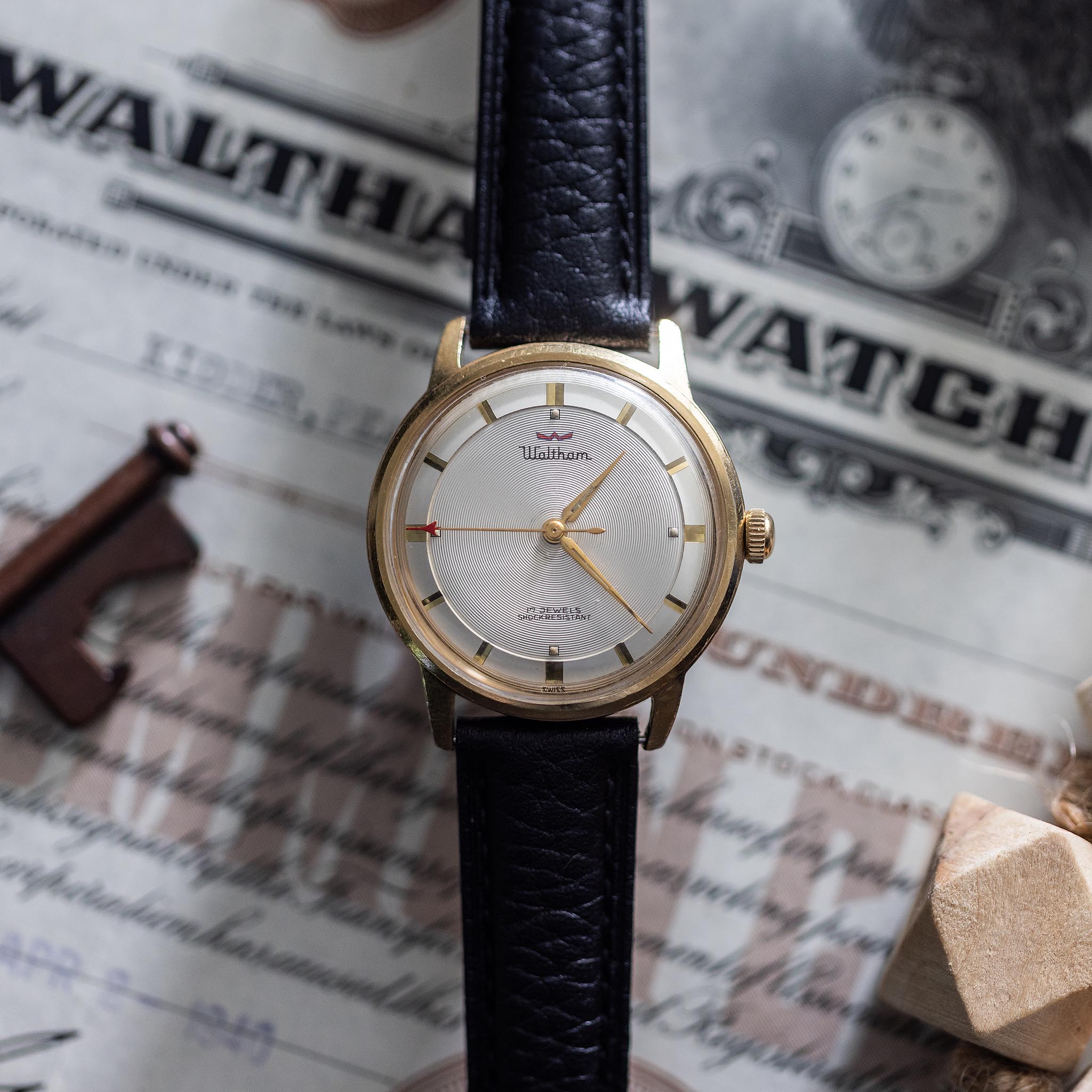
A thin central hand ends in a bright red spear or arrow-shaped tip. On a watch that is otherwise almost entirely silver and gold, that tiny piece of color changes the whole face. I had not seen many vintage watches using that detail, and it was enough to make me take a closer look.
The price made the decision easy. It was a genuine flea-market bargain—the kind where there is enough room for the watch to be interesting even if the story turns out to be less glamorous than you hoped.
The bigger uncertainty was condition.
The watch ran at the booth, but “it runs” means something very different on a vendor’s table than it does after a full day on the wrist. And the crystal was bad enough that I could not properly judge the dial beneath it.
So I bought the watch mostly on three things: the Waltham name, the red seconds hand, and the possibility that there was a much better dial hiding underneath that damaged acrylic.
At a Glance
| Watch | Waltham 17-Jewel Shock Resistant Swiss Manual-Wind |
|---|---|
| Approx. production | Circa 1960s |
| Factory reference | Not confirmed |
| Movement | Signed Swiss manual-wind mechanical movement |
| Caliber | Not confirmed |
| Jewels | 17 |
| Functions | Hours, minutes, central seconds |
| Case | Gold-tone laminated/plated top with stainless-steel back |
| Case diameter | 33.5 mm measured |
| Lug-to-lug | 38.2 mm measured |
| Thickness | 9.8 mm measured |
| Lug width | 17 mm measured |
| Crystal | Domed acrylic; original crystal restored by sanding and polishing |
| Dial | Silver concentric-texture dial with applied gold-tone markers, red Waltham emblem and red spear-tipped seconds hand |
| Caseback | Marked ANTIMAGNETIC / SHOCKPROTECTED / WATERPROOF / 17 JEWELS / PLAQUE D’OR / LAMINATED GOLD / ST. STEEL BACK |
| Current rate | Approximately -95 sec/day at latest check |
| Operation | Winding and time-setting function normally; watch is running well |
| Water resistance | Not pressure tested; historical WATERPROOF marking should not be treated as modern water resistance |
| Available from The Found Dial | View this Waltham in the store |
The World Behind the Name
For an American watch collector, Waltham is almost impossible to separate from the idea of American industrial watchmaking.
The company that became Waltham Watch Company began manufacturing in Waltham, Massachusetts in the 1850s and helped transform watchmaking from a largely hand-fitted craft into a system of precision industrial production. The factory developed machinery capable of producing interchangeable watch parts at scale—one of the important steps toward making accurate watches more affordable and more widely available.
That is the Waltham most collectors think of first: American pocket watches, railroad watches, huge factory output, and the idea that a complete precision timepiece could be produced under one industrial roof.
But that is not exactly the Waltham represented by this watch.
By the middle of the twentieth century, the economics of American watchmaking had changed dramatically. Waltham struggled after World War II, entered bankruptcy in 1949, and progressively shifted away from producing all of its own consumer watch movements in Massachusetts. By 1952, the reorganized company had announced that it would begin importing complete Swiss movements because producing equivalent movements domestically had become more expensive.
In 1956, according to later federal court findings, the Massachusetts company ceased manufacturing watches at Waltham and began purchasing movements from Switzerland and cases from Switzerland and the United States for assembly.
The name continued even as the manufacturing system behind it changed.
When an American Name Became a Swiss Watch
That transition is what makes this otherwise modest watch historically useful.
The movement inside is signed Waltham and marked Swiss. It is a 17-jewel manual-wind movement, not an American Waltham movement from the nineteenth- or early-twentieth-century factory system.
After the old manufacturing structure unraveled, the Waltham name moved into a different business model. By 1958, Hallmark Watch Company had an agreement to assemble watches from imported components under the Waltham name. The name itself was sold in 1959, and the successor operation moved its center of gravity away from Massachusetts.
Then, in 1962, Waltham opened a movement factory in Neuchâtel, Switzerland, reportedly designed for production on a very large scale.
That is the world this watch belongs to.
It is not “American made” in the simple sense that an 1890s Waltham pocket watch is American made. The dial carries an American industrial name, while the movement reflects the Swiss production network Waltham increasingly relied upon in the postwar era.
That does not make the watch less interesting. It makes it evidence of what happened next.
The Red Arrow

The seconds hand is still the first thing I would point out if I handed the watch to somebody else.
The rest of the dial is disciplined. Applied gold-tone baton markers ring a silver surface. Larger square markers sit at three, six and nine. Gold-tone dauphine-style hands carry the hours and minutes. The Waltham name is black. The small emblem above it is red.
Then the seconds hand repeats that red accent with an arrow-shaped tip.
It is a small design decision, but vintage watches often live or die by details exactly that size.
The Dial Hidden Under the Crystal
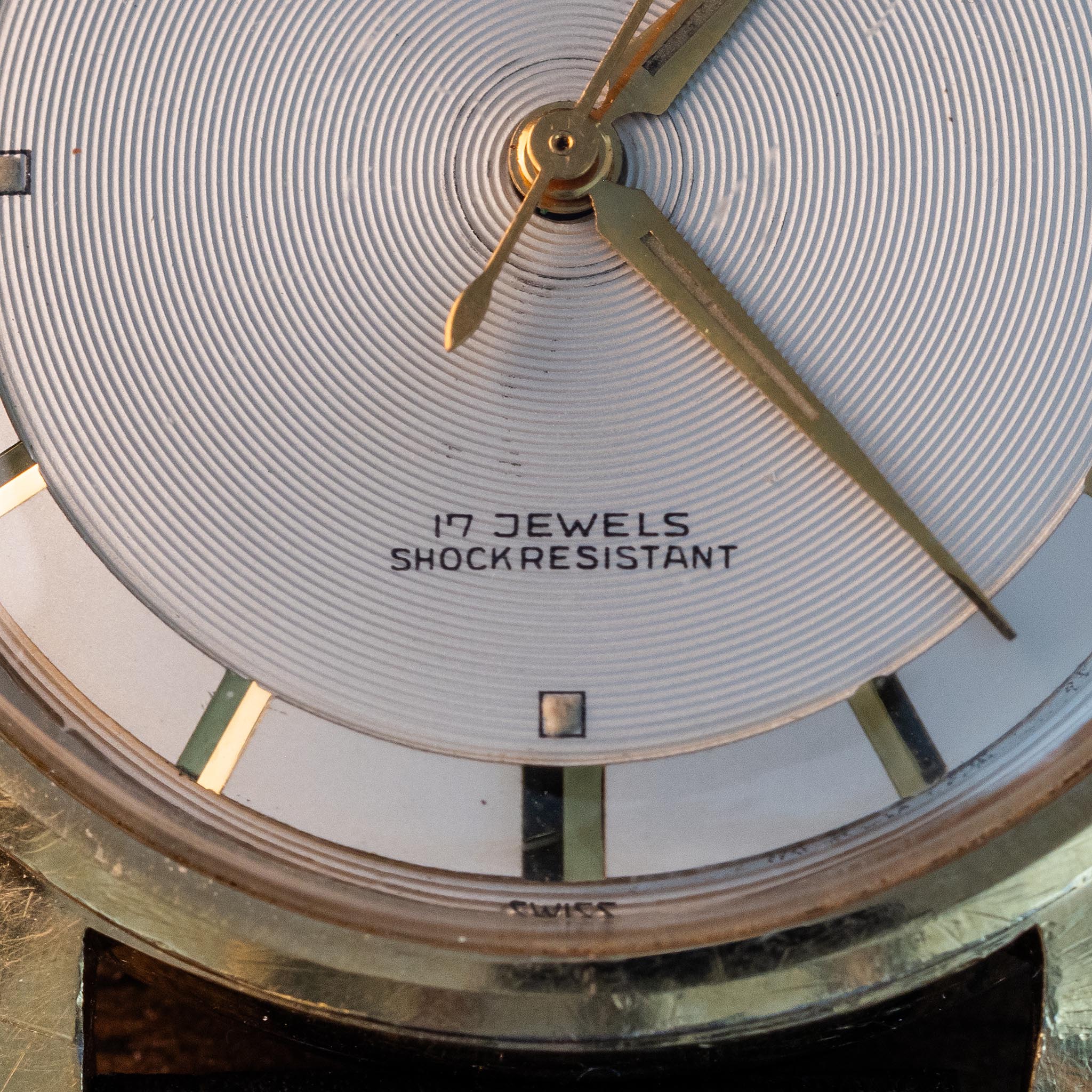
The flea-market crystal was the biggest visual problem.
It was scratched heavily enough—and had enough discoloration or haze—that I could not really judge the dial while standing at the booth. Once I got the watch home and began working through the acrylic, the situation changed.
I had initially remembered this as a crystal replacement. Looking back at the work, that was wrong.
This is the original crystal I restored.
It took repeated sanding and polishing to bring it back. Acrylic is forgiving that way: damage that can make a vintage watch look almost hopeless may still be sitting entirely in material that can be carefully leveled and polished rather than discarded.
When the haze and scratches came out, the dial underneath was much better than expected.
The surface is not flat. Under macro light it resolves into tight concentric circular machining across the silver field. That texture changes with the angle of the light and gives the watch considerably more visual depth than the flea-market version suggested.
The Caseback Is a Mid-Century Sales Pitch

Turn the watch over and the restraint disappears.
The back is crowded with claims:
ANTIMAGNETIC. SHOCKPROTECTED. WATERPROOF. 17 JEWELS. PLAQUE D’OR. LAMINATED GOLD. ST. STEEL BACK.
It reads almost like a condensed advertisement.
Those words are useful because they tell us how a mid-century watch was being sold. Magnetism, shock damage, mainspring failure and water intrusion were practical anxieties for mechanical-watch owners. Case manufacturers and watch brands answered by putting the solutions directly on the product.
The language also needs modern context. “Waterproof” was common period terminology. It is not a promise that this sixty-year-old watch should go anywhere near water today. This example has not been pressure tested.
Inside: My First Waltham Movement
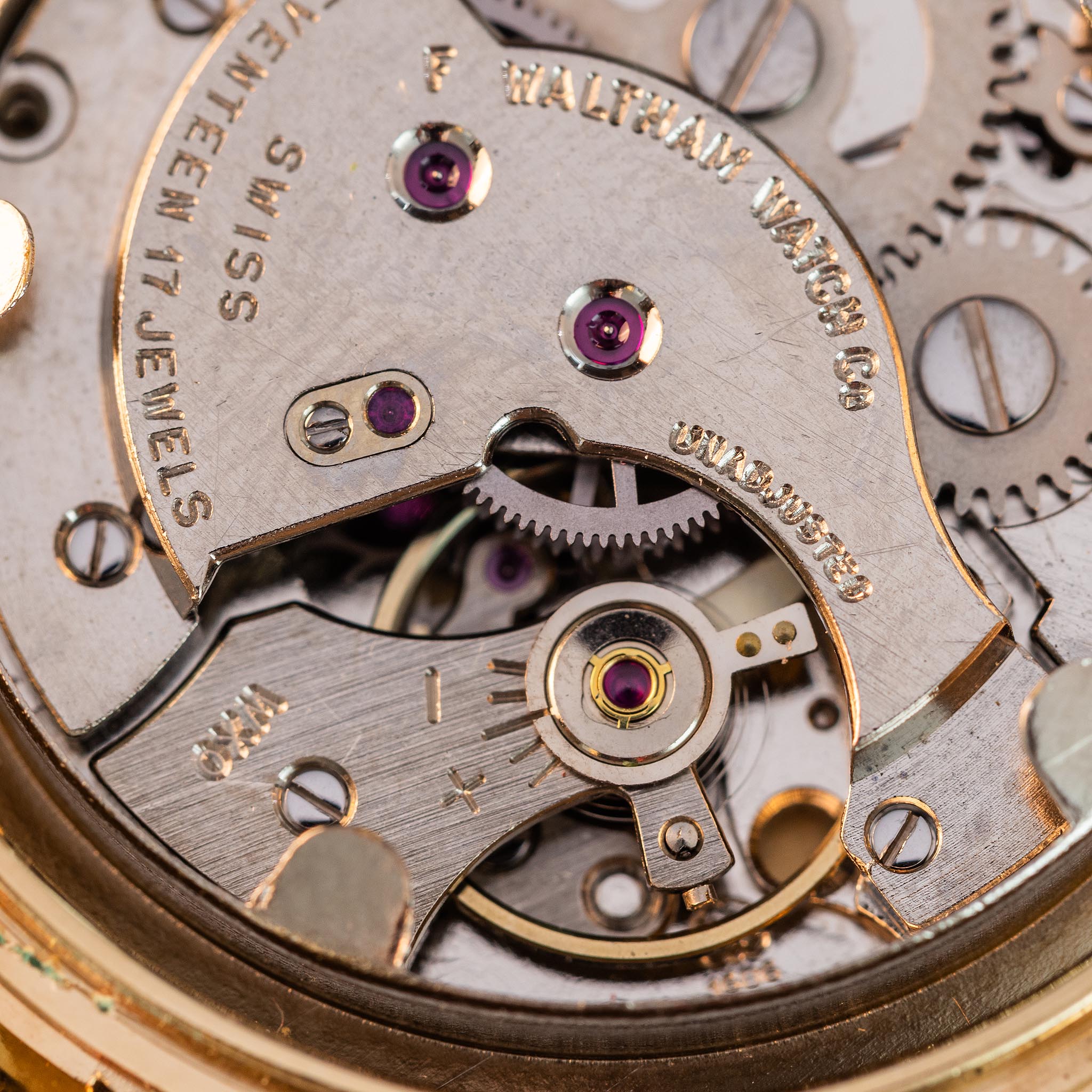
I already knew the Waltham name was solid when I bought the watch.
What I had never done was open one.
This was my first time seeing a Waltham-branded movement in person, which made the “SWISS” marking more interesting rather than less. It forced me to separate the history of the Waltham name from the history of the individual movement in front of me.
The movement is signed A. Waltham Watch Co., marked Swiss and identifies itself as a 17-jewel movement. It is a conventional manual-wind layout and appears complete in the photographs.
What it does not give us—at least not from the markings currently documented—is a confidently identified caliber.
That matters.
There are multiple Swiss movements used in Waltham-branded watches from this broad period, and similar watches appear with different movement families. Without a defensible caliber marking or reference, assigning one because another Waltham happens to look similar would turn research into guessing.
So the caliber remains unknown.
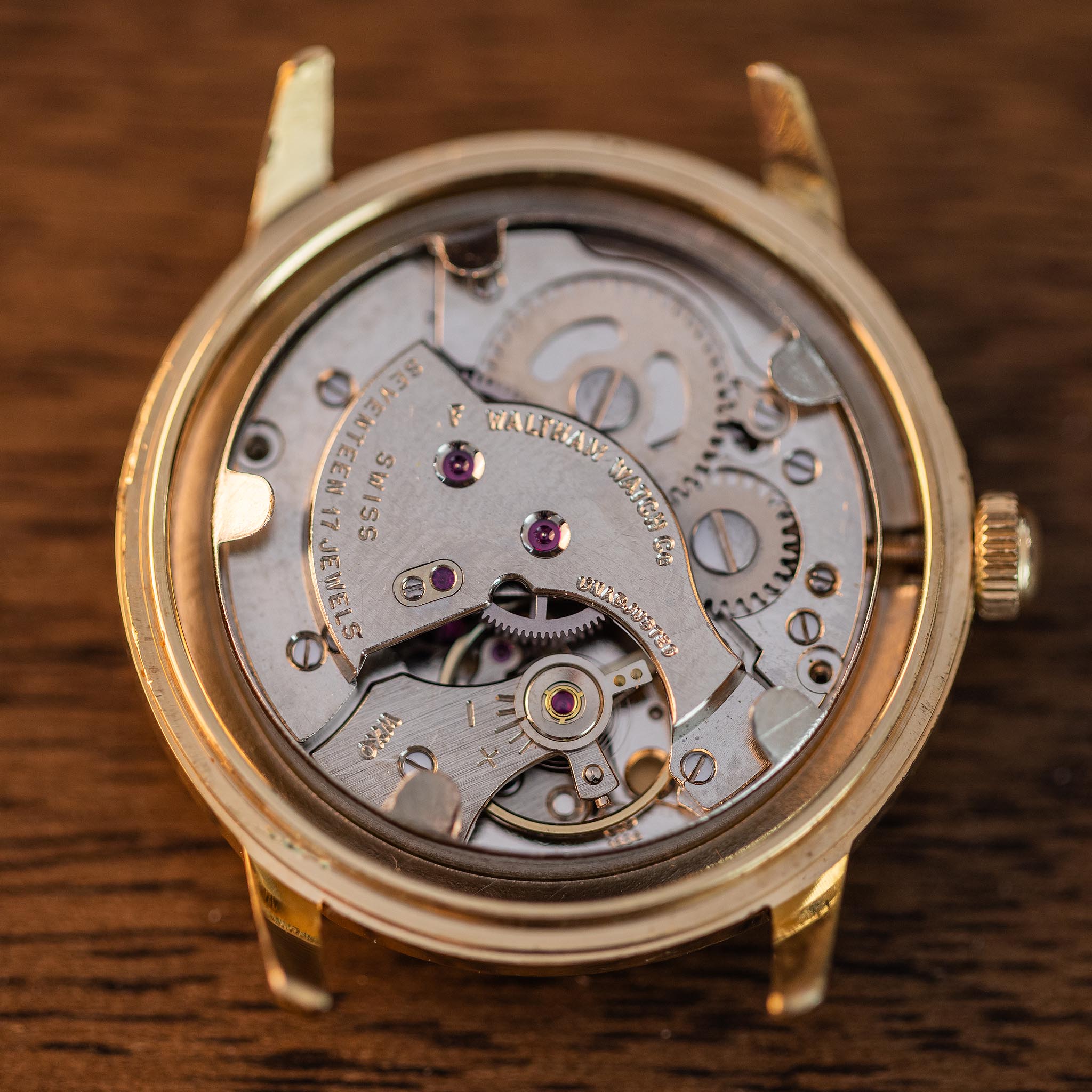
Mechanically, the watch works properly. It winds. It sets. It runs reliably in normal operation. The latest timegrapher check showed approximately -95 seconds per day, so it should not be represented as freshly regulated or chronometer-like. That reading is simply a snapshot of how this old manual movement was behaving at the time of testing.
What Original Looks Like—and What We Cannot Prove
This watch is easier to describe honestly than it is to force into a catalog identity.
Confirmed: the Waltham-signed Swiss 17-jewel movement, manual-wind operation, silver concentric dial, red emblem, red spear-tipped central seconds hand, laminated/plated gold-tone case construction and marked stainless-steel back.
Believed original: the unsigned gold-tone crown. Its shape and wear are consistent with the rest of the watch, but there is no factory documentation tying that specific crown to the watch.
Restored rather than replaced: the domed acrylic crystal. It was sanded and polished extensively while preserving the original part.
Still unresolved: the exact factory model or reference, the exact movement caliber and the complete service history before the watch reached me.
That unresolved reference is not a problem to solve with confidence theater. It is simply where the evidence stops.
Restoration Without Erasing the Past

This one did not need surgery.
The movement was running. Winding and setting worked. There was no complicated parts hunt and no attempt to turn a worn flea-market watch into something artificially pristine.
The job was the crystal.
That meant sanding through the damaged surface, stepping the abrasive work finer, and then polishing the acrylic back to clarity. It was a lot more work than dropping in a replacement crystal would have been, but the original part was still salvageable.
Once finished, the watch looked radically different—not because anything important had been changed, but because the thing obscuring the dial had been removed.
Minor lubrication was performed. The dial and hands were left alone. The case was not machine polished.
Sometimes preservation is not about doing less work. It is about putting the work into saving the part that is already there.
Waltham Was Still Selling “America”
Period advertising makes this era more interesting.
A 1960 Waltham advertisement celebrated the company’s centennial under the line “Timing America for Over 100 Years.” It presented a broad lineup of wristwatches while advertising features such as Incabloc shock protection, unbreakable mainsprings, waterproof cases and jewel counts.
The ad does not show this exact watch, and it should not be used as proof of this particular reference.
What it does show is the brand position surrounding watches like this one: Waltham was still selling the weight of a deeply American name while its products were increasingly tied to Swiss movements, Swiss technology and eventually Swiss manufacturing.
That contrast was not merely collector hindsight. Federal regulators eventually scrutinized Waltham’s country-of-origin advertising, and a 1964 federal appellate decision records that the company had to deal explicitly with how the Waltham name was used on watches containing foreign-made components.
So when “Swiss” appears on the movement inside this watch, it is not a footnote.
It is part of the central story of Waltham after American mass-production supremacy ended.
The Certificate

The old stock certificate in these photographs came from another flea market entirely.
I did not buy it for this watch. I did not know this watch would exist when I found it. But when the two objects eventually ended up in the same room, putting them together felt obvious.
A stock certificate is ownership reduced to paper. It represents a corporation as a legal and financial thing—shares, signatures, transfer language, seals and obligations.
The watch represents the same name as a physical consumer object.
One came out of the corporate history of Waltham. The other came out of Waltham’s later Swiss manufacturing chapter.
Neither proves anything about the other. Together, they make the history easier to see.
Why It Still Matters
This is not one of the Waltham watches that built the company’s nineteenth-century reputation.
That is exactly why I think it belongs in the Reference Room.
Brand histories are usually told through their peaks: the pioneering factory, the important railroad grades, the precision records, the famous owners.
But companies also have afterlives.
This watch carries the Waltham name after the original American manufacturing model had already begun to unravel. It shows what happens when a famous national brand survives longer than the industrial system that created it.
And because it came from a flea market rather than a curated vintage dealer, none of that history was attached to it when I bought it.
It was just a small gold-tone watch with a terrible crystal and a red arrow seconds hand.
What to Look For When Buying a Swiss Waltham
Read the movement. Do not assume that every watch bearing the Waltham name contains an American-made Waltham movement. Later watches may use Swiss movements, and the country-of-origin marking matters.
Do not force a reference. Many mid-century Waltham wristwatches are poorly documented online. If the case or movement does not supply a reliable reference, describe what is visible instead of borrowing a model number from a similar-looking watch.
Look closely at the dial. These watches can have surprisingly interesting textures, applied furniture and color accents that disappear in poor auction or flea-market photographs.
Check plated and laminated surfaces. Gold-tone cases often show edge wear around the lugs, crown and case sides. That is different from damage to a solid-gold case and should be described accurately.
Inspect the acrylic before replacing it. Deep scratches can look catastrophic while still being repairable. If the original crystal can be safely restored, preservation may be preferable to replacement.
Treat WATERPROOF as historical language. Unless a vintage watch has been properly serviced and pressure tested, keep it away from water regardless of what the caseback says.
Expect mechanical service needs. Running is not the same thing as serviced. This example operates correctly but was measuring roughly -95 seconds per day at its latest check.
The New Life
The best part of this watch is that almost none of this was obvious at the flea market.
I saw the red arrow. I knew Waltham was a name worth stopping for. The price was good enough that the risk made sense.
Then the crystal came back.
The dial underneath was much better than expected. The movement ran properly. Opening the watch gave me my first real look at a Waltham movement—and immediately sent the story somewhere I had not expected when I bought it, because that movement was Swiss.
Later, the old Waltham stock certificate I had found somewhere else ended up underneath it in a photograph.
One discarded object from one flea market. Another discarded object from another.
A company that once helped industrialize American watchmaking. A later Swiss-made watch carrying the same name after that American manufacturing era had changed almost beyond recognition.
That is more interesting to me than pretending this is a rarer or more important watch than it is.
It was simply worth noticing.
Research Notes & Sources
This article distinguishes between the physical evidence on this watch and broader company history. Useful external research included:
- Waltham Watch Factory — History, for the Massachusetts factory and Waltham’s role in interchangeable-part watch production.
- Waltham Precision Instrument Co. v. FTC, 327 F.2d 427 (1964), for documented postwar movement sourcing, company reorganization and country-of-origin context.
- Buying On Time — Vintage Waltham Advertisements, including a 1960 centennial-era Waltham advertisement used only as family/era context, not as evidence for this exact watch.
- Federal Register, November 2, 1962, documenting FTC action regarding jewel-count and foreign-origin representation.
Period-art search note: period Waltham advertising from the late 1950s and 1960s survives in useful quantity, including material emphasizing shock resistance, waterproofing, jewel counts and Waltham’s American heritage. No advertisement for this exact dial/case configuration was verified, so period material is used only to establish brand and era context.



0 Comments