
The photos were terrible. Not the charming sort of terrible where you can still make out what you are buying. These were almost impressively unhelpful: a bright gold blur on a watch stand, another view of a black tray scattered with jewelry, and so little detail that even identifying the watch felt like a wager.
The listing came from an abandoned safe-deposit box auction. I had never bought anything from one before. The bidding was real, the payment would have to be made by wire transfer, and if the watch turned out to be something entirely different from what I hoped, there would be no magical detail hidden in the photographs to save me.
Then, almost three weeks later, a box arrived. I finally saw the word Constellation. And suddenly, the gamble had a different ending.
What followed was a discovery that connected an extremely questionable auction decision to one of Omega’s most storied achievements in precision watchmaking—and to a small, original Omega symbol hidden in a scratched crystal.

The Hunt: A Watch Hidden in Two Terrible Photographs
I was browsing auctions, moving from one unfamiliar lot to another, when I found a group of jewelry from an abandoned safe-deposit box. Among the rings and the other gold-colored pieces stood one wristwatch. Not photographed separately with useful details. Not opened. No view of a caliber, a serial number, a hallmark or even a properly legible dial. Just a watch, apparently gold-colored, standing slightly out of focus among objects people were already bidding on.
I remember thinking the photography was almost conspiracy-level bad. You could not have designed a better way to hide a potentially interesting watch. At the same time, the bidders looking for gold had already taken an interest in the lot. That told me somebody saw potential value—but it did not tell me whether the watch itself was worth anything.
Here are the two photos I used to make that decision. They are not the crisp restoration photographs that came afterward. They are the auction images: the whole available visual case for taking a risk.

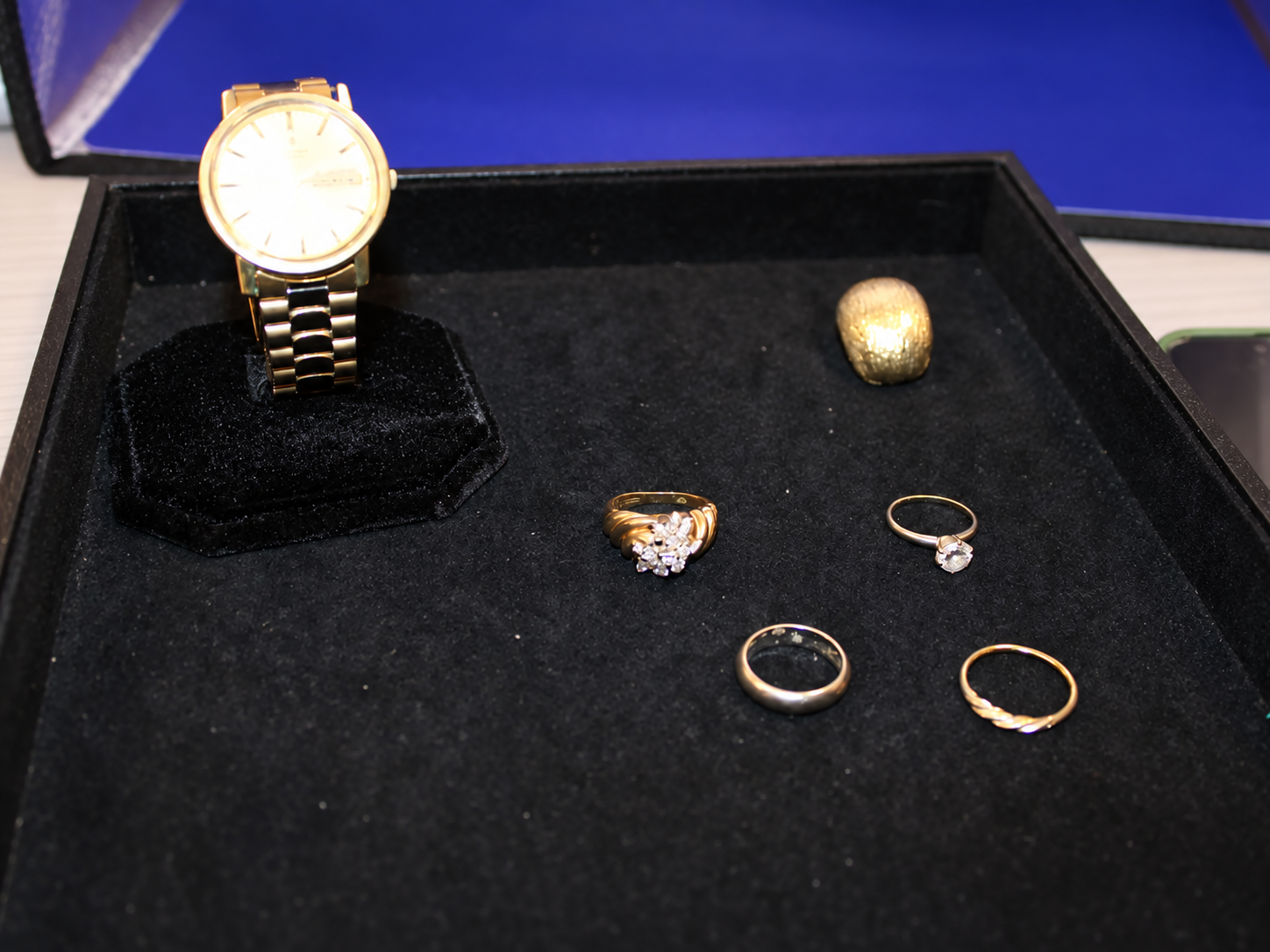
There were more reasons to walk away than to bid. It was one of the more expensive watch gambles I had taken. There was no reliable identification, and the required wire transfer added another layer of discomfort. I had to decide whether a vague outline and an instinct were enough.
For me, sometimes they are. I like hunting for watches precisely because the interesting ones do not always arrive with perfect provenance and a dealer’s certification. That does not make it a sensible strategy for everybody. In this case, it meant accepting the possibility that I might have bought myself a costly lesson.
The package took nearly three weeks to arrive. By then I was less excited about the potential score than relieved when I could finally open the box and inspect what I had paid for. Only once it was in hand could I see the Omega name, then the Constellation script, then the details that would make the watch worth restoring. Under the caseback was a genuine Omega automatic chronometer movement. The poor photography had hidden a piece of real watchmaking history.
At a Glance
| Maker / Collection | Omega Constellation Day-Date, automatic chronometer |
| Approximate year | Circa 1968, based on the movement serial |
| Movement | Omega caliber 751, 24 jewels, automatic |
| Movement serial | 27,652,386 |
| Probable case reference | CD 168.016; caseback reference not clearly legible in available photo |
| Functions | Hours, minutes, center seconds, day and date |
| Case | Gold-capped over stainless steel; stainless-steel screwback |
| Case size | 35 mm diameter; 40 mm lug-to-lug; 11.7 mm thickness |
| Lug spacing | Approximately 19 mm based on related references; physical confirmation outstanding |
| Dial | Warm silver/champagne sunburst with applied gold and black-inlaid markers |
| Crystal | Original Omega-signed acrylic/Hesalite with calendar magnifier, restored rather than replaced |
| Caseback | Observatory medallion and eight stars; Omega-signed inner caseback |
| Mechanical condition | Running and setting; day/date functions reported operational; noted rate approximately −26 seconds/day |
| Restoration | Cleaned, lightly lubricated as needed; original Omega crystal restored; no parts replaced |
| Included | Watch on aftermarket brown leather strap; no original box or papers documented |
| Source of this watch | Abandoned safe-deposit-box jewelry auction; identified after delivery |
View this watch: 1968 Omega Constellation Day-Date, caliber 751 — The Found Dial product page.
Why It’s Called the Constellation
The name Constellation sounds romantic, as though someone simply wanted a watch to belong among the stars. The real inspiration was more technical, and arguably more interesting.
In the middle of the twentieth century, precision watchmaking was a competitive science. Watchmakers submitted movements to observatory trials where their accuracy could be examined under controlled conditions. These were not ordinary wristwatches being compared over coffee; the trials tested the limits of how reliably a balance, escapement and carefully adjusted mechanism could keep time. Results mattered to manufacturers that wanted to demonstrate more than an attractive dial.
Omega had been collecting awards and setting precision records long before its Constellation appeared. The 1948 Centenary automatic chronometer helped establish the formula for a watch that combined everyday practicality with a demanding standard of timekeeping. Then, in 1952, Omega introduced the Constellation as a series-produced chronometer collection.
The eight stars were not decoration chosen at random. They commemorated eight landmark observatory precision achievements in the company’s history. That is where the collection’s name came from: a constellation formed around measurable accomplishments. Every time an owner turned the watch over, the emblem reinforced the promise printed on the front—Automatic Chronometer Officially Certified.
Omega’s own account of the observatory design adds a lovely detail: although the dome is often described as Geneva Observatory, the engraving is probably a more general representation of an astronomical observatory. Its meaning is unmistakable even without assigning every stone of the building a precise address. The watchmaker put the idea of precision in miniature on the caseback.

The Observatory: A Trophy You Wear Against Your Wrist
On the outside, a gold-toned medallion interrupts the broad steel back. Its observatory cupola and ring of stars are worn, but they remain instantly recognizable. The rest of the caseback bears the familiar marks of decades of handling. It is not a perfectly preserved display piece. It is a survivor.
A medallion is an odd feature for a watch if its only purpose is to look expensive. It spends almost all of its life against the wrist. On the Constellation, that hidden position makes sense. It is less an outward boast than a signature: the wearer might forget it is there, but the manufacturer’s precision heritage is literally carried with the watch.
The stars are also why I particularly wanted to understand what I had found. At the auction, I could barely make out the face. Once the back came off, I could see how much history Omega had chosen to put into the watch’s most unassuming surface.
From the Early Constellations to a Practical Day-Date
Early Constellations became famous for their elegant dial designs, including the sharply faceted forms collectors call pie pans, along with applied stars and richly finished cases. By the later 1960s, tastes were shifting toward cleaner, straighter lines. This example follows that direction: a round gold-capped case with relatively straightforward lugs, a smooth bezel, an open sunburst dial and the useful addition of both weekday and date at three.
Omega had not abandoned its chronometer ambitions to make the watch more practical. It developed automatic movements that could carry calendar complications while continuing to meet chronometer standards. The caliber 751 belongs to that story.
The reference most consistent with this watch is CD 168.016. Period examples of that reference share the gold-capped case, 35 mm diameter, caliber 751 and day-date layout. But the interior-back photographs do not resolve its stamped reference number clearly enough to close the identification absolutely. The family and caliber are established; the precise case reference remains an excellent working identification awaiting a better reading.
There were also contemporary Constellations in different case shapes, dial treatments and metals. Some wore the sweeping C-shaped cases collectors immediately associate with the late 1960s; this one has a more conventional, straighter profile. It is worth identifying the actual case rather than borrowing details from a famous neighboring reference.

The Dial That the Auction Could Not Show
A watch can be almost invisible in an auction listing and full of character when held six inches from your face. The Constellation’s dial is one of the strongest examples of that change. The champagne-tinted silver surface catches light with a subtle sunburst finish. Slim gold indices with black inserts make the hour markers distinct without turning the face into something busy.
The applied Omega symbol sits above the brand name, while a small Constellation star marks the lower dial. At three o’clock, the day and date appear through a single framed aperture, enlarged by the magnifier in the original acrylic crystal. The hour and minute hands echo the gold-and-black combination used on the markers.
Look closely at the photographs and there are visible age marks across the dial and around its details. Time has had its say here. Those imperfections matter when describing the watch, but they also prove something simpler: this is the actual dial that arrived from the auction, not a spotless replacement face brought in to create an illusion of newness.

The Crystal That Deserved Another Chance
My favorite restoration decision concerned a component many people would have replaced without thinking twice. The acrylic crystal had scratches and imperfections accumulated through years of wear. It would have been easy to remove it, fit a clear replacement and move on.
Except this one had something worth preserving: the tiny Omega symbol at the center, the manufacturer’s signature on the original crystal. The crystal was part of the history of the watch, and a very good reason not to discard it simply because it had become difficult to see through.
I restored and polished the original crystal instead of replacing it. It still carries minor imperfections—the result of preserving an old part rather than substituting a new one—but the dial is visible again. The day-date magnifier survived, as did the center logo.
There are moments when restoration is about replacing what has failed. There are others when the better choice is to save something the watch already has. This was firmly the second sort.

Inside: Caliber 751, 24 Jewels and a Serious Chronometer
Opening the case finally provided the kind of evidence the auction photographs had withheld. Inside is a copper-toned Omega caliber 751, an automatic movement carrying twenty-four jewels, with a central sweeping seconds hand and a day-date mechanism. The movement is signed and bears serial 27,652,386, putting it in the late 1960s, approximately 1968.
The 751 was part of Omega’s highly regarded family of automatic chronometer calibers. It was developed for more complicated daily use than the three-hand watches of earlier Constellation generations. A full weekday and date display is convenient today; mechanically, it also demands additional components, careful coordination and proper adjustment.
Its rate of 19,800 vibrations per hour is characteristic of the period. Twenty-four jewel bearings help reduce friction at key moving points; the oscillating rotor winds the mainspring as the wrist moves. The bridges and movement components photographed here show the finish and architecture of a mature Swiss automatic built with serviceability and consistent timekeeping in mind.
The owner has recorded it running with the hands and calendar setting properly and an observed rate of approximately 26 seconds slow per day. That is useful information about this specimen today, not a claim that it currently meets the standards attached to its original chronometer certification. Mechanical condition changes over decades, and a period chronometer certificate is not an automatic promise of modern accuracy.
There is a particularly useful primary technical source for this model: an Omega caliber 751 technical sheet dated June 1968. It describes the day-and-date calendar’s assembly and adjustment, including how the changeover should occur around midnight. It is not an advert for this specific watch, but it gives a rare contemporary look at the engineering and service procedures behind the exact movement found inside.

The Marks Inside the Back
The inner caseback is marked for Omega, including the triangular OMEGA WATCH CO. signature and Swiss manufacture wording. It also bears fine scratch marks left by previous hands that opened the case. There is a modest mystery in those scratches: watchmakers sometimes kept their own private marks to record services or work, but these cannot be decoded confidently without whoever made them or their workshop records.
The gold-capped exterior and stainless-steel back reflect a practical approach to luxury: a warm gold appearance on the outside supported by robust base materials. It is important not to mistake gold-capped construction for a solid-gold case. The medallion was part of Omega’s recognizable Constellation design, but the actual metal construction is also part of the watch’s honest identity.
For all the clues the case gives, it has not yet given up a perfectly readable case-reference stamp. That uncertainty is small compared with what is established—the dial, movement, serial and model family—but it is a good reason to keep looking rather than forcing a number onto the watch.

Restoration Without Rewriting the Watch
The restoration was straightforward in its philosophy. I cleaned the watch, performed limited lubrication where needed and worked to restore the original Omega-signed acrylic crystal. There was no need to repaint the dial, replace the hands or make the case look as though the 1960s had happened yesterday.
The dial spotting, wear on the gold-capped surfaces and marks on the observatory medallion remain part of the photographs. I did not machine-polish the case. The new brown strap is an aftermarket fit, chosen so the watch can return comfortably to the wrist.
Sometimes a restoration is more dramatic in the telling than in the work. Here, the most satisfying part was recognizing that a scratched original crystal was worth saving. Better clarity with the genuine small Omega emblem still in place felt like a much greater success than a perfectly new-looking replacement.

The Advertisements and Technical Documents That Survived
There is something satisfying about locating advertisements from the same year as a watch’s movement. Two archived original Omega Constellation advertisements dated 1968 and a second 1968 campaign show how Omega was presenting the Constellation during this era. They are period collection-level advertising—not evidence that the exact watch in my hands, its dial or its case reference, appeared in either advertisement.
The surviving June 1968 caliber 751 service document is more directly connected to this particular watch’s mechanics. Together, the ads and the watchmaker’s instructions reveal two halves of the same object: how Omega hoped its customers would see it, and how Omega instructed a technician to keep it working.
For the story behind the name and emblem, the most valuable source is Omega’s own historical account of the Constellation observatory motif, which traces the line back to 1952 and the precision victories represented by the stars.
What to Look For if You’re Hunting a Vintage Constellation
The first thing I would want is a watch I could actually identify. Clear photos of the dial, movement and inside caseback will tell you far more than a seller’s description alone. For a late-1960s day-date example, verify the movement caliber, observe whether the calendar changes properly and compare case proportions with reference examples. Look closely at the case’s surface construction; a gold-capped watch and a solid-gold watch are very different things.
Check the observatory medallion and the dial for signs of age, heavy refinishing or mismatched parts. An Omega-logo acrylic crystal can be a useful originality clue, but crystal replacement during decades of service is not unusual. A well-restored original can be a virtue, provided the work and remaining scratches are disclosed.
The watch should wind, run, set and advance its day and date correctly. A timegrapher measurement can help quantify performance, but it cannot replace a careful overall examination. The most attractive example is not automatically the one with the fewest visible scratches. Sometimes the one with the best documented and most sympathetically preserved details has the more interesting story.
From an Abandoned Box to a New Wrist
I have only bought one watch from an abandoned safe-deposit box auction, and I can think of easier ways to shop. Everything about this purchase felt like gambling: terrible pictures, gold hunters already interested in the lot, a meaningful amount of money and a wire-transfer payment. Then there were the nearly three weeks of waiting before I could find out what I’d actually bought.
At first I was simply relieved I hadn’t made a terrible mistake. Then I read the name. Then I opened the back. Then the crystal gave up a small Omega emblem worth saving. The story kept improving, one detail at a time.
A Constellation had been tucked away among forgotten jewelry, waiting to become more than a blurry shape in an auction photo. Now its observatory is visible again, the original crystal has another life, and the watch is ready for its next wrist.
Not every risk pays off. That’s part of why I keep hunting. But every once in a while, the least promising photograph turns out to hold the most interesting story.
Less casting aside. More Restoring.
EXPLORE THE OMEGA CONSTELLATION AT THE FOUND DIAL →
Further Reading
- Omega: The Observer — official historical background on the observatory emblem and its eight stars.
- Omega: Constellation heritage and chronometer timeline — modern historical retrospective.
- Omega caliber 751 technical sheet, June 1968 — contemporary day-date mechanism service instructions.
- Original Omega Constellation print advertisement, 1968 — collection-level period advertising.
- Additional Omega Constellation period advertising, 1968 — second historic advertisement.
- Six Letters the Auction Missed: The Omega Seamaster Türler — another auction find with a story hiding in the details.
- Continue through The Found Dial Reference Room.



0 Comments