
The gold was the reason I bid. The heart was the reason I stayed interested.
From the auction photographs, this Croton Aquamedico looked like a fairly straightforward proposition: a small vintage wristwatch in a solid-gold case, with enough intrinsic value to soften the risk of buying an old mechanical movement online. The bidding was quiet. The purchase made sense.
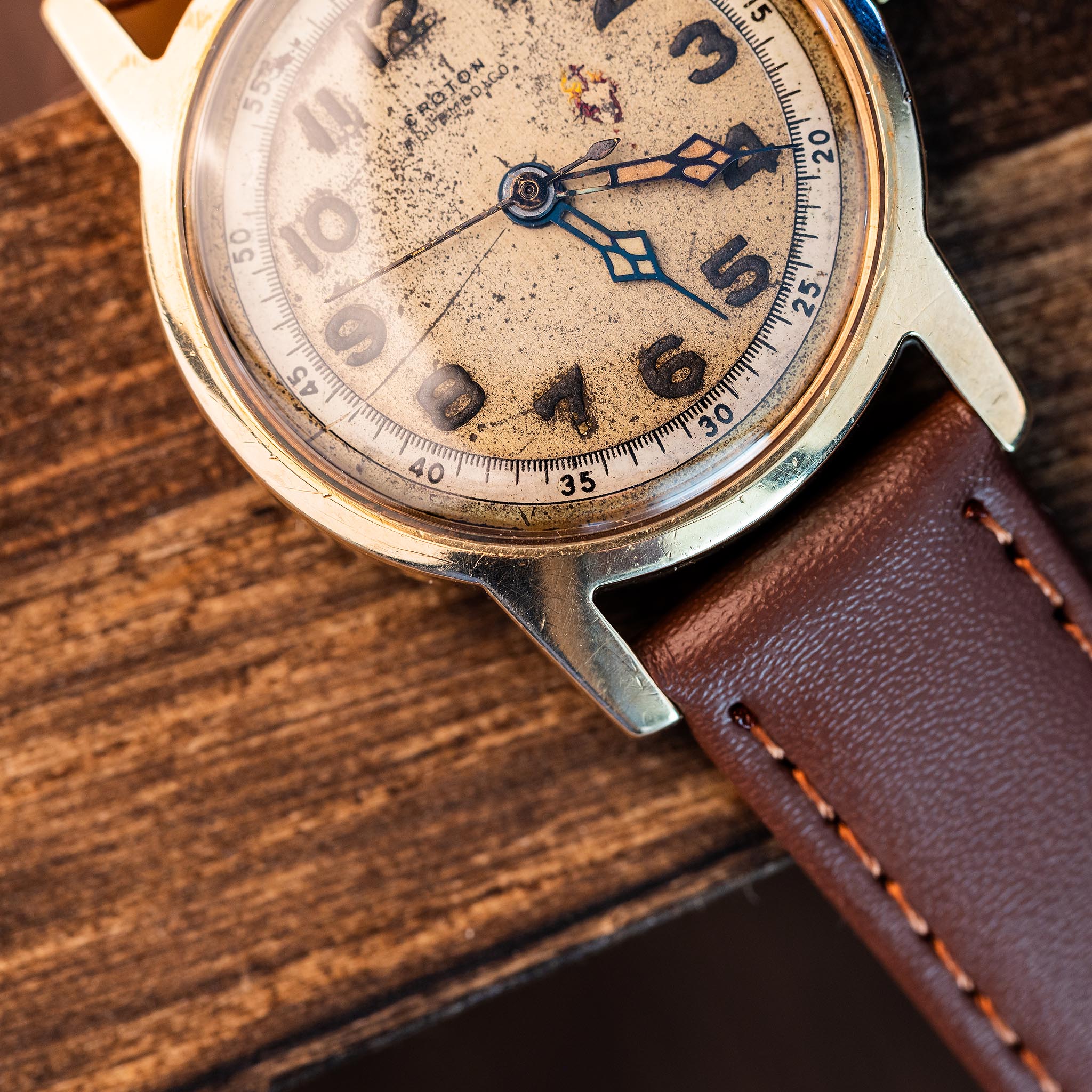
Then the watch arrived. The black cathedral hands were better in person than I expected, and under magnification, something appeared beside the three: the worn remains of a little painted heart-and-cross. It was not a printed detail I had noticed in the listing. Its chipped red-and-yellow paint was still holding on to the dial. Suddenly, the case’s gold was no longer the most interesting thing about it.

The Hunt: Gold First, Questions Later
I found the watch as a single lot in an online auction. I am always willing to consider a solid-gold mechanical watch: the metal can establish a useful floor beneath the purchase, even when the movement’s condition is uncertain. That was the calculation here. A functioning vintage mechanism would be a bonus; the case helped make the risk tolerable.
There was no drawn-out bidding contest. The quiet result reminded me how much remains overlooked on auction sites when a watch lacks a headline-making name or an immediately recognizable model. My original interest was practical rather than romantic, and I knew very little about the Aquamedico when I placed the bid.
In person, the watch was smaller than I had pictured: just 30.4 millimeters across. But it also made more sense at that size. A compact, readable watch on the wrist of someone moving through a busy medical setting is easier to imagine than a large, obstructive one. That is an observation about its design, not evidence that this specific watch ever belonged to a doctor.
Only after handling it, studying the hands, and examining the old dial closely did the purchase change character. I began looking not just at what it was worth, but at what it might have meant.
At a Glance
| Watch | Croton Aquamedico, medical-style seconds dial |
| Era | Mid-20th century; exact production year unverified |
| Movement | Swiss mechanical manual-wind, 17 jewels; markings 630 and A3N, exact caliber identification unresolved |
| Case | Solid 10K gold; S&W and number 722919 stamped inside caseback |
| Gold case and back | 12.39 g total of 10K gold alloy, owner-weighed; movement and strap excluded |
| Dimensions | 30.4 mm diameter · 37.9 mm lug-to-lug · 9.5 mm thickness · 16 mm lug width |
| Dial and hands | Aged cream Arabic-numeral dial; outer 60-second track; black skeletonized cathedral-style hands; remnants of hand-applied heart-and-cross paint |
| Condition | Significant authentic-looking dial patina, scratches to case and back; currently running and setting per owner |
| Work performed | Crystal replaced; movement lubricated; no documented complete overhaul |
| Current water resistance | Not tested or guaranteed |
The companion Croton Aquamedico product listing includes a full photo gallery, condition notes, measurements and availability. Both pages are being prepared for publication.
The World It Came From: A Watch Built Around the Seconds
The Aquamedico was more than an evocative name. A surviving 1942 Croton print advertisement identifies both the Aquamatic and the Aquamedico by name, placing the family firmly in Croton’s wartime catalog. Another original advertisement dated 1944 shows Croton offering a 14K-gold Aquamedico at $100. These are valuable period artifacts, but they feature a different watch or family presentation and do not date this particular 10K example.
Its medical connection is clearest in the dial’s outer track. A center-sweep seconds hand and a legible sixty-second chapter can help someone time a pulse: count beats for fifteen or thirty seconds, then convert that count to a per-minute rate. Unlike a dedicated pulsometer scale, the markings here are ordinary seconds divisions; they do not calculate heartbeats per minute automatically.
The design belongs to a moment when practical mechanical watches were small, functional tools. Croton-signed Swiss movements were offered to the American market in a wide range of cases, from utilitarian steel and plated models to precious-metal pieces. Gold did not remove the watch from that world of function; it simply gave this particular example a different presence.
In a 1999 WIRED essay about an early online watch purchase, William Gibson wrote about acquiring another Croton Aquamedico and its medical seconds ring. It is an unusual later echo of the same idea: this little-known model can become much more interesting once somebody learns how to read the details.

The Heart That Almost Disappeared
Near the three o’clock numeral, under decades of age and spotting, is a surviving fragment of red and yellow: the remains of a heart-and-cross device. Looking through magnification, I could distinguish applied paint and the way that paint has chipped away. It is not simply a modern sticker resting on the dial.
That physical evidence establishes how the emblem appears on this example. It does not establish who applied it, when it was painted, or whether it was commissioned by an individual, an institution, or the watch’s original manufacturer. I have not found a period Croton catalog illustration linking this particular emblem to a named medical organization. Any more specific story would outrun the evidence.
The uncertainty makes the remaining paint worth preserving, not reinventing. A cosmetic restoration could make the dial cleaner. Repainting the heart might even make the design easier to recognize. But it would also replace the watch’s most curious surviving feature with somebody else’s interpretation of it.

Cathedral Hands and the Anatomy of a Dial
The hands first caught my attention once the watch was in hand. Openworked, elongated and dark against the pale dial, they carry the architectural shapes often described as cathedral style. Their small diamond-shaped openings lend a watch of modest dimensions a surprising amount of personality.
Surrounding them are bold Arabic numerals and closely spaced timing divisions. The cream background has aged into a complicated surface of dark freckling, scattered spots and uneven discoloration. That aging is extensive, unmistakable and impossible to explain away with lighting. It is also what gives this particular dial its texture.
The unusual combination is important. This is not a stripped-back modern reinterpretation of a doctor’s watch. It is an old instrument whose dial, hands, printed seconds track and painted symbol have each aged in a different way. The individual factory originality of every component has not been confirmed by a surviving original bill of materials or catalog match. The visible combination, however, is the combination found on this watch.
Four Marks Inside a Gold Case
The outside of the caseback carries the wear you would expect from years of use: circular scratches, fine marks and the occasional sharper line. More revealing is the inside. It is stamped S&W / 10K GOLD / 722919, and it also bears four separately recognizable handwritten watchmaker marks. Their distinct handwriting was clear when the case was examined in person.
These marks are physical evidence that somebody opened this watch and left a record. They strongly suggest that it received attention at more than one point in its life. They do not by themselves tell us the precise dates, work performed, or identities of the people involved; nor can we automatically count each inscription as a separately documented full service.
Still, they are one of my favorite details. The watch has not merely survived as an unused object. It appears to have been kept going, considered worth opening, checking and caring for. For a small watch with such an aged dial, that distinction matters.
The gold case and its back weigh 12.39 grams together, as measured after separation from the movement. That is the weight of the 10K gold alloy components, not 12.39 grams of pure gold. The inner stamping establishes the case’s stated fineness; it does not identify the original owner or independently explain the case maker’s initials.


Inside: Seventeen Jewels and a Swiss Movement
Beneath the back is a manual-wind movement signed Croton Watch Co. Inc., with 17 jewels and Swiss markings. The plates also carry 630 and a boxed A3N designation, along with a marking referring to a patented compensating device. A documented gold Aquamedico elsewhere has been described with a Croton A-3N movement, but that comparison is not enough to identify every marking and movement variant on this watch beyond doubt.
Mechanically, this is a straightforward watch rather than a complication-heavy instrument: hand winding, hours and minutes, and a center-sweep seconds hand that makes the outer timing ring useful. It has been reported running and setting correctly. No measured daily rate, positional test or full power-reserve record is available, so the article cannot promise chronometer-like accuracy or a documented complete service.
The movement is modest in a way that suits the rest of the watch. No oversized rotor, no display caseback, no theatrical finishing. Just a small mechanical movement intended to be read and relied upon, maintained long enough to reach another wearer.

Restoration Without Erasing the Past
The crystal needed replacing. That work brought the cathedral hands, seconds track and fragments of the heart into clear view again. The movement was lubricated, and the watch is running and setting. I have not represented those steps as a documented complete overhaul.
The dial was a different decision. Its spotting is heavy. The original-looking finish is uneven, and the heart-and-cross paint is missing in places. I left it that way deliberately. Refinishing the surface or reconstructing the artwork would erase precisely the evidence that made the watch worth writing about.
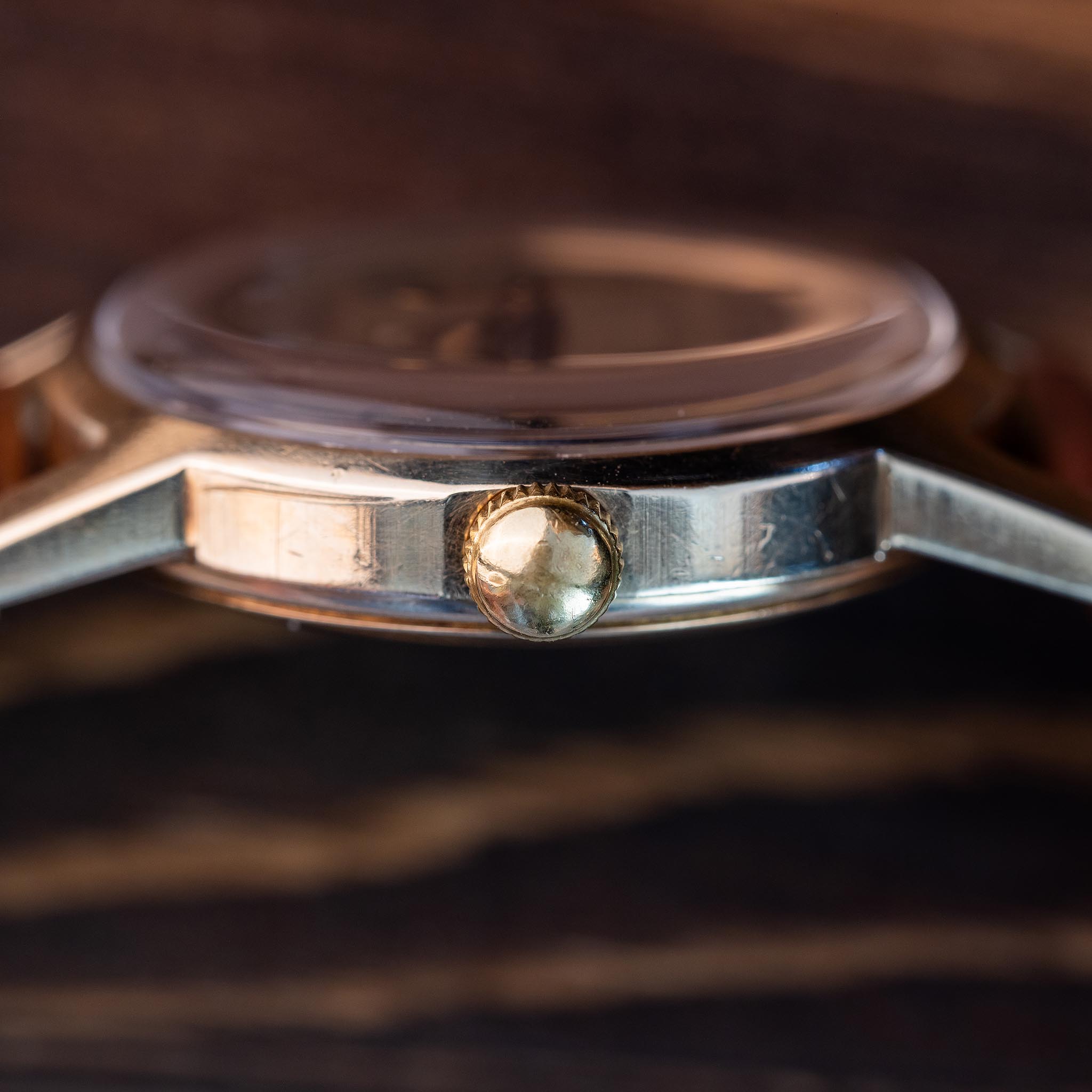
Nor was the case subjected to documented machine polishing. Its scratches are still visible, as are the handwritten notes inside. A later-style brown strap makes it wearable, without pretending to be original equipment.
What Original Looks Like—and What We Cannot Prove
The signed dial, Croton movement and hallmarked gold case belong convincingly to the Aquamedico story, but a complete factory archive for this particular case number has not been found. Other surviving Aquamedico watches vary in dial colors, chapter-ring layouts, case metals and movement specifications. That variability is a reason to compare references carefully, not to impose a single imagined standard.
The emblem is the largest open question. Its brush-applied appearance is apparent under magnification, but whether it was applied at Croton, customized for a buyer, or added later is unknown. The cathedral hands and unsigned crown have not been proven factory-original. The strap and crystal are replacements. And while the caseback records its own number, 722919 is a caseback stamp—not a movement serial or independently established catalog model reference.
What to Look For in a Croton Aquamedico
Start with the watch, not the seller’s story. Read the dial signature and look closely at the seconds track. Some variants are marketed as medical or doctor’s watches because a clear outer scale and sweep seconds support pulse timing. A different Aquamatic or a similar-looking Croton should not automatically be called an Aquamedico.
Check case composition directly, especially when a listing says ‘gold.’ A stamped solid-gold back differs materially from plated or gold-filled construction, and a separate case-and-back weight is more useful than a complete-watch weight. Ask for movement photographs, measure the case for contemporary wearability, and look for evidence of repairs or moisture exposure. On a dial this old, originality claims should be cautious; unusual painted symbols deserve close inspection, not instant provenance.
Finally, treat old claims of water resistance as history rather than a present guarantee. A vintage mechanical watch, even one designed with practical professional use in mind, should not be exposed to water without testing and appropriate service.
Why It Still Matters
I bought the Aquamedico because of the gold. The gold is still there, and it still gives the watch a tangible, measurable value. But it was not what stayed with me.
It was the little heart, its paint breaking away. It was the unexpectedly elegant shape of the hands. It was the evidence of four separate watchmaker inscriptions inside a case that somebody had apparently seen fit to maintain rather than abandon.
The Aquamedico is a reminder that preservation does not always mean recovering the condition a watch had on its first day. Sometimes it means recognizing what has survived, understanding which parts are still uncertain, and choosing not to erase the difference.
Less casting aside. More restoring.
Research Notes & Period Material
- 1942 original Croton advertisement: confirms the Aquamatic and Aquamedico families were being advertised by 1942; does not picture or date this individual watch conclusively.
- 1944 Croton Aquamedico advertisement: documents an advertised 14K gold Aquamedico at $100; it is not this 10K case reference.
- William Gibson, “My Obsession,” WIRED (1999): period-independent collector writing about another Croton Aquamedico and its medical seconds chapter.
- Documented 30 mm Aquamedico variant: illustrates variation in case construction and dial design, not a direct match.
- Gold Aquamedico with Croton A-3N designation: useful movement and material comparison; identification and dating are seller-provided, not archival verification.
More stories from the hunt: The Found Dial Reference Room. Also see Two Flea Markets, One Waltham for another watch whose value is not explained by a polished case alone.



0 Comments