
At first, I thought it said Turkey.
The auction photographs were that bad.
The watch was buried in a group lot, the title mentioned Omega but not Seamaster, and there was certainly no mention of Türler. I already pay more attention to mixed-watch lots than I probably should, because they are exactly where important details get flattened into a generic description. This time, the detail was a tiny word beneath OMEGA AUTOMATIC that did not belong on most Omega dials.
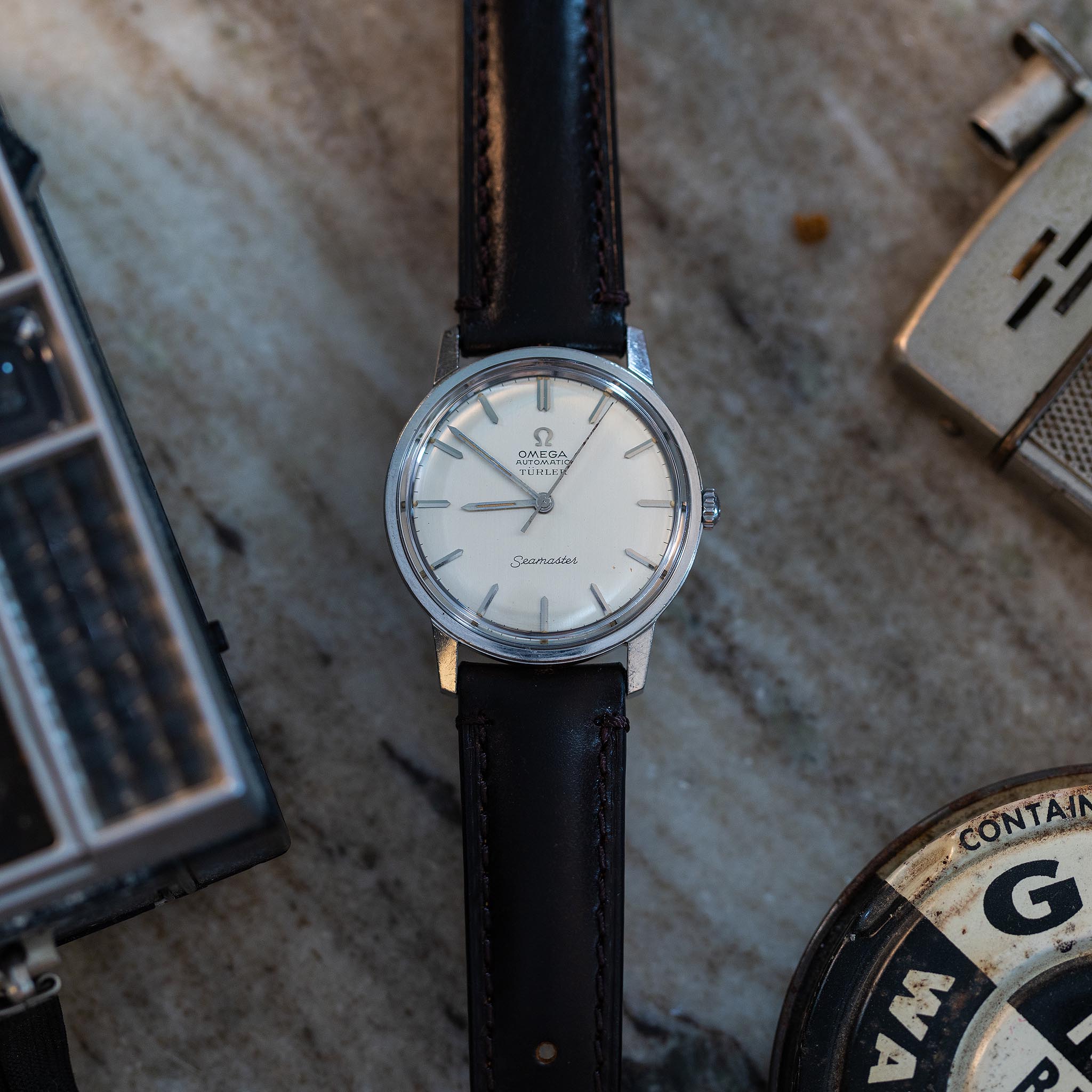
Once I realized the word was TÜRLER, the watch changed.
It was still an Omega Seamaster. Still a clean, restrained, mid-1960s automatic. But now there was another story printed directly on the dial: not another manufacturer, not a later aftermarket flourish, but the name of a Swiss retailer important enough that watches from Omega and other major houses could leave the retail chain carrying its signature.

The Hunt
I always look closely at auctions containing multiple watches. They are messy by nature. Model names get skipped. References go unidentified. A watch that would receive an entire listing on its own can become “Omega watch” when it is sitting next to four or five others.
That was exactly what happened here.
The first thing that caught my eye was the extra name on the dial. I had no idea what Türler was. In the low-resolution photographs, I honestly thought it might say “Turkey,” which may or may not have made the watch even more interesting.
A little research changed the entire auction for me. Türler was not some suspicious aftermarket addition. It was a historic Swiss watch and jewelry retailer, and surviving watches from a number of important manufacturers are known with the Türler name sharing the dial.
The easiest way I can describe what surprised me is this: imagine a major manufacturer allowing the name of the store selling its product to appear permanently on the product itself. Not on the box. Not on a receipt. On the face.
Once I understood that, I wanted the watch.
For most of the auction it looked like I might steal the entire lot for under $200. Then, with roughly five minutes left, somebody else apparently noticed the same thing I had. The bidding changed quickly.
The timing could not have been worse. I was helping my son move.
There are easier ways to buy a vintage Omega than trying to move a couch while refreshing an online auction, but the point of no return had already passed. Needless to say, I did not get it for anywhere near the number I had been watching earlier.
The risk was not really whether the lot contained an Omega. It clearly did. The risk was whether the detail that made this particular Omega interesting would hold up once it arrived. There are a lot of vintage Seamasters. There are far fewer with Türler printed below the Omega signature.
At a Glance
| Watch | Omega Seamaster Automatic — Türler co-signed dial |
|---|---|
| Reference | 165.002 |
| Approx. production | Circa 1966 |
| Movement | Omega caliber 552 automatic |
| Jewels | 24 |
| Beat rate | 19,800 vph |
| Movement serial | 23,787,910 |
| Functions | Hours, minutes, central seconds; no date |
| Case | Stainless steel |
| Case diameter | 34.4 mm measured |
| Lug-to-lug | 40.7 mm measured |
| Thickness | 10.9 mm measured |
| Lug width | 18.6 mm measured; nominal 18 mm |
| Crystal | Genuine Omega replacement acrylic crystal |
| Dial | Silver/cream, applied baton markers, OMEGA AUTOMATIC / TÜRLER co-signature, Seamaster script |
| Caseback | Seamaster hippocampus exterior; inside marked 165.002 |
| Current rate | Approximately -17 sec/day at latest check |
| Water resistance | Not pressure tested; no water-resistance guarantee |
| Available from The Found Dial | View this Omega Seamaster Türler in the store |
The World It Came From
By the time this watch was made, the Seamaster name had already been part of Omega for nearly two decades.
Omega introduced the Seamaster in 1948, its centenary year, using experience gained from producing robust military watches during the Second World War. The earliest Seamasters were not the purpose-built dive watches the name may suggest today. They were refined everyday watches designed to combine respectable water resistance and durability with the proportions of a conventional wristwatch.
That distinction matters when looking at a reference like 165.002. In modern language, a 34-millimeter silver-dial watch on leather can look like a dress watch. In the context of its own period, the Seamaster identity was broader. It was meant to be useful, reliable and adaptable rather than visually announcing a single purpose.
The professional diving branch of the family arrived separately with the Seamaster 300 in 1957. References like this one kept the other side of the Seamaster idea alive: a clean automatic watch that could be worn every day.

Reference 165.002
The inside caseback removes most of the mystery here. This watch is stamped 165.002.
Surviving examples place the reference in the early-to-mid 1960s, commonly with Omega’s no-date caliber 552. Period-correct examples appear in stainless steel as well as gold-plated configurations, with a range of dial treatments. The basic architecture remains familiar: approximately 34 to 35 millimeters across, straight/faceted lugs, a smooth fixed bezel, acrylic crystal and screw back carrying the Seamaster hippocampus.
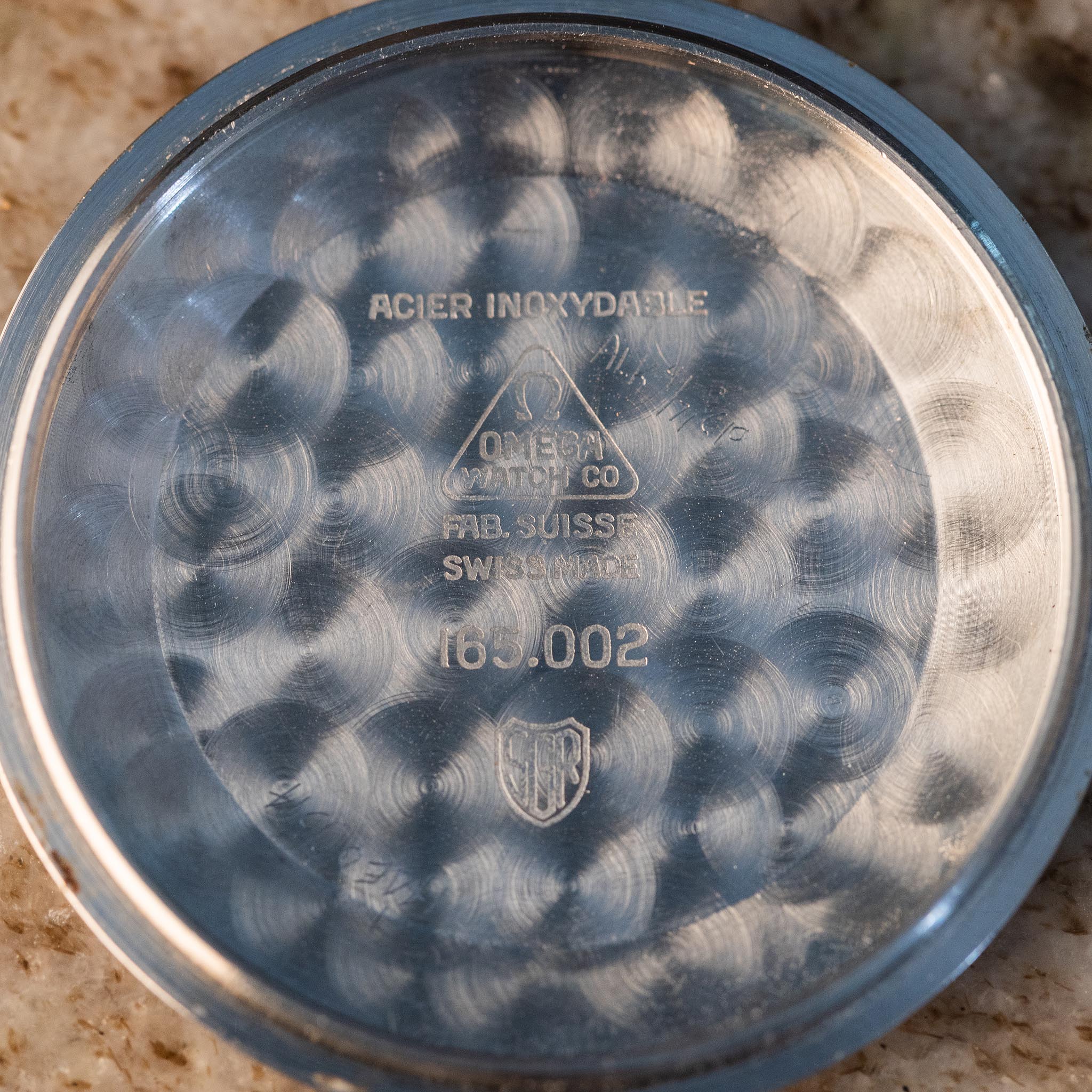
That is one of the things I like about this watch. The research does not have to start by forcing a visual match. We have the reference in the metal, the caliber on the movement and the movement serial visible in the photographs.
The Name That Wasn’t Supposed to Be There

Türler began in Biel/Bienne in 1883. By 1907 the family business had established itself in Zurich, eventually becoming closely associated with Paradeplatz and Bahnhofstrasse—one of the most visible luxury retail addresses in Switzerland.
Türler did more than sell its own watches. It retailed watches from major Swiss manufacturers, and surviving vintage examples exist with the Türler name co-signed on dials from Omega, IWC, Universal Genève, Heuer, Audemars Piguet and others.
That practice belongs to a retail world that feels almost foreign now.
Today, luxury watch manufacturers largely control their own branding with enormous precision. In the mid-twentieth century, influential jewelers and watch retailers occupied a more visible position between manufacturer and customer. A retailer signature could become part of the watch itself.
Christie’s has documented a 1960s Omega Constellation retailed by Türler with the dial signed by both maker and retailer, and with Omega archive documentation confirming delivery to Switzerland. That does not prove the individual retail history of this Seamaster—the original sales records for this watch are not present—but it does establish that Türler-signed Omega dials belong to a documented period practice rather than being an inherently suspicious aftermarket idea.
The Türler signature does not turn reference 165.002 into a different Omega model. Mechanically and structurally, it remains a Seamaster 165.002. What changes is the retail story attached to the dial.
The Dial Under a Loupe

The dial is why this watch works even without the retailer story.
It is simple: a warm silver-to-cream surface, applied baton hour markers, narrow dark hands and a central seconds hand. There is no date window to interrupt the symmetry. The Omega logo and wordmark sit beneath twelve, AUTOMATIC follows, and then Türler occupies a small line of its own.
The Seamaster script balances the lower half.
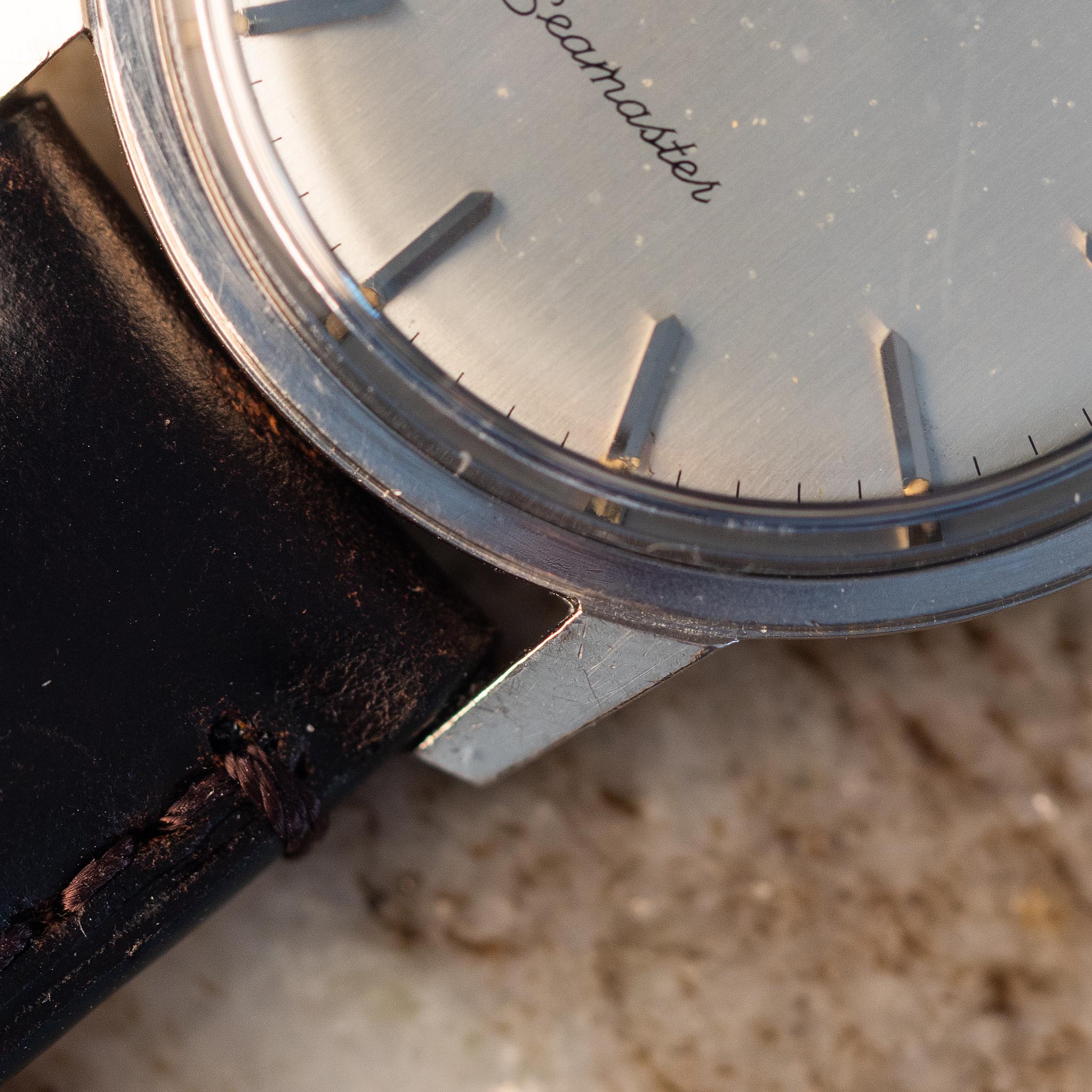
There is age here. Macro photography shows surface marks and light patina that are easier to see under a lens than on the wrist. That is exactly why the watch is photographed this way. A vintage dial does not need to be made visually perfect to be compelling.
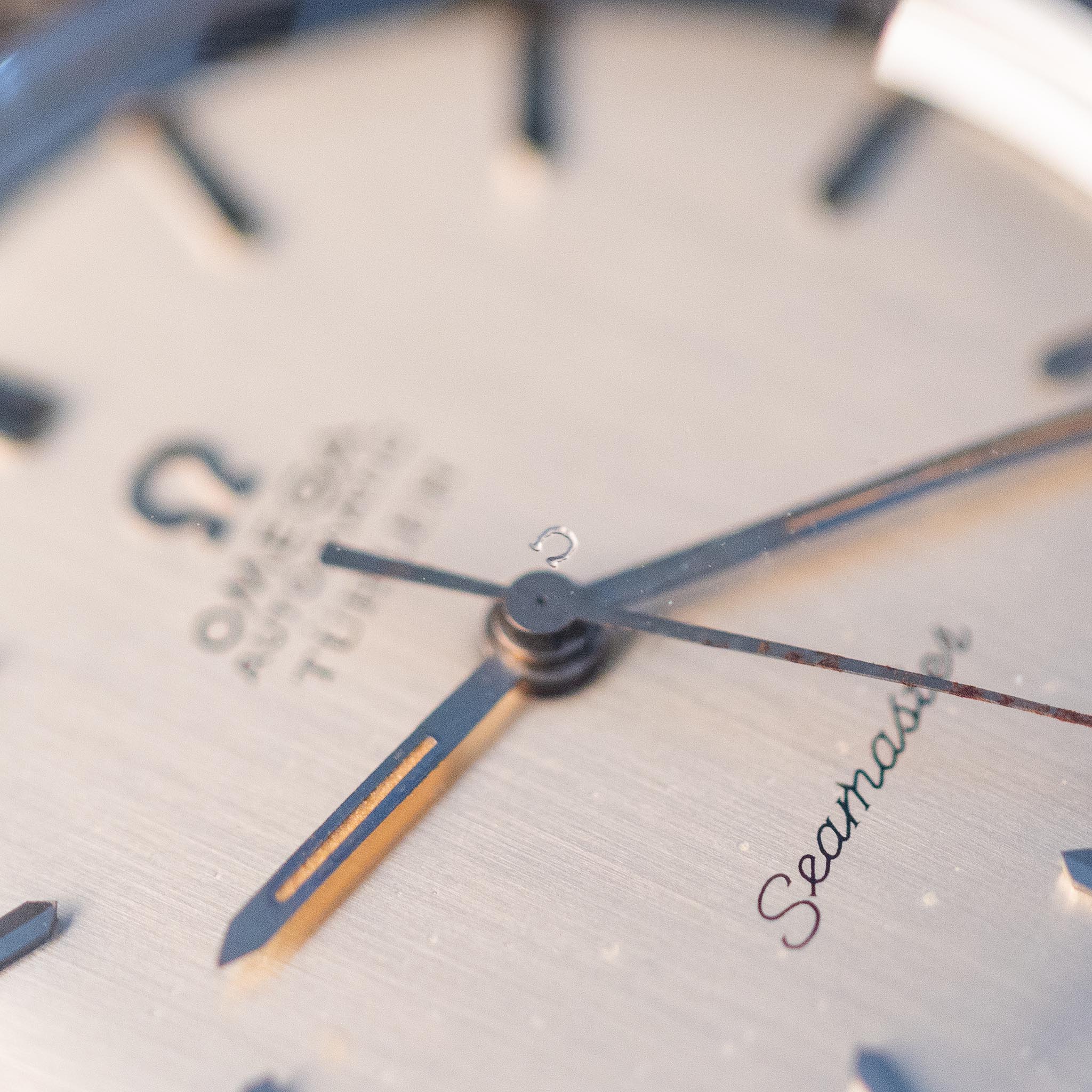
The dial and hands were left alone. No repainting. No cosmetic refinishing. Whatever this watch has accumulated across roughly six decades remains part of the object.
The Seahorse on the Back

The exterior caseback carries one of Omega’s most recognizable vintage signatures: the Seamaster hippocampus.
The emblem became associated with the Seamaster family in the late 1950s, visually tying the watches back to Omega’s water-resistant identity. On this example it also creates a useful contrast with the inside of the same piece of steel.
Outside: branding and mythology.
Inside: OMEGA WATCH CO., SWISS MADE, ACIER INOXYDABLE, 165.002.
One side tells you what family the watch belongs to. The other tells you exactly which case reference you are holding.
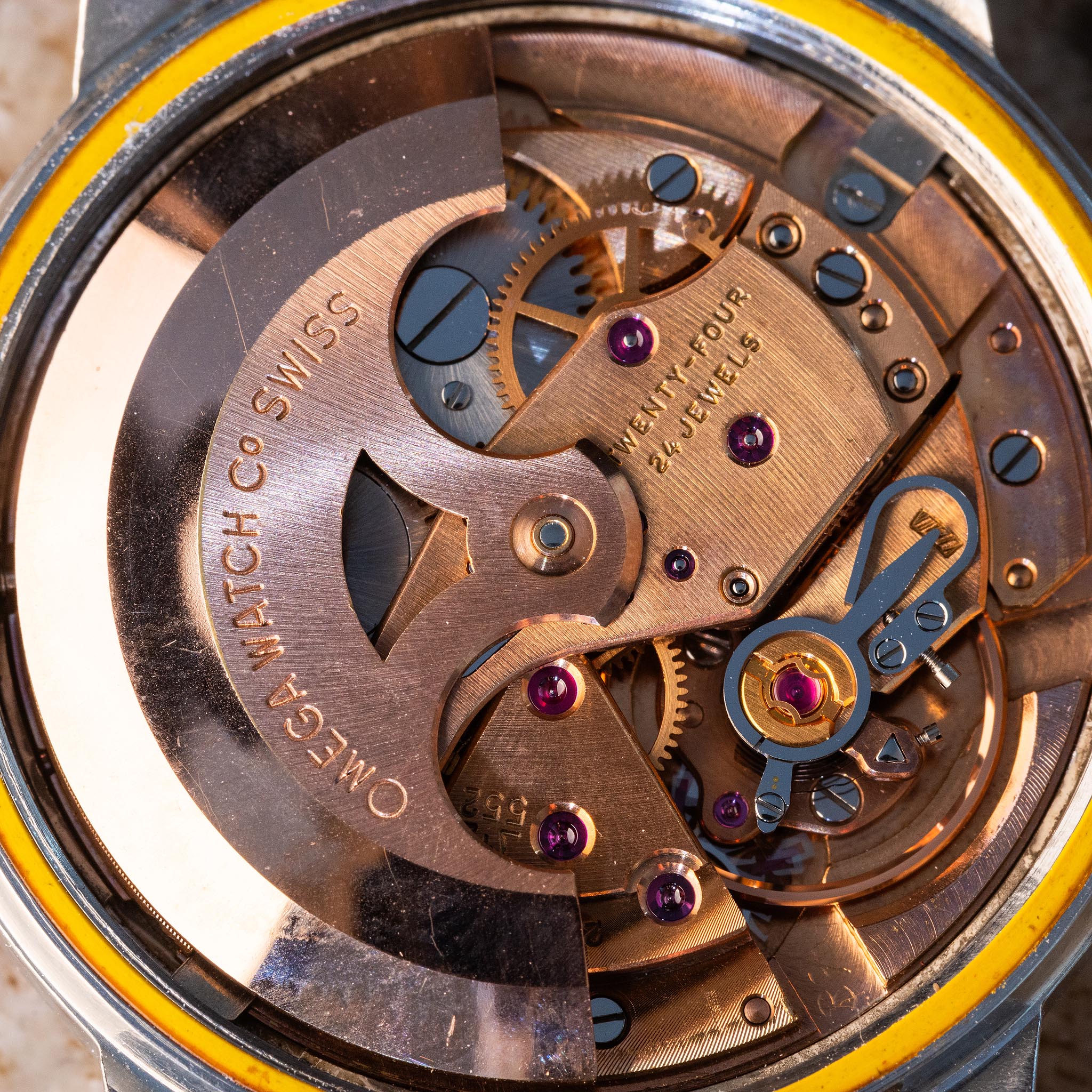
Inside: Caliber 552

The other half of the identification sits inside the case.
Omega caliber 552 is a 24-jewel full-rotor automatic from the brand’s 55x movement family, running at 19,800 vibrations per hour. In this reference it handles exactly what the dial promises: hours, minutes and central seconds, without a date complication.
The movement serial on this watch is 23,787,910. Commonly used Omega serial dating places that number around 1966, which aligns well with the reference and the design.
When I opened it, the movement was as clean as the outside of the watch had suggested. There is also at least one old watchmaker service marking inside the case. A service mark cannot tell us exactly what was replaced or adjusted, but it does tell us the watch was opened and attended to before it reached me.
That matches how the watch behaves. Everything works properly, and at the latest check it was running approximately -17 seconds per day. More importantly than a single rate number, the watch gives the impression of having been cared for rather than simply surviving untouched.
What Original Looks Like—and What We Can Actually Prove
Vintage Omega is a place where certainty can become expensive very quickly.
Reference 165.002 appears with multiple legitimate dial executions. Different marker shapes, finishes, crosshairs, lume configurations and case materials exist. A watch looking different from another 165.002 does not automatically make one of them wrong.
For this watch, several pieces of evidence are unusually strong:
Confirmed directly: the 165.002 case reference, caliber 552, 23,787,910 movement serial, stainless-steel case and Türler retailer signature visible on the dial.
Strongly believed: the crown appears correct and I am about 99 percent confident it is original, but I do not have factory documentation tying that individual crown to this watch.
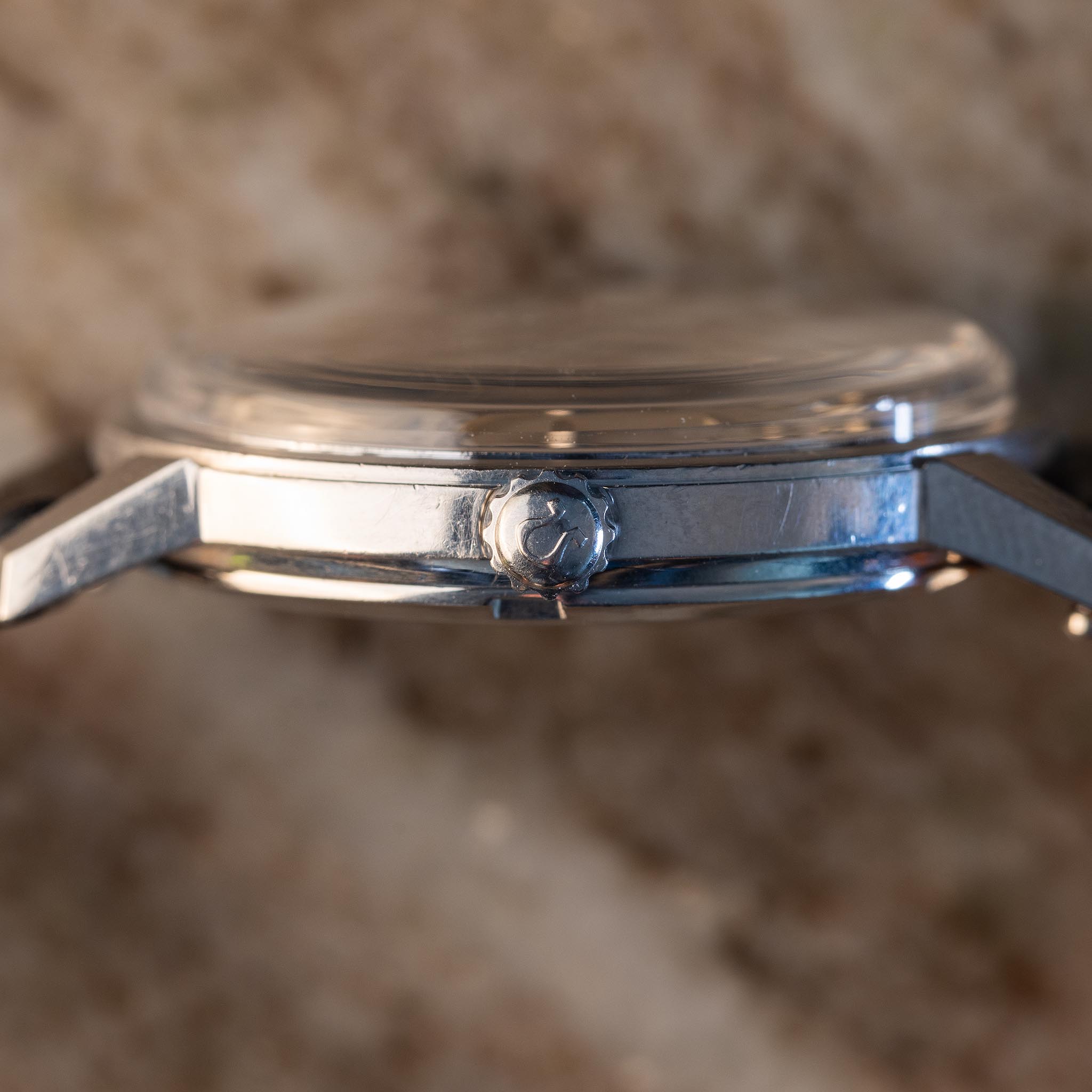
Disclosed replacement: the acrylic crystal is a genuine Omega replacement installed during my ownership. The macro photography even catches the tiny Omega logo etched into the crystal itself—a small detail that is easy to miss at normal viewing distance but a satisfying confirmation of the correct signed part.
Unknown: the watch’s full service history before it reached me and the exact circumstances of its original retail sale.
That last point is important. A Türler signature is historically meaningful, but without original papers or a specific archival record, I am not going to invent the store, customer or date of sale.
A Genuine Omega Crystal

The most annoying part of working on this watch was also one of the simplest parts mechanically.
The crystal was a pain to find.
Once the correct genuine Omega acrylic crystal was in hand, installation with a crystal press was straightforward. That is often how vintage watch repair works: the physical job can take minutes after the parts search takes days.
I did not replace the crystal because the watch needed to look new. A crystal is a functional wear component and one of the first things between a dial and the outside world. Using the appropriate Omega part let the dial present clearly again without changing the dial itself.
Restoration Without Erasing the Past
This was not a rescue from mechanical disaster.
It arrived surprisingly clean, inside and out. The movement was healthy enough to show that somebody had cared for it before me, and the visible service mark reinforced that impression.
The case received a thorough cleaning by hand. No machine polishing. No attempt to grind away every scratch or soften the case into a generic shine.
The dial and hands stayed as they were.
The crystal was replaced with a genuine Omega part.
That is the entire philosophy in miniature. Fix what prevents the watch from doing its job. Clean what can be cleaned safely. Preserve what makes it this particular watch.
Period Context: How Omega Was Selling the Seamaster in 1966
A dedicated period advertisement for this exact Türler-signed reference 165.002 has not surfaced in the accessible material I found. That distinction matters: a general Seamaster advertisement should not be presented as proof of this exact dial configuration.
What does survive is a 1966 Omega Seamaster print advertisement built around the phrase “unruffled elegance”. The ad emphasizes a Seamaster that could survive demanding testing without giving up the appearance of a refined wristwatch.
That broader message fits reference 165.002 extremely well. This is not the professional Seamaster 300. It is the other side of the Seamaster family—the ordinary-sized automatic meant to live comfortably between daily use and formal wear.
For Türler itself, period advertising from the 1950s and 1970s confirms the retailer’s Paradeplatz identity and international presence, including Zurich Airport and overseas service locations. Those advertisements are useful context for the retailer, but they do not establish that this specific Omega was shown in a Türler campaign.
Why the Türler Name Matters
It would be easy to reduce the extra signature to rarity.
That is not the part I find most interesting.
The six letters under AUTOMATIC are evidence of a different relationship between manufacturer, retailer and customer. Omega made the watch. Türler occupied the retail position strongly enough that its identity could become part of the face of that watch.
It is a small surviving artifact of how Swiss watches moved through the market before vertically controlled brand boutiques became the dominant luxury model.
And it is exactly the kind of detail that makes hunting old watches interesting.
I did not enter the auction looking for a Türler-signed Omega. I did not even know what Türler was. I saw a word I could barely read, asked why it was there, and ended up learning something about Omega, Swiss retail history and an entire category of double-signed watches.
That rabbit hole became more important than the name itself.
What to Look For When Buying a 165.002
Start inside the case. The inside caseback should establish the actual reference. A seller calling a watch “165.002 style” or identifying it only by appearance is not the same thing as seeing the stamp.
Confirm the movement. No-date examples of this reference are commonly associated with caliber 552. Photograph the caliber marking and serial rather than relying on an auction description.
Study the dial before chasing perfection. Legitimate 165.002 dial variations exist. Look at printing quality, marker alignment, minute tracks, lume placement where applicable and whether the overall configuration makes sense together.
Treat retailer signatures as another layer to authenticate, not a shortcut. Türler-signed Omegas are documented, but an extra name on a dial should make you inspect the watch more carefully, not less.
Look at the case geometry. Mid-century Omega cases can lose definition after repeated polishing. Originality is not the same as an absence of scratches.
Assume an old water-resistant watch is no longer water resistant. This example has not been pressure tested, and the word Seamaster should never be treated as permission to expose a sixty-year-old watch to water.
Budget for service. A watch running today does not prove when it was last properly serviced. Service marks can establish prior attention, but usually not enough detail to substitute for present mechanical evaluation.
The New Life
The watch that arrived was better than the auction photographs.
Super clean. Clean movement. Clean case. A dial whose most important detail had barely been visible in the listing. The internal markings confirmed the reference and caliber. The service mark suggested somebody had been inside before and cared enough to leave evidence of the work.
It did not need a dramatic resurrection.
It needed a correct crystal, a careful cleaning and someone willing to notice the word the auction house had ignored.
That may be the best summary of what I want The Found Dial to be.
There are plenty of Seamasters. There are fewer Türler Seamasters. But the reason this watch matters to me is not simply that one group is smaller than the other.
It is that I almost read the word as “Turkey,” stopped long enough to ask a question, and ended up discovering a piece of Swiss watch history I did not know existed.
Sometimes the hunt is not about finding the watch you already understand.
Sometimes it is about finding the detail that makes you want to understand it.

Research Notes & Sources
This article separates evidence visible on the watch from broader historical context. Key external references used during research include:
- Christie’s — 1960s Omega Constellation retailed by Türler, documenting an Omega/Türler double-signed dial and Swiss delivery context.
- Phillips — Around the World in 62 Watches, for Türler’s 1883 origins, Zurich/Paradeplatz history and retailer-signed watch context.
- Europa Star — Türler: the pride of Paradeplatz, for the retailer’s company history.
- Black Bough — Omega Seamaster ref. 165.002, for reference-era and caliber-552 technical comparison.
- Omega — The Seamaster at 70, for official Seamaster historical context.
Period-art search note: accessible research located a 1966 family-level Omega Seamaster advertisement and period Türler retailer advertising, but no verified advertisement for this exact 165.002 Türler configuration. They are therefore treated only as era context, not proof of this individual watch.



0 Comments